mirror of
https://github.com/nextcloud/all-in-one.git
synced 2026-05-22 19:30:11 +00:00
Compare commits
386 Commits
v4.4.1
...
helm-chart
| Author | SHA1 | Date | |
|---|---|---|---|

|
dae2da8494 | ||
|
|
bdf45c7204 | ||
|
|
07dc39c832 | ||
|
|
fe631e8a88 | ||
|
|
ed92f9c138 | ||
|
|
7d288268bc | ||
|
|
32d9cee2be | ||
|
|
2ba096a1ab | ||
|
|
08746f4aff | ||
|
|
05db035919 | ||
|
|
4ffed7e23c | ||
|
|
de9397ad54 | ||
|
|
74b4f1d395 | ||
|
|
37b5e12a6f | ||
|
|
2260ccc876 | ||
|
|
5a9e45ee6d | ||
|
|
f111363459 | ||
|
|
241041512f | ||
|
|
b20eec34e3 | ||
|
|
3e0aa8a52d | ||
|
|
9f207810b8 | ||
|
|
4e6288b934 | ||
|
|
31627f9270 | ||
|
|
2af2e3a3cd | ||
|
|
6c4f7c22d3 | ||
|
|
05b5e41894 | ||
|
|
83c77d86e7 | ||
|
|
f46c72b359 | ||
|
|
00f166675a | ||
|
|
f12885b09b | ||
|
|
1863078937 | ||
|
|
e02be7234d | ||
|
|
cf10c495d1 | ||
|
|
90082704f6 | ||
|
|
838084f073 | ||
|
|
7373bb5960 | ||
|
|
aee32ed357 | ||
|
|
6a4281fc12 | ||
|
|
b9bd1ecdc3 | ||
|
|
c8783f79d6 | ||
|
|
45a33d4b5b | ||
|
|
b94bb6569e | ||
|
|
be5b5deb7a | ||
|
|
5550d30065 | ||
|
|
6b487302a8 | ||
|
|
939c50726f | ||
|
|
d37d21e151 | ||
|
|
25b04bccdf | ||
|
|
b3cc1644bb | ||
|
|
76841af339 | ||
|
|
1af8112308 | ||
|
|
57d9534133 | ||
|
|
cb5bee70b0 | ||
|
|
66430a945d | ||
|
|
324ed4dc63 | ||
|
|
e0857cc954 | ||
|
|
87cb3cd819 | ||
|
|
52f4d4b41e | ||
|
|
566619ecac | ||
|
|
b8379c81d7 | ||
|
|
38392e0dcf | ||
|
|
c5fc60d1fa | ||
|
|
87f97a5270 | ||
|
|
68af3916cb | ||
|
|
6331a94758 | ||
|
|
3e2a64e6d4 | ||
|
|
cd4131a82d | ||
|
|
d1d66845a3 | ||
|
|
8de8274a31 | ||
|
|
ef82f1aaf9 | ||
|
|
4b1ed4e227 | ||
|
|
30883d0d61 | ||
|
|
f22117545f | ||
|
|
512c134e11 | ||
|
|
3a438ff329 | ||
|
|
5c3e719e87 | ||
|
|
cc3dc75917 | ||
|
|
2ebfebf24a | ||
|
|
b566cd179e | ||
|
|
2a44208f56 | ||
|
|
46f4136d30 | ||
|
|
fcf1a1e11b | ||
|
|
efd6f2a738 | ||
|
|
a145bf33a3 | ||
|
|
3873795c05 | ||
|
|
edf723e4f4 | ||
|
|
34239f3e15 | ||
|
|
cf28ad7d45 | ||
|
|
cda66b1a11 | ||
|
|
1aa861ba2a | ||
|
|
085d878223 | ||
|
|
f0069816bc | ||
|
|
8babb33540 | ||
|
|
7f918c37fc | ||
|
|
ead696b683 | ||
|
|
f122ee5a07 | ||
|
|
1818eb10c3 | ||
|
|
779ca8e03d | ||
|
|
4e7ab122e9 | ||
|
|
1c5d9f0eb7 | ||
|
|
9ba70425f4 | ||
|
|
7acdb2dc92 | ||
|
|
157588d95f | ||
|
|
cab39e59be | ||
|
|
ac005eb5c9 | ||
|
|
4df6d2c971 | ||
|
|
b75e10e5f3 | ||
|
|
033f0166f4 | ||
|
|
e7e29a2731 | ||
|
|
916a25a62e | ||
|
|
5a8989bb9f | ||
|
|
714815e9f0 | ||
|
|
3a9d5d52d5 | ||
|
|
854b4115e8 | ||
|
|
23f2e96c71 | ||
|
|
07adf95c35 | ||
|
|
9848ceec38 | ||
|
|
cbfc5d4d15 | ||
|
|
28b9755a50 | ||
|
|
34a5e6badf | ||
|
|
401150d427 | ||
|
|
2d1ddccb28 | ||
|
|
06733e8009 | ||
|
|
0b2c7f09b6 | ||
|
|
73e734b011 | ||
|
|
e1890c8f3b | ||
|
|
904d23147c | ||
|
|
46ec1ea7f5 | ||
|
|
8cabad38a6 | ||
|
|
1fa1c90e22 | ||
|
|
1ce496a323 | ||
|
|
d93c01f368 | ||
|
|
ee5d9493de | ||
|
|
c5a1a00e38 | ||
|
|
99f29aaaed | ||
|
|
0435609521 | ||
|
|
6fe6d7e0b4 | ||
|
|
d3b099e8e3 | ||
|
|
3cebbb6487 | ||
|
|
c6fc7baf2d | ||
|
|
0c93ad6def | ||
|
|
cd2208f295 | ||
|
|
e55500640b | ||
|
|
ab8b455b71 | ||
|
|
81a8352d64 | ||
|
|
93a0616f7e | ||
|
|
409dda00bd | ||
|
|
517ac319ba | ||
|
|
34d8ae8e5a | ||
|
|
ed36ba6c8d | ||
|
|
15c90407bc | ||
|
|
287a5a08cd | ||
|
|
187bf3f767 | ||
|
|
7a10602c63 | ||
|
|
aba666859b | ||
|
|
00a7e65a2d | ||
|
|
fb3b040290 | ||
|
|
baf7778ed3 | ||
|
|
565a84a7bf | ||
|
|
6b0ce132f9 | ||
|
|
cc13161ec6 | ||
|
|
7ccc699402 | ||
|
|
9954641e02 | ||
|
|
c1595afe2d | ||
|
|
974190fd86 | ||
|
|
1bf1b2b284 | ||
|
|
291d543f37 | ||
|
|
8b6bb94539 | ||
|
|
1cae0980cd | ||
|
|
bd4d16ebb0 | ||
|
|
ba2b5a4638 | ||
|
|
98eb90360b | ||
|
|
2a9c4e3198 | ||
|
|
94f7ca00b5 | ||
|
|
b4a8d7d649 | ||
|
|
63e7be45fe | ||
|
|
f6f5598e97 | ||
|
|
736e93b5eb | ||
|
|
db9657f125 | ||
|
|
2b1ae17e88 | ||
|
|
e6510c21cf | ||
|
|
92dd734993 | ||
|
|
556afe5f51 | ||
|
|
23e495fc45 | ||
|
|
5002de61a2 | ||
|
|
c56959b9d0 | ||
|
|
5d9573602b | ||
|
|
aba40c4633 | ||
|
|
ec6b37178b | ||
|
|
a0267c6efa | ||
|
|
f0222394a1 | ||
|
|
ba88aa1d35 | ||
|
|
f726e4a8c6 | ||
|
|
7da2c627c6 | ||
|
|
e75a426749 | ||
|
|
5058270c99 | ||
|
|
e0f4024ead | ||
|
|
c63d44c1cf | ||
|
|
cb3d8d6b30 | ||
|
|
fe336cf6d8 | ||
|
|
386533b02f | ||
|
|
cd6f5ccebd | ||
|
|
9c0ea8a23c | ||
|
|
d5c857325b | ||
|
|
ef42467cc2 | ||
|
|
d0f11028d3 | ||
|
|
0e7e1eaf3d | ||
|
|
20062b6095 | ||
|
|
bf9482e560 | ||
|
|
b7e012f886 | ||
|
|
b4bd4d115d | ||
|
|
961f894372 | ||
|
|
a68b00b126 | ||
|
|
1c2b4f042d | ||
|
|
c9acb396ad | ||
|
|
af974046f5 | ||
|
|
62afa918f0 | ||
|
|
69cb6bee4d | ||
|
|
fc56c262c1 | ||
|
|
ed1e6191b8 | ||
|
|
4ffc3fc866 | ||
|
|
cf8cfc5dff | ||
|
|
f1edbd71c5 | ||
|
|
de64fceab9 | ||
|
|
d20489de7c | ||
|
|
83fb39dabf | ||
|
|
4256dc8021 | ||
|
|
af78a8ff4c | ||
|
|
48f93991bb | ||
|
|
a86555da16 | ||
|
|
e16340ffcb | ||
|
|
28ec69e505 | ||
|
|
9a1371a96b | ||
|
|
71f143b4aa | ||
|
|
a9a3f74d45 | ||
|
|
43b15ae7e7 | ||
|
|
3d8fa710c1 | ||
|
|
dbe30bba2c | ||
|
|
d41d0c7f94 | ||
|
|
4b30bcd92e | ||
|
|
01a670e503 | ||
|
|
9876491446 | ||
|
|
cc3b94a4c1 | ||
|
|
3c1dcb374f | ||
|
|
1322eea980 | ||
|
|
c22a94ccc3 | ||
|
|
51f3964c27 | ||
|
|
e50ad0b850 | ||
|
|
569975297a | ||
|
|
e6b63cf9ef | ||
|
|
1546db7f9f | ||
|
|
2666313d63 | ||
|
|
cfbb6752ee | ||
|
|
cd34d8d6f5 | ||
|
|
0b15352132 | ||
|
|
c5bfdbb653 | ||
|
|
cbc19c17ca | ||
|
|
067604ceac | ||
|
|
e6ecf52df9 | ||
|
|
5e6e433cd2 | ||
|
|
86b6d92761 | ||
|
|
a97af08bb8 | ||
|
|
264980df57 | ||
|
|
e94f63bd26 | ||
|
|
4689e402f8 | ||
|
|
ba760b060e | ||
|
|
4800888da6 | ||
|
|
8539b25278 | ||
|
|
5ddf989703 | ||
|
|
90c2328400 | ||
|
|
f5ee38247c | ||
|
|
f51029270b | ||
|
|
d27aa357db | ||
|
|
4b3e192ee6 | ||
|
|
d974023c8d | ||
|
|
204aa5649c | ||
|
|
8cd5f604c4 | ||
|
|
fdb0330959 | ||
|
|
4f5062080b | ||
|
|
39b669ae83 | ||
|
|
671a73a6c4 | ||
|
|
a4f0852bdf | ||
|
|
46ae99e36b | ||
|
|
07054d869b | ||
|
|
ebbcb998ce | ||
|
|
9f8d17d888 | ||
|
|
56a95182c7 | ||
|
|
e218c1d041 | ||
|
|
356792ec68 | ||
|
|
30ae4eeecd | ||
|
|
8685107e2e | ||
|
|
f01a5841b9 | ||
|
|
2a01e9683b | ||
|
|
0873e526b4 | ||
|
|
2306587a7d | ||
|
|
69b0911db1 | ||
|
|
6587530242 | ||
|
|
cf3f1f04cd | ||
|
|
ba6efd2a9c | ||
|
|
1e96eed341 | ||
|
|
c54395aa4c | ||
|
|
4590b28b50 | ||
|
|
a77ae20e5d | ||
|
|
c5e481b767 | ||
|
|
c23b7aa396 | ||
|
|
a12022f290 | ||
|
|
01291bbcce | ||
|
|
97b0622cc3 | ||
|
|
f67cae35fa | ||
|
|
50aa368169 | ||
|
|
5748f111d3 | ||
|
|
aec815119e | ||
|
|
6463ea368a | ||
|
|
2aef10ce47 | ||
|
|
81dff779b6 | ||
|
|
a34d6c1726 | ||
|
|
9bddac5937 | ||
|
|
fba13e8824 | ||
|
|
bc3e13bf69 | ||
|
|
ee06a04f51 | ||
|
|
1f66f4c9ca | ||
|
|
6a22d5443b | ||
|
|
98078cbe0a | ||
|
|
de9b2bba0e | ||
|
|
5fbe902145 | ||
|
|
0dcdbf8be2 | ||
|
|
9758c12491 | ||
|
|
d9ec23e0f8 | ||
|
|
a06add045c | ||
|
|
5fd0b3294e | ||
|
|
bcdb692dd1 | ||
|
|
ac7c7b19d8 | ||
|
|
d8de7e0765 | ||
|
|
cf8d3dd437 | ||
|
|
3eb3a9ff9f | ||
|
|
73b4c2d3ea | ||
|
|
d7a174615c | ||
|
|
e2f92a30c6 | ||
|
|
e28aef0c6a | ||
|
|
8a0c495d4d | ||
|
|
70eefd1f0d | ||
|
|
457644dc52 | ||
|
|
3f22ec8b4d | ||
|
|
85e3172d7f | ||
|
|
c9f2d260f1 | ||
|
|
6506594155 | ||
|
|
491693f402 | ||
|
|
2c546fd5be | ||
|
|
9e8cab8eec | ||
|
|
d686d3eae0 | ||
|
|
7c9cbdc121 | ||
|
|
f8457a2830 | ||
|
|
6a86209451 | ||
|
|
ea5219f40d | ||
|
|
f2154bf2b7 | ||
|
|
fc1d8e0b32 | ||
|
|
9e9e991cb6 | ||
|
|
c2444912b8 | ||
|
|
e85c43d075 | ||
|
|
66851eda8f | ||
|
|
93bd1ce2ee | ||
|
|
c3d3a29c6b | ||
|
|
cad3b0968a | ||
|
|
a2585fffe4 | ||
|
|
b8930bc577 | ||
|
|
e0a7ca3656 | ||
|
|
dfc2d9798e | ||
|
|
403cc5cae7 | ||
|
|
1a329d83aa | ||
|
|
f4e471e002 | ||
|
|
a8ac8a8c00 | ||
|
|
ef4835fcef | ||
|
|
00293d3ac0 | ||
|
|
7058cf2090 | ||
|
|
342a3b8b8f | ||
|
|
98a32b1ccf | ||
|
|
78db980b2f | ||
|
|
31ca661345 | ||
|
|
e97aa44fe4 | ||
|
|
f97bfc7dd1 | ||
|
|
758bc8b3ff | ||
|
|
5ab67cea1e | ||
|
|
4fd365764c | ||
|
|
a57185a34b | ||
|
|
60399acbc7 | ||
|
|
6d2d054328 |
4
.github/workflows/command-rebase.yml
vendored
4
.github/workflows/command-rebase.yml
vendored
@@ -23,7 +23,7 @@ jobs:
|
||||
|
||||
steps:
|
||||
- name: Add reaction on start
|
||||
uses: peter-evans/create-or-update-comment@v2
|
||||
uses: peter-evans/create-or-update-comment@v3
|
||||
with:
|
||||
token: ${{ secrets.COMMAND_BOT_PAT }}
|
||||
repository: ${{ github.event.repository.full_name }}
|
||||
@@ -42,7 +42,7 @@ jobs:
|
||||
GITHUB_TOKEN: ${{ secrets.COMMAND_BOT_PAT }}
|
||||
|
||||
- name: Add reaction on failure
|
||||
uses: peter-evans/create-or-update-comment@v2
|
||||
uses: peter-evans/create-or-update-comment@v3
|
||||
if: failure()
|
||||
with:
|
||||
token: ${{ secrets.COMMAND_BOT_PAT }}
|
||||
|
||||
25
.github/workflows/dependency-updates.yml
vendored
25
.github/workflows/dependency-updates.yml
vendored
@@ -19,17 +19,18 @@ jobs:
|
||||
run: |
|
||||
set -x
|
||||
cd ./php
|
||||
composer update
|
||||
set +e
|
||||
ALL_LINES="$(composer outdated | grep -v "^$\|Direct dependencies\|Everything up to date\|Transitive dependencies")"
|
||||
set -e
|
||||
while [ -n "$ALL_LINES" ]; do
|
||||
CURRENT_LINE="$(echo "$ALL_LINES" | head -1)"
|
||||
composer require "$(echo "$CURRENT_LINE" | awk '{print $1}')" "^$(echo "$CURRENT_LINE" | awk '{print $4}')" --with-all-dependencies
|
||||
ALL_LINES="$(echo "$ALL_LINES" | sed '1d')"
|
||||
done
|
||||
echo "outdated dependencies:
|
||||
$(composer outdated)"
|
||||
composer update --with-all-dependencies
|
||||
# Disable dependency updates for now
|
||||
# set +e
|
||||
# ALL_LINES="$(composer outdated | grep -v "^$\|Direct dependencies\|Everything up to date\|Transitive dependencies")"
|
||||
# set -e
|
||||
# while [ -n "$ALL_LINES" ]; do
|
||||
# CURRENT_LINE="$(echo "$ALL_LINES" | head -1)"
|
||||
# composer require "$(echo "$CURRENT_LINE" | awk '{print $1}')" "^$(echo "$CURRENT_LINE" | awk '{print $4}')" --with-all-dependencies
|
||||
# ALL_LINES="$(echo "$ALL_LINES" | sed '1d')"
|
||||
# done
|
||||
# echo "outdated dependencies:
|
||||
# $(composer outdated)"
|
||||
- name: Update apcu
|
||||
run: |
|
||||
# APCU
|
||||
@@ -43,7 +44,7 @@ jobs:
|
||||
)"
|
||||
sed -i "s|pecl install APCu.*\;|pecl install APCu-$apcu_version\;|" ./Containers/mastercontainer/Dockerfile
|
||||
- name: Create Pull Request
|
||||
uses: peter-evans/create-pull-request@v4
|
||||
uses: peter-evans/create-pull-request@v5
|
||||
with:
|
||||
commit-message: dependency updates
|
||||
signoff: true
|
||||
|
||||
48
.github/workflows/helm-release.yml
vendored
Normal file
48
.github/workflows/helm-release.yml
vendored
Normal file
@@ -0,0 +1,48 @@
|
||||
|
||||
name: Helm Chart Releaser
|
||||
|
||||
on:
|
||||
push:
|
||||
branches:
|
||||
- main
|
||||
paths:
|
||||
- 'nextcloud-aio-helm-chart/**'
|
||||
|
||||
jobs:
|
||||
release:
|
||||
runs-on: ubuntu-latest
|
||||
steps:
|
||||
- name: Checkout
|
||||
uses: actions/checkout@v3
|
||||
|
||||
- name: Turnstyle
|
||||
uses: softprops/turnstyle@v1
|
||||
with:
|
||||
continue-after-seconds: 180
|
||||
env:
|
||||
GITHUB_TOKEN: ${{ secrets.GITHUB_TOKEN }}
|
||||
|
||||
- name: Fetch history
|
||||
run: git fetch --prune --unshallow
|
||||
|
||||
- name: Configure Git
|
||||
run: |
|
||||
git config user.name "$GITHUB_ACTOR"
|
||||
git config user.email "$GITHUB_ACTOR@users.noreply.github.com"
|
||||
|
||||
# See https://github.com/helm/chart-releaser-action/issues/6
|
||||
- name: Set up Helm
|
||||
uses: azure/setup-helm@v3.1
|
||||
with:
|
||||
version: v3.6.3
|
||||
|
||||
- name: Run chart-releaser
|
||||
# TODO: switch back @main to a specific version like @v1.5.1 or higher
|
||||
uses: helm/chart-releaser-action@main
|
||||
with:
|
||||
mark_as_latest: false
|
||||
charts_dir: .
|
||||
env:
|
||||
CR_TOKEN: "${{ secrets.GITHUB_TOKEN }}"
|
||||
CR_RELEASE_NAME_TEMPLATE: "helm-chart-{{ .Version }}"
|
||||
CR_SKIP_EXISTING: true
|
||||
33
.github/workflows/imaginary-update.yml
vendored
Normal file
33
.github/workflows/imaginary-update.yml
vendored
Normal file
@@ -0,0 +1,33 @@
|
||||
name: imaginary-update
|
||||
|
||||
on:
|
||||
workflow_dispatch:
|
||||
schedule:
|
||||
- cron: '00 12 * * *'
|
||||
|
||||
jobs:
|
||||
run_update:
|
||||
name: update to latest imaginary commit on master branch
|
||||
runs-on: ubuntu-latest
|
||||
steps:
|
||||
- uses: actions/checkout@v3
|
||||
- name: Run imaginary-update
|
||||
run: |
|
||||
# Imaginary
|
||||
imaginary_version="$(
|
||||
git ls-remote https://github.com/h2non/imaginary master \
|
||||
| cut -f1 \
|
||||
| tail -1
|
||||
)"
|
||||
sed -i "s|go install github.com/h2non/imaginary.*|go install github.com/h2non/imaginary@$imaginary_version|" ./Containers/imaginary/Dockerfile
|
||||
|
||||
- name: Create Pull Request
|
||||
uses: peter-evans/create-pull-request@v5
|
||||
with:
|
||||
commit-message: imaginary-update automated change
|
||||
signoff: true
|
||||
title: Imaginary update
|
||||
body: Automated Imaginary container update
|
||||
labels: dependencies, enhancement
|
||||
milestone: next
|
||||
branch: imaginary-container-update
|
||||
2
.github/workflows/nextcloud-update.yml
vendored
2
.github/workflows/nextcloud-update.yml
vendored
@@ -66,7 +66,7 @@ jobs:
|
||||
sed -i "s|^ENV NEXTCLOUD_VERSION.*|ENV NEXTCLOUD_VERSION $NCVERSION|" ./Containers/nextcloud/Dockerfile
|
||||
|
||||
- name: Create Pull Request
|
||||
uses: peter-evans/create-pull-request@v4
|
||||
uses: peter-evans/create-pull-request@v5
|
||||
with:
|
||||
commit-message: nextcloud-update automated change
|
||||
signoff: true
|
||||
|
||||
@@ -26,4 +26,7 @@ jobs:
|
||||
cd php
|
||||
composer global require wapmorgan/php-deprecation-detector dev-master
|
||||
composer install
|
||||
composer run php-deprecation-detector
|
||||
composer run php-deprecation-detector | tee -i ./phpdd.log
|
||||
if grep "Total issues:" ./phpdd.log; then
|
||||
exit 1
|
||||
fi
|
||||
|
||||
2
.github/workflows/psalm-update-baseline.yml
vendored
2
.github/workflows/psalm-update-baseline.yml
vendored
@@ -31,7 +31,7 @@ jobs:
|
||||
continue-on-error: true
|
||||
|
||||
- name: Create Pull Request
|
||||
uses: peter-evans/create-pull-request@v4
|
||||
uses: peter-evans/create-pull-request@v5
|
||||
with:
|
||||
token: ${{ secrets.COMMAND_BOT_PAT }}
|
||||
commit-message: Update psalm baseline
|
||||
|
||||
6
.github/workflows/update-helm.yml
vendored
6
.github/workflows/update-helm.yml
vendored
@@ -17,11 +17,11 @@ jobs:
|
||||
DOCKER_TAG="$(curl -L -s 'https://registry.hub.docker.com/v2/repositories/nextcloud/all-in-one/tags?page_size=1024' | jq '."results"[]["name"]' | sed 's|"||g' | grep '^20' | sort -r | head -1)"
|
||||
DOCKER_TAG="${DOCKER_TAG%%-latest*}"
|
||||
export DOCKER_TAG
|
||||
if [ -n "$DOCKER_TAG" ] && ! grep -q "$DOCKER_TAG" ./helm-chart/templates/nextcloud-aio-nextcloud-deployment.yaml; then
|
||||
sudo bash helm-chart/update-helm.sh "$DOCKER_TAG"
|
||||
if [ -n "$DOCKER_TAG" ] && ! grep -q "$DOCKER_TAG" ./nextcloud-aio-helm-chart/templates/nextcloud-aio-nextcloud-deployment.yaml; then
|
||||
sudo bash nextcloud-aio-helm-chart/update-helm.sh "$DOCKER_TAG"
|
||||
fi
|
||||
- name: Create Pull Request
|
||||
uses: peter-evans/create-pull-request@v4
|
||||
uses: peter-evans/create-pull-request@v5
|
||||
with:
|
||||
commit-message: Helm Chart updates
|
||||
signoff: true
|
||||
|
||||
2
.github/workflows/update-yaml.yml
vendored
2
.github/workflows/update-yaml.yml
vendored
@@ -16,7 +16,7 @@ jobs:
|
||||
run: |
|
||||
sudo bash manual-install/update-yaml.sh
|
||||
- name: Create Pull Request
|
||||
uses: peter-evans/create-pull-request@v4
|
||||
uses: peter-evans/create-pull-request@v5
|
||||
with:
|
||||
commit-message: Yaml updates
|
||||
signoff: true
|
||||
|
||||
@@ -1,7 +1,7 @@
|
||||
# Caddy is a requirement
|
||||
FROM caddy:2.6.4-alpine as caddy
|
||||
|
||||
FROM httpd:2.4.55-alpine3.17
|
||||
FROM httpd:2.4.57-alpine3.17
|
||||
|
||||
RUN set -ex; \
|
||||
apk add --no-cache shadow; \
|
||||
|
||||
@@ -2,8 +2,5 @@
|
||||
|
||||
nc -z "$NEXTCLOUD_HOST" 9000 || exit 0
|
||||
nc -z localhost 8000 || exit 1
|
||||
if [ "$APACHE_PORT" != '443' ]; then
|
||||
nc -z localhost "$APACHE_PORT" || exit 1
|
||||
else
|
||||
nc -z "$NC_DOMAIN" "$APACHE_PORT" || exit 1
|
||||
fi
|
||||
nc -z localhost "$APACHE_PORT" || exit 1
|
||||
nc -z "$NC_DOMAIN" 443 || exit 1
|
||||
|
||||
@@ -1,8 +1,9 @@
|
||||
FROM alpine:3.17.2
|
||||
FROM alpine:3.17.3
|
||||
|
||||
RUN set -ex; \
|
||||
\
|
||||
apk add --no-cache \
|
||||
util-linux-misc \
|
||||
bash \
|
||||
borgbackup \
|
||||
rsync \
|
||||
|
||||
@@ -127,15 +127,19 @@ if [ "$BORG_MODE" = backup ]; then
|
||||
# Borg options
|
||||
# auto,zstd compression seems to has the best ratio based on:
|
||||
# https://forum.level1techs.com/t/optimal-compression-for-borg-backups/145870/6
|
||||
BORG_OPTS=(-v --stats --compression "auto,zstd" --exclude-caches --checkpoint-interval 86400)
|
||||
BORG_OPTS=(-v --stats --compression "auto,zstd" --exclude-caches)
|
||||
|
||||
# Exclude the nextcloud log and audit log for GDPR reasons
|
||||
BORG_EXCLUDE=(--exclude "/nextcloud_aio_volumes/nextcloud_aio_nextcloud/data/nextcloud.log*" --exclude "/nextcloud_aio_volumes/nextcloud_aio_nextcloud/data/audit.log")
|
||||
|
||||
# Create the backup
|
||||
echo "Starting the backup..."
|
||||
get_start_time
|
||||
if ! borg create "${BORG_OPTS[@]}" "$BORG_BACKUP_DIRECTORY::$CURRENT_DATE-nextcloud-aio" "/nextcloud_aio_volumes/"; then
|
||||
if ! borg create "${BORG_OPTS[@]}" "${BORG_EXCLUDE[@]}" "$BORG_BACKUP_DIRECTORY::$CURRENT_DATE-nextcloud-aio" "/nextcloud_aio_volumes/"; then
|
||||
echo "Deleting the failed backup archive..."
|
||||
borg delete --stats "$BORG_BACKUP_DIRECTORY::$CURRENT_DATE-nextcloud-aio"
|
||||
echo "Backup failed!"
|
||||
echo "You might want to check the backup integrity via the AIO interface."
|
||||
if [ "$NEW_REPOSITORY" = 1 ]; then
|
||||
echo "Deleting borg.config file so that you can choose a different location for the backup."
|
||||
rm "/nextcloud_aio_volumes/nextcloud_aio_mastercontainer/data/borg.config"
|
||||
@@ -264,13 +268,15 @@ if [ "$BORG_MODE" = restore ]; then
|
||||
|
||||
# Restore everything except the configuration file
|
||||
if ! rsync --stats --archive --human-readable -vv --delete \
|
||||
--exclude "nextcloud_aio_apache/caddy/"** \
|
||||
--exclude "nextcloud_aio_mastercontainer/caddy/"** \
|
||||
--exclude "nextcloud_aio_mastercontainer/certs/"** \
|
||||
--exclude "nextcloud_aio_apache/caddy/**" \
|
||||
--exclude "nextcloud_aio_mastercontainer/caddy/**" \
|
||||
--exclude "nextcloud_aio_nextcloud/data/nextcloud.log*" \
|
||||
--exclude "nextcloud_aio_nextcloud/data/audit.log" \
|
||||
--exclude "nextcloud_aio_mastercontainer/certs/**" \
|
||||
--exclude "nextcloud_aio_mastercontainer/data/configuration.json" \
|
||||
--exclude "nextcloud_aio_mastercontainer/data/daily_backup_running" \
|
||||
--exclude "nextcloud_aio_mastercontainer/data/session_date_file" \
|
||||
--exclude "nextcloud_aio_mastercontainer/session/"** \
|
||||
--exclude "nextcloud_aio_mastercontainer/session/**" \
|
||||
/tmp/borg/nextcloud_aio_volumes/ /nextcloud_aio_volumes; then
|
||||
RESTORE_FAILED=1
|
||||
echo "Something failed while restoring from backup."
|
||||
@@ -357,6 +363,7 @@ if [ "$BORG_MODE" = check ]; then
|
||||
# Perform the check
|
||||
if ! borg check -v --verify-data "$BORG_BACKUP_DIRECTORY"; then
|
||||
echo "Some errors were found while checking the backup integrity!"
|
||||
echo "Check the AIO interface for advices on how to proceed now!"
|
||||
exit 1
|
||||
fi
|
||||
|
||||
|
||||
@@ -1,5 +1,5 @@
|
||||
# Probably from this file: https://github.com/Cisco-Talos/clamav-docker/blob/main/clamav/0.105/alpine/Dockerfile
|
||||
FROM clamav/clamav:1.0.1-1
|
||||
FROM clamav/clamav:1.0.1-2
|
||||
|
||||
RUN apk add --no-cache tzdata
|
||||
COPY clamav.conf /tmp/
|
||||
|
||||
@@ -1,5 +1,5 @@
|
||||
# From a file located probably somewhere here: https://github.com/CollaboraOnline/online/tree/master/docker
|
||||
FROM collabora/code:22.05.10.1.1
|
||||
FROM collabora/code:22.05.13.1.1
|
||||
|
||||
USER root
|
||||
|
||||
|
||||
@@ -1,4 +1,4 @@
|
||||
FROM alpine:3.17.2
|
||||
FROM alpine:3.17.3
|
||||
RUN apk add --no-cache lighttpd bash netcat-openbsd
|
||||
|
||||
RUN adduser -S www-data -G www-data
|
||||
|
||||
@@ -11,10 +11,5 @@ RUN set -ex; \
|
||||
; \
|
||||
rm -rf /var/lib/apt/lists/*
|
||||
|
||||
COPY start.sh /
|
||||
|
||||
RUN chmod +x /start.sh
|
||||
ENTRYPOINT ["/bin/tini", "--", "/start.sh"]
|
||||
|
||||
HEALTHCHECK CMD nc -z localhost 9200 || exit 1
|
||||
LABEL com.centurylinklabs.watchtower.monitor-only="true"
|
||||
|
||||
@@ -1,18 +0,0 @@
|
||||
#!/bin/bash
|
||||
|
||||
# Only start container if database is accessible (needed for backup to work correctly)
|
||||
while ! nc -z "$POSTGRES_HOST" 5432; do
|
||||
echo "Waiting for database to start..."
|
||||
sleep 5
|
||||
done
|
||||
|
||||
# Show wiki if vm.max_map_count is too low
|
||||
if [ "$(sysctl -n vm.max_map_count)" -le 65530 ]; then
|
||||
echo "max_map_count is too low and needs to be adjusted."
|
||||
echo "See https://github.com/nextcloud/all-in-one/discussions/1775 how to change max_map_count"
|
||||
fi
|
||||
|
||||
# Run initial entrypoint
|
||||
/usr/local/bin/docker-entrypoint.sh
|
||||
|
||||
exec "$@"
|
||||
@@ -1,17 +1,33 @@
|
||||
# From https://github.com/h2non/imaginary/blob/master/Dockerfile
|
||||
FROM nextcloud/imaginary:20230201
|
||||
|
||||
USER root
|
||||
FROM golang:1.20.3-alpine3.17 as go
|
||||
RUN set -ex; \
|
||||
\
|
||||
apt-get update; \
|
||||
apt-get install -y --no-install-recommends \
|
||||
netcat \
|
||||
; \
|
||||
rm -rf /var/lib/apt/lists/*
|
||||
apk add --no-cache \
|
||||
vips-dev \
|
||||
vips-magick \
|
||||
vips-heif \
|
||||
vips-jxl \
|
||||
vips-poppler \
|
||||
build-base; \
|
||||
go install github.com/h2non/imaginary@b632dae8cc321452c3f85bcae79c580b1ae1ed84
|
||||
|
||||
FROM alpine:3.17.3
|
||||
RUN set -ex; \
|
||||
apk add --no-cache \
|
||||
tzdata \
|
||||
ca-certificates \
|
||||
netcat-openbsd \
|
||||
vips \
|
||||
vips-magick \
|
||||
vips-heif \
|
||||
vips-jxl \
|
||||
vips-poppler
|
||||
|
||||
COPY --from=go /go/bin/imaginary /usr/local/bin/imaginary
|
||||
|
||||
USER nobody
|
||||
|
||||
ENTRYPOINT ["/usr/local/bin/imaginary", "-return-size", "-max-allowed-resolution", "222.2"]
|
||||
# https://github.com/h2non/imaginary#memory-issues
|
||||
ENV MALLOC_ARENA_MAX=2
|
||||
ENTRYPOINT ["imaginary", "-p", "9000", "-return-size", "-max-allowed-resolution", "222.2"]
|
||||
|
||||
HEALTHCHECK CMD nc -z localhost 9000 || exit 1
|
||||
LABEL com.centurylinklabs.watchtower.monitor-only="true"
|
||||
|
||||
@@ -1,11 +1,11 @@
|
||||
# Docker CLI is a requirement
|
||||
FROM docker:23.0.1-dind as dind
|
||||
FROM docker:23.0.4-cli as docker
|
||||
|
||||
# Caddy is a requirement
|
||||
FROM caddy:2.6.4-alpine as caddy
|
||||
|
||||
# From https://github.com/docker-library/php/blob/master/8.1/alpine3.17/fpm/Dockerfile
|
||||
FROM php:8.1.16-fpm-alpine3.17
|
||||
FROM php:8.1.18-fpm-alpine3.17
|
||||
|
||||
RUN set -ex; \
|
||||
apk add --no-cache shadow; \
|
||||
@@ -18,19 +18,15 @@ EXPOSE 80
|
||||
EXPOSE 8080
|
||||
EXPOSE 8443
|
||||
|
||||
RUN mkdir -p /mnt/docker-aio-config/;
|
||||
|
||||
VOLUME /mnt/docker-aio-config/
|
||||
|
||||
RUN mkdir -p /var/www/docker-aio;
|
||||
|
||||
WORKDIR /var/www/docker-aio
|
||||
|
||||
RUN set -ex; \
|
||||
apk add --no-cache \
|
||||
util-linux-misc \
|
||||
ca-certificates \
|
||||
wget \
|
||||
tzdata \
|
||||
bash \
|
||||
apache2 \
|
||||
apache2-proxy \
|
||||
@@ -66,7 +62,7 @@ RUN set -ex; \
|
||||
COPY --from=caddy /usr/bin/caddy /usr/bin/
|
||||
RUN chmod +x /usr/bin/caddy
|
||||
|
||||
COPY --from=dind /usr/local/bin/docker /usr/local/bin/
|
||||
COPY --from=docker /usr/local/bin/docker /usr/local/bin/
|
||||
RUN chmod +x /usr/local/bin/docker
|
||||
|
||||
RUN set -e && \
|
||||
|
||||
@@ -38,8 +38,10 @@ while true; do
|
||||
# Make sure to delete the lock file always
|
||||
rm -f "/mnt/docker-aio-config/data/daily_backup_running"
|
||||
|
||||
# Check for updates and send notification if yes
|
||||
sudo -u www-data php /var/www/docker-aio/php/src/Cron/UpdateNotification.php
|
||||
# Check for updates and send notification if yes on saturdays
|
||||
if [ "$(date +%u)" = 6 ]; then
|
||||
sudo -u www-data php /var/www/docker-aio/php/src/Cron/UpdateNotification.php
|
||||
fi
|
||||
|
||||
# Check if AIO is outdated
|
||||
sudo -u www-data php /var/www/docker-aio/php/src/Cron/OutdatedNotification.php
|
||||
@@ -47,8 +49,13 @@ while true; do
|
||||
# Remove sessions older than 24h
|
||||
find "/mnt/docker-aio-config/session/" -mindepth 1 -mmin +1440 -delete
|
||||
|
||||
# Remove nextcloud-aio-domaincheck container
|
||||
if sudo -u www-data docker ps --format "{{.Names}}" --filter "status=exited" | grep -q "^nextcloud-aio-domaincheck$"; then
|
||||
sudo -u www-data docker container remove nextcloud-aio-domaincheck
|
||||
fi
|
||||
|
||||
# Remove dangling images
|
||||
sudo -u www-data docker image prune -f
|
||||
sudo -u www-data docker image prune --force
|
||||
|
||||
# Wait 60s so that the whole loop will not be executed again
|
||||
sleep 60
|
||||
|
||||
@@ -38,9 +38,10 @@ if [ "$AUTOMATIC_UPDATES" = 1 ]; then
|
||||
fi
|
||||
|
||||
# Wait for watchtower to stop
|
||||
if [ "$AUTOMATIC_UPDATES" = 1 ] && ! docker ps --format "{{.Names}}" | grep -q "^nextcloud-aio-watchtower$"; then
|
||||
echo "Something seems to be wrong: Watchtower should be started at this step."
|
||||
else
|
||||
if [ "$AUTOMATIC_UPDATES" = 1 ]; then
|
||||
if ! docker ps --format "{{.Names}}" | grep -q "^nextcloud-aio-watchtower$"; then
|
||||
echo "Something seems to be wrong: Watchtower should be started at this step."
|
||||
fi
|
||||
while docker ps --format "{{.Names}}" | grep -q "^nextcloud-aio-watchtower$"; do
|
||||
echo "Waiting for watchtower to stop"
|
||||
sleep 30
|
||||
@@ -58,6 +59,13 @@ fi
|
||||
if [ "$DAILY_BACKUP" = 1 ]; then
|
||||
echo "Creating daily backup..."
|
||||
sudo -u www-data php /var/www/docker-aio/php/src/Cron/CreateBackup.php
|
||||
if ! docker ps --format "{{.Names}}" | grep -q "^nextcloud-aio-borgbackup$"; then
|
||||
echo "Something seems to be wrong: the borg container should be started at this step."
|
||||
fi
|
||||
while docker ps --format "{{.Names}}" | grep -q "^nextcloud-aio-borgbackup$"; do
|
||||
echo "Waiting for backup container to stop"
|
||||
sleep 30
|
||||
done
|
||||
fi
|
||||
|
||||
# Execute backup check
|
||||
|
||||
@@ -17,6 +17,7 @@ esac
|
||||
# Check if socket is available and readable
|
||||
if ! [ -a "/var/run/docker.sock" ]; then
|
||||
echo "Docker socket is not available. Cannot continue."
|
||||
echo "If you did this by purpose because you don't want the container to have access to the docker socket, see https://github.com/nextcloud/all-in-one/tree/main/manual-install."
|
||||
exit 1
|
||||
elif ! mountpoint -q "/mnt/docker-aio-config"; then
|
||||
echo "/mnt/docker-aio-config is not a mountpoint. Cannot proceed!"
|
||||
@@ -77,23 +78,28 @@ elif echo "$STORAGE_DRIVER" | grep -q fuse-overlayfs; then
|
||||
fi
|
||||
|
||||
# Check if startup command was executed correctly
|
||||
if ! sudo -u www-data docker ps | grep -q "nextcloud-aio-mastercontainer"; then
|
||||
echo "It seems like you did not give the mastercontainer the correct name?
|
||||
Using a different name is not supported!"
|
||||
if ! sudo -u www-data docker ps --format "{{.Names}}" | grep -q "^nextcloud-aio-mastercontainer$"; then
|
||||
echo "It seems like you did not give the mastercontainer the correct name? (The 'nextcloud-aio-mastercontainer' container was not found.)
|
||||
Using a different name is not supported since mastercontainer updates will not work in that case!
|
||||
If you are on docker swarm and try to run AIO, see https://github.com/nextcloud/all-in-one#can-i-run-this-with-docker-swarm"
|
||||
exit 1
|
||||
elif ! sudo -u www-data docker volume ls | grep -q "nextcloud_aio_mastercontainer"; then
|
||||
echo "It seems like you did not give the mastercontainer volume the correct name?
|
||||
Using a different name is not supported!"
|
||||
elif ! sudo -u www-data docker volume ls --format "{{.Name}}" | grep -q "^nextcloud_aio_mastercontainer$"; then
|
||||
echo "It seems like you did not give the mastercontainer volume the correct name? (The 'nextcloud_aio_mastercontainer' volume was not found.)
|
||||
Using a different name is not supported since the built-in backup solution will not work in that case!"
|
||||
exit 1
|
||||
elif ! sudo -u www-data docker inspect nextcloud-aio-mastercontainer | grep -q "nextcloud_aio_mastercontainer"; then
|
||||
echo "It seems like you did not attach the 'nextcloud_aio_mastercontainer' volume to the mastercontainer?
|
||||
This is not supported since the built-in backup solution will not work in that case!"
|
||||
exit 1
|
||||
fi
|
||||
|
||||
# Check for other options
|
||||
if [ -n "$NEXTCLOUD_DATADIR" ]; then
|
||||
if [ "$NEXTCLOUD_DATADIR" = "nextcloud_aio_nextcloud_datadir" ]; then
|
||||
echo "NEXTCLOUD_DATADIR is set to $NEXTCLOUD_DATADIR"
|
||||
sleep 1
|
||||
elif ! echo "$NEXTCLOUD_DATADIR" | grep -q "^/" || [ "$NEXTCLOUD_DATADIR" = "/" ]; then
|
||||
echo "You've set NEXTCLOUD_DATADIR but not to an allowed value.
|
||||
The string must start with '/' and must not be equal to '/'.
|
||||
The string must start with '/' and must not be equal to '/'. Also allowed is 'nextcloud_aio_nextcloud_datadir'.
|
||||
It is set to '$NEXTCLOUD_DATADIR'."
|
||||
exit 1
|
||||
fi
|
||||
@@ -172,11 +178,11 @@ if [ -n "$APACHE_PORT" ] && [ -n "$TALK_PORT" ]; then
|
||||
exit 1
|
||||
fi
|
||||
fi
|
||||
if [ -n "$DOCKER_SOCKET_PATH" ]; then
|
||||
if ! echo "$DOCKER_SOCKET_PATH" | grep -q "^/" || echo "$DOCKER_SOCKET_PATH" | grep -q "/$"; then
|
||||
echo "You've set DOCKER_SOCKET_PATH but not to an allowed value.
|
||||
if [ -n "$WATCHTOWER_DOCKER_SOCKET_PATH" ]; then
|
||||
if ! echo "$WATCHTOWER_DOCKER_SOCKET_PATH" | grep -q "^/" || echo "$WATCHTOWER_DOCKER_SOCKET_PATH" | grep -q "/$"; then
|
||||
echo "You've set WATCHTOWER_DOCKER_SOCKET_PATH but not to an allowed value.
|
||||
The string must start with '/' and must not end with '/'.
|
||||
It is set to '$DOCKER_SOCKET_PATH'."
|
||||
It is set to '$WATCHTOWER_DOCKER_SOCKET_PATH'."
|
||||
exit 1
|
||||
fi
|
||||
fi
|
||||
@@ -189,9 +195,9 @@ It is set to '$NEXTCLOUD_TRUSTED_CACERTS_DIR '."
|
||||
fi
|
||||
fi
|
||||
if [ -n "$NEXTCLOUD_STARTUP_APPS" ]; then
|
||||
if ! echo "$NEXTCLOUD_STARTUP_APPS" | grep -q "^[a-z _-]\+$"; then
|
||||
if ! echo "$NEXTCLOUD_STARTUP_APPS" | grep -q "^[a-z0-9 _-]\+$"; then
|
||||
echo "You've set NEXTCLOUD_STARTUP_APPS but not to an allowed value.
|
||||
It needs to be a string. Allowed are small letters a-z, spaces, hyphens and '_'.
|
||||
It needs to be a string. Allowed are small letters a-z, 0-9, spaces, hyphens and '_'.
|
||||
It is set to '$NEXTCLOUD_STARTUP_APPS'."
|
||||
exit 1
|
||||
fi
|
||||
@@ -219,7 +225,8 @@ curl https://nextcloud.com &>/dev/null
|
||||
if [ "$?" = 6 ]; then
|
||||
echo "Could not resolve the host nextcloud.com."
|
||||
echo "Most likely the DNS resolving does not work."
|
||||
echo "You should be able to fix this by adding the '--dns=\"ip.address.of.dns.server\"' option to the docker run command."
|
||||
echo "You should be able to fix this by following https://dockerlabs.collabnix.com/intermediate/networking/Configuring_DNS.html"
|
||||
echo "Apart from that, there has been this: https://github.com/nextcloud/all-in-one/discussions/2065"
|
||||
exit 1
|
||||
fi
|
||||
|
||||
@@ -267,7 +274,7 @@ if [ -f ./ssl.crt ] && [ -f ./ssl.key ]; then
|
||||
cp "$GENERATED_CERTS/ssl.key" ./
|
||||
fi
|
||||
|
||||
print_green "Initial startup of Nextcloud All In One complete!
|
||||
print_green "Initial startup of Nextcloud All-in-One complete!
|
||||
You should be able to open the Nextcloud AIO Interface now on port 8080 of this server!
|
||||
E.g. https://internal.ip.of.this.server:8080
|
||||
|
||||
|
||||
@@ -27,32 +27,21 @@ RUN set -ex; \
|
||||
apk add --no-cache --virtual .build-deps \
|
||||
$PHPIZE_DEPS \
|
||||
autoconf \
|
||||
libtool \
|
||||
freetype-dev \
|
||||
gmp-dev \
|
||||
icu-dev \
|
||||
imagemagick-dev \
|
||||
libevent-dev \
|
||||
libjpeg-turbo-dev \
|
||||
libmcrypt-dev \
|
||||
libpng-dev \
|
||||
libmemcached-dev \
|
||||
libpng-dev \
|
||||
libwebp-dev \
|
||||
libxml2-dev \
|
||||
libzip-dev \
|
||||
openldap-dev \
|
||||
pcre-dev \
|
||||
postgresql-dev \
|
||||
libwebp-dev \
|
||||
gmp-dev \
|
||||
lcms2-dev \
|
||||
fontconfig-dev \
|
||||
freetype-dev \
|
||||
ghostscript-dev \
|
||||
tiff-dev \
|
||||
zlib-dev \
|
||||
imagemagick-dev \
|
||||
libheif-dev \
|
||||
librsvg-dev \
|
||||
libxext-dev \
|
||||
ghostscript-fonts \
|
||||
; \
|
||||
\
|
||||
docker-php-ext-configure gd --with-freetype --with-jpeg --with-webp; \
|
||||
@@ -61,13 +50,14 @@ RUN set -ex; \
|
||||
bcmath \
|
||||
exif \
|
||||
gd \
|
||||
gmp \
|
||||
intl \
|
||||
ldap \
|
||||
opcache \
|
||||
pcntl \
|
||||
pdo_pgsql \
|
||||
sysvsem \
|
||||
zip \
|
||||
gmp \
|
||||
; \
|
||||
\
|
||||
# pecl will claim success even if one install fails, so we need to perform each install separately
|
||||
@@ -98,6 +88,8 @@ RUN { \
|
||||
echo 'opcache.interned_strings_buffer=32'; \
|
||||
echo 'opcache.save_comments=1'; \
|
||||
echo 'opcache.revalidate_freq=60'; \
|
||||
echo 'opcache.jit=1255'; \
|
||||
echo 'opcache.jit_buffer_size=128M'; \
|
||||
} > /usr/local/etc/php/conf.d/opcache-recommended.ini; \
|
||||
\
|
||||
echo 'apc.enable_cli=1' >> /usr/local/etc/php/conf.d/docker-php-ext-apcu.ini; \
|
||||
@@ -116,7 +108,7 @@ RUN { \
|
||||
|
||||
VOLUME /var/www/html
|
||||
|
||||
ENV NEXTCLOUD_VERSION 25.0.3
|
||||
ENV NEXTCLOUD_VERSION 25.0.6
|
||||
|
||||
RUN set -ex; \
|
||||
apk add --no-cache --virtual .fetch-deps \
|
||||
@@ -213,12 +205,8 @@ RUN set -ex; \
|
||||
mawk \
|
||||
sudo \
|
||||
grep \
|
||||
coreutils \
|
||||
libjpeg \
|
||||
librsvg \
|
||||
libheif \
|
||||
libpng \
|
||||
ghostscript-fonts;
|
||||
nodejs \
|
||||
coreutils;
|
||||
|
||||
RUN set -ex; \
|
||||
grep -q '^pm = dynamic' /usr/local/etc/php-fpm.d/www.conf; \
|
||||
@@ -262,6 +250,11 @@ RUN set -ex; \
|
||||
|
||||
VOLUME /mnt/ncdata
|
||||
|
||||
RUN set -ex; \
|
||||
mkdir -p /nc-updater; \
|
||||
chown -R www-data:www-data /nc-updater; \
|
||||
chmod -R 770 /nc-updater
|
||||
|
||||
# Give root a random password
|
||||
RUN echo "root:$(openssl rand -base64 12)" | chpasswd
|
||||
|
||||
|
||||
@@ -39,7 +39,10 @@ $(stat -c "%u:%g %a" "$NEXTCLOUD_DATA_DIR")
|
||||
(userID:groupID permissions)
|
||||
but they should be:
|
||||
33:0 750
|
||||
(userID:groupID permissions)"
|
||||
(userID:groupID permissions)
|
||||
Also make sure that the parent directories on the host of the directory that you've chosen as datadir are publicly readable with e.g. 'sudo chmod +r /mnt' (adjust the command accordingly to your case) and the same for all subdirectories.
|
||||
Additionally, if you want to use a Fuse-mount as datadir, set 'allow_other' as additional mount option.
|
||||
For SMB/CIFS mounts as datadir, see https://github.com/nextcloud/all-in-one#can-i-use-a-cifssmb-share-as-nextclouds-datadir"
|
||||
exit 1
|
||||
fi
|
||||
rm "$NEXTCLOUD_DATA_DIR/this-is-a-test-file"
|
||||
@@ -212,27 +215,72 @@ if ! [ -f "$NEXTCLOUD_DATA_DIR/skip.update" ]; then
|
||||
exit 1
|
||||
fi
|
||||
|
||||
# We do our own permission check so the permission check is not needed
|
||||
cat << DATADIR_PERMISSION_CONF > /var/www/html/config/datadir.permission.config.php
|
||||
<?php
|
||||
\$CONFIG = array (
|
||||
'check_data_directory_permissions' => false
|
||||
);
|
||||
DATADIR_PERMISSION_CONF
|
||||
php /var/www/html/occ config:system:set check_data_directory_permissions --value=false --type=bool
|
||||
|
||||
# Try to force generation of appdata dir:
|
||||
php /var/www/html/occ maintenance:repair
|
||||
|
||||
max_retries=10
|
||||
try=0
|
||||
while [ -z "$(find "$NEXTCLOUD_DATA_DIR/" -maxdepth 1 -mindepth 1 -type d -name "appdata_*")" ] && [ "$try" -lt "$max_retries" ]; do
|
||||
echo "Waiting for appdata to become available..."
|
||||
try=$((try+1))
|
||||
sleep 10s
|
||||
done
|
||||
if [ -z "$OBJECTSTORE_S3_BUCKET" ] && [ -z "$OBJECTSTORE_SWIFT_URL" ]; then
|
||||
max_retries=10
|
||||
try=0
|
||||
while [ -z "$(find "$NEXTCLOUD_DATA_DIR/" -maxdepth 1 -mindepth 1 -type d -name "appdata_*")" ] && [ "$try" -lt "$max_retries" ]; do
|
||||
echo "Waiting for appdata to become available..."
|
||||
try=$((try+1))
|
||||
sleep 10s
|
||||
done
|
||||
|
||||
if [ "$try" -ge "$max_retries" ]; then
|
||||
echo "Installation of Nextcloud failed!"
|
||||
echo "Install errors: $(cat /var/www/html/data/nextcloud.log)"
|
||||
touch "$NEXTCLOUD_DATA_DIR/install.failed"
|
||||
exit 1
|
||||
if [ "$try" -ge "$max_retries" ]; then
|
||||
echo "Installation of Nextcloud failed!"
|
||||
echo "Install errors: $(cat /var/www/html/data/nextcloud.log)"
|
||||
touch "$NEXTCLOUD_DATA_DIR/install.failed"
|
||||
exit 1
|
||||
fi
|
||||
fi
|
||||
|
||||
# This autoconfig is not needed anymore and should be able to be overwritten by the user
|
||||
rm /var/www/html/config/datadir.permission.config.php
|
||||
|
||||
# unset admin password
|
||||
unset ADMIN_PASSWORD
|
||||
|
||||
if [ "$INSTALL_LATEST_MAJOR" = yes ]; then
|
||||
php /var/www/html/occ config:system:set updater.release.channel --value=beta
|
||||
php /var/www/html/occ config:system:set updatedirectory --value="/nc-updater"
|
||||
php /var/www/html/updater/updater.phar --no-interaction
|
||||
php /var/www/html/occ app:enable nextcloud-aio --force
|
||||
if ! php /var/www/html/occ -V || php /var/www/html/occ status | grep maintenance | grep -q 'true'; then
|
||||
echo "Installation of Nextcloud failed!"
|
||||
touch "$NEXTCLOUD_DATA_DIR/install.failed"
|
||||
exit 1
|
||||
fi
|
||||
# shellcheck disable=SC2016
|
||||
installed_version="$(php -r 'require "/var/www/html/version.php"; echo implode(".", $OC_Version);')"
|
||||
INSTALLED_MAJOR="${installed_version%%.*}"
|
||||
IMAGE_MAJOR="${image_version%%.*}"
|
||||
if ! [ "$INSTALLED_MAJOR" -gt "$IMAGE_MAJOR" ]; then
|
||||
php /var/www/html/occ config:system:set updater.release.channel --value=beta
|
||||
php /var/www/html/occ config:system:set updatedirectory --value="/nc-updater"
|
||||
php /var/www/html/updater/updater.phar --no-interaction
|
||||
if ! php /var/www/html/occ -V || php /var/www/html/occ status | grep maintenance | grep -q 'true'; then
|
||||
echo "Installation of Nextcloud failed!"
|
||||
touch "$NEXTCLOUD_DATA_DIR/install.failed"
|
||||
exit 1
|
||||
fi
|
||||
fi
|
||||
php /var/www/html/occ config:system:set updater.release.channel --value=stable
|
||||
php /var/www/html/occ db:add-missing-indices
|
||||
php /var/www/html/occ db:add-missing-columns
|
||||
php /var/www/html/occ db:add-missing-primary-keys
|
||||
yes | php /var/www/html/occ db:convert-filecache-bigint
|
||||
fi
|
||||
|
||||
# Apply log settings
|
||||
echo "Applying default settings..."
|
||||
mkdir -p /var/www/html/data
|
||||
@@ -349,6 +397,8 @@ if ! [ -f "$NEXTCLOUD_DATA_DIR/skip.update" ]; then
|
||||
# Performing update of all apps if daily backups are enabled, running and successful and if it is saturday
|
||||
if [ "$UPDATE_NEXTCLOUD_APPS" = 'yes' ] && [ "$(date +%u)" = 6 ]; then
|
||||
UPDATED_APPS="$(php /var/www/html/occ app:update --all)"
|
||||
# Update all apps again and try to prevent something like https://github.com/nextcloud/polls/issues/2793 from happening
|
||||
php /var/www/html/occ app:update --all
|
||||
if [ -n "$UPDATED_APPS" ]; then
|
||||
bash /notify.sh "Your apps just got updated!" "$UPDATED_APPS"
|
||||
fi
|
||||
@@ -357,18 +407,18 @@ else
|
||||
SKIP_UPDATE=1
|
||||
fi
|
||||
|
||||
# Check if appdata is present
|
||||
# If not, something broke (e.g. changing ncdatadir after aio was first started)
|
||||
if [ -z "$(find "$NEXTCLOUD_DATA_DIR/" -maxdepth 1 -mindepth 1 -type d -name "appdata_*")" ]; then
|
||||
echo "Appdata is not present. Did you maybe change the datadir after aio was first started?"
|
||||
echo "See https://github.com/nextcloud/all-in-one#how-to-change-the-default-location-of-nextclouds-datadir"
|
||||
echo "In the datadir was found:"
|
||||
ls -la "$NEXTCLOUD_DATA_DIR/"
|
||||
exit 1
|
||||
fi
|
||||
|
||||
# Configure tempdirectory
|
||||
if [ -z "$OBJECTSTORE_S3_BUCKET" ] && [ -z "$OBJECTSTORE_SWIFT_URL" ]; then
|
||||
# Check if appdata is present
|
||||
# If not, something broke (e.g. changing ncdatadir after aio was first started)
|
||||
if [ -z "$(find "$NEXTCLOUD_DATA_DIR/" -maxdepth 1 -mindepth 1 -type d -name "appdata_*")" ]; then
|
||||
echo "Appdata is not present. Did you maybe change the datadir after aio was first started?"
|
||||
echo "See https://github.com/nextcloud/all-in-one#how-to-change-the-default-location-of-nextclouds-datadir"
|
||||
echo "In the datadir was found:"
|
||||
ls -la "$NEXTCLOUD_DATA_DIR/"
|
||||
exit 1
|
||||
fi
|
||||
|
||||
# Configure tempdirectory
|
||||
mkdir -p "$NEXTCLOUD_DATA_DIR/tmp/"
|
||||
if ! grep -q upload_tmp_dir /usr/local/etc/php/conf.d/nextcloud.ini; then
|
||||
echo "upload_tmp_dir = $NEXTCLOUD_DATA_DIR/tmp/" >> /usr/local/etc/php/conf.d/nextcloud.ini
|
||||
@@ -393,6 +443,7 @@ php /var/www/html/occ app:enable support
|
||||
echo "Adjusting log files..."
|
||||
php /var/www/html/occ config:system:set logfile --value="/var/www/html/data/nextcloud.log"
|
||||
php /var/www/html/occ config:app:set admin_audit logfile --value="/var/www/html/data/audit.log"
|
||||
php /var/www/html/occ config:system:set updatedirectory --value="/nc-updater"
|
||||
|
||||
# Apply network settings
|
||||
echo "Applying network settings..."
|
||||
@@ -439,10 +490,10 @@ if [ "$COLLABORA_ENABLED" = 'yes' ]; then
|
||||
php /var/www/html/occ config:system:set allow_local_remote_servers --type=bool --value=true
|
||||
# Make collabora more save
|
||||
COLLABORA_IPv4_ADDRESS="$(echo "<?php echo gethostbyname('$NC_DOMAIN');" | php | head -1)"
|
||||
COLLABORA_IPv6_Address="<?php \$record = dns_get_record('$NC_DOMAIN', DNS_AAAA);"
|
||||
COLLABORA_IPv6_ADDRESS="<?php \$record = dns_get_record('$NC_DOMAIN', DNS_AAAA);"
|
||||
# shellcheck disable=SC2016
|
||||
COLLABORA_IPv6_Address+='if (!empty($record)) {echo $record[0]["ipv6"];}'
|
||||
COLLABORA_IPv6_Address="$(echo "$COLLABORA_IPv6_Address" | php | head -1)"
|
||||
COLLABORA_IPv6_ADDRESS+='if (!empty($record)) {echo $record[0]["ipv6"];}'
|
||||
COLLABORA_IPv6_ADDRESS="$(echo "$COLLABORA_IPv6_ADDRESS" | php | head -1)"
|
||||
COLLABORA_ALLOW_LIST="$(php /var/www/html/occ config:app:get richdocuments wopi_allowlist)"
|
||||
if [ -n "$COLLABORA_IPv4_ADDRESS" ]; then
|
||||
if ! echo "$COLLABORA_ALLOW_LIST" | grep -q "$COLLABORA_IPv4_ADDRESS"; then
|
||||
@@ -517,7 +568,8 @@ if [ "$TALK_ENABLED" = 'yes' ]; then
|
||||
if [ -z "$(php /var/www/html/occ talk:turn:list --output="plain")" ]; then
|
||||
php /var/www/html/occ talk:turn:add turn "$NC_DOMAIN:$TALK_PORT" "udp,tcp" --secret="$TURN_SECRET"
|
||||
fi
|
||||
if php /var/www/html/occ talk:stun:list --output="plain" | grep -oP '[a-zA-Z.:0-9]+' | grep -q "^stun.nextcloud.com:443$"; then
|
||||
STUN_SERVER="$(php /var/www/html/occ talk:stun:list --output="plain")"
|
||||
if [ -z "$STUN_SERVER" ] || echo "$STUN_SERVER" | grep -oP '[a-zA-Z.:0-9]+' | grep -q "^stun.nextcloud.com:443$"; then
|
||||
php /var/www/html/occ talk:stun:add "$NC_DOMAIN:$TALK_PORT"
|
||||
php /var/www/html/occ talk:stun:delete "stun.nextcloud.com:443"
|
||||
fi
|
||||
@@ -532,23 +584,30 @@ fi
|
||||
|
||||
# Clamav
|
||||
if [ "$CLAMAV_ENABLED" = 'yes' ]; then
|
||||
while ! nc -z "$CLAMAV_HOST" 3310; do
|
||||
count=0
|
||||
while ! nc -z "$CLAMAV_HOST" 3310 && [ "$count" -lt 90 ]; do
|
||||
echo "waiting for clamav to become available..."
|
||||
count=$((count+5))
|
||||
sleep 5
|
||||
done
|
||||
if ! [ -d "/var/www/html/custom_apps/files_antivirus" ]; then
|
||||
php /var/www/html/occ app:install files_antivirus
|
||||
elif [ "$(php /var/www/html/occ config:app:get files_antivirus enabled)" != "yes" ]; then
|
||||
php /var/www/html/occ app:enable files_antivirus
|
||||
elif [ "$SKIP_UPDATE" != 1 ]; then
|
||||
php /var/www/html/occ app:update files_antivirus
|
||||
if [ "$count" -ge 90 ]; then
|
||||
echo "Clamav did not start in time. Skipping initialization and disabling files_antivirus app."
|
||||
php /var/www/html/occ app:disable files_antivirus
|
||||
else
|
||||
if ! [ -d "/var/www/html/custom_apps/files_antivirus" ]; then
|
||||
php /var/www/html/occ app:install files_antivirus
|
||||
elif [ "$(php /var/www/html/occ config:app:get files_antivirus enabled)" != "yes" ]; then
|
||||
php /var/www/html/occ app:enable files_antivirus
|
||||
elif [ "$SKIP_UPDATE" != 1 ]; then
|
||||
php /var/www/html/occ app:update files_antivirus
|
||||
fi
|
||||
php /var/www/html/occ config:app:set files_antivirus av_mode --value="daemon"
|
||||
php /var/www/html/occ config:app:set files_antivirus av_port --value="3310"
|
||||
php /var/www/html/occ config:app:set files_antivirus av_host --value="$CLAMAV_HOST"
|
||||
php /var/www/html/occ config:app:set files_antivirus av_stream_max_length --value="104857600"
|
||||
php /var/www/html/occ config:app:set files_antivirus av_max_file_size --value="-1"
|
||||
php /var/www/html/occ config:app:set files_antivirus av_infected_action --value="only_log"
|
||||
fi
|
||||
php /var/www/html/occ config:app:set files_antivirus av_mode --value="daemon"
|
||||
php /var/www/html/occ config:app:set files_antivirus av_port --value="3310"
|
||||
php /var/www/html/occ config:app:set files_antivirus av_host --value="$CLAMAV_HOST"
|
||||
php /var/www/html/occ config:app:set files_antivirus av_stream_max_length --value="104857600"
|
||||
php /var/www/html/occ config:app:set files_antivirus av_max_file_size --value="-1"
|
||||
php /var/www/html/occ config:app:set files_antivirus av_infected_action --value="only_log"
|
||||
else
|
||||
if [ -d "/var/www/html/custom_apps/files_antivirus" ]; then
|
||||
php /var/www/html/occ app:remove files_antivirus
|
||||
@@ -571,6 +630,12 @@ if version_greater "$installed_version" "24.0.0.0"; then
|
||||
fi
|
||||
fi
|
||||
|
||||
# Migration to ES8 is pending, thus disabling FTS for now.
|
||||
if [ "$INSTALL_LATEST_MAJOR" = yes ] || version_greater "$installed_version" "26.0.0.0"; then
|
||||
export FULLTEXTSEARCH_ENABLED=no
|
||||
echo "Fulltextsearch is not compatible with Nextcloud 26 and is getting disabled."
|
||||
fi
|
||||
|
||||
# Fulltextsearch
|
||||
if [ "$FULLTEXTSEARCH_ENABLED" = 'yes' ]; then
|
||||
while ! nc -z "$FULLTEXTSEARCH_HOST" 9200; do
|
||||
|
||||
@@ -17,10 +17,11 @@ if [ -f "/var/www/html/config/config.php" ]; then
|
||||
echo "Waiting for the database to start..."
|
||||
sleep 5
|
||||
done
|
||||
if [ "$POSTGRES_USER" = "oc_nextcloud" ] && echo "$POSTGRES_PASSWORD" | grep -q '^[a-z0-9]\+$'; then
|
||||
# this was introduced with https://github.com/nextcloud/all-in-one/pull/218
|
||||
if [ "$POSTGRES_USER" = "oc_nextcloud" ] && [ "$POSTGRES_DB" = "nextcloud_database" ] && echo "$POSTGRES_PASSWORD" | grep -q '^[a-z0-9]\+$'; then
|
||||
# This was introduced with https://github.com/nextcloud/all-in-one/pull/218
|
||||
sed -i "s|'dbuser'.*=>.*$|'dbuser' => '$POSTGRES_USER',|" /var/www/html/config/config.php
|
||||
sed -i "s|'dbpassword'.*=>.*$|'dbpassword' => '$POSTGRES_PASSWORD',|" /var/www/html/config/config.php
|
||||
sed -i "s|'db_name'.*=>.*$|'db_name' => '$POSTGRES_DB',|" /var/www/html/config/config.php
|
||||
fi
|
||||
fi
|
||||
|
||||
|
||||
@@ -1,5 +1,5 @@
|
||||
# From https://github.com/ONLYOFFICE/Docker-DocumentServer/blob/master/Dockerfile
|
||||
FROM onlyoffice/documentserver:7.3.2.8
|
||||
FROM onlyoffice/documentserver:7.3.3.49
|
||||
|
||||
HEALTHCHECK CMD nc -z localhost 80 || exit 1
|
||||
LABEL com.centurylinklabs.watchtower.monitor-only="true"
|
||||
|
||||
@@ -1,5 +1,5 @@
|
||||
# From https://github.com/docker-library/redis/blob/master/7.0/alpine/Dockerfile
|
||||
FROM redis:7.0.8-alpine
|
||||
FROM redis:7.0.11-alpine
|
||||
|
||||
RUN apk add --no-cache openssl bash
|
||||
|
||||
|
||||
@@ -1,69 +1,64 @@
|
||||
FROM ubuntu:focal-20230126
|
||||
FROM nats:2.9.16-scratch as nats
|
||||
FROM strukturag/nextcloud-spreed-signaling:1.1.2 as signaling
|
||||
FROM coturn/coturn:4.6.2-alpine
|
||||
USER root
|
||||
|
||||
COPY --from=nats /nats-server /usr/local/bin/nats-server
|
||||
COPY --from=signaling /usr/bin/nextcloud-spreed-signaling /usr/local/bin/nextcloud-spreed-signaling
|
||||
|
||||
RUN set -ex; \
|
||||
\
|
||||
apt-get update; \
|
||||
apt-get install -y --no-install-recommends \
|
||||
openssl \
|
||||
coturn \
|
||||
supervisor \
|
||||
curl \
|
||||
apk add --no-cache \
|
||||
ca-certificates \
|
||||
netcat \
|
||||
; \
|
||||
rm -rf /var/lib/apt/lists/*
|
||||
|
||||
RUN set -ex; \
|
||||
curl -sL -o "/etc/apt/trusted.gpg.d/morph027-nats-server.asc" "https://packaging.gitlab.io/nats-server/gpg.key"; \
|
||||
echo "deb https://packaging.gitlab.io/nats-server nats main" > /etc/apt/sources.list.d/morph027-nats-server.list; \
|
||||
. /etc/lsb-release; \
|
||||
curl -sL -o "/etc/apt/trusted.gpg.d/morph027-janus.asc" "https://packaging.gitlab.io/janus/gpg.key"; \
|
||||
echo "deb https://packaging.gitlab.io/janus/$DISTRIB_CODENAME $DISTRIB_CODENAME main" > /etc/apt/sources.list.d/morph027-janus.list; \
|
||||
curl -sL -o "/etc/apt/trusted.gpg.d/morph027-nextcloud-spreed-signaling.asc" "https://packaging.gitlab.io/nextcloud-spreed-signaling/gpg.key"; \
|
||||
echo "deb https://packaging.gitlab.io/nextcloud-spreed-signaling signaling main" > /etc/apt/sources.list.d/morph027-nextcloud-spreed-signaling.list
|
||||
|
||||
RUN set -ex; \
|
||||
\
|
||||
apt-get update; \
|
||||
apt-get install -y --no-install-recommends \
|
||||
nats-server \
|
||||
janus \
|
||||
nextcloud-spreed-signaling \
|
||||
; \
|
||||
rm -rf /var/lib/apt/lists/*
|
||||
|
||||
RUN adduser --system --group talk
|
||||
|
||||
RUN mkdir /var/log/supervisord; \
|
||||
mkdir /var/run/supervisord; \
|
||||
chown talk:talk /var/run/supervisord; \
|
||||
chown talk:talk /var/log/supervisord;
|
||||
|
||||
COPY start.sh /usr/bin/
|
||||
COPY supervisord.conf /
|
||||
RUN chmod +x /usr/bin/start.sh; \
|
||||
chmod +r /supervisord.conf; \
|
||||
touch /etc/turnserver.conf; \
|
||||
chown talk:talk /etc/turnserver.conf; \
|
||||
sed -i '/TURNSERVER_ENABLED/c\TURNSERVER_ENABLED=1' /etc/default/coturn; \
|
||||
mkdir -p /var/tmp;
|
||||
|
||||
RUN curl -sL -o "/usr/share/janus/lua/json.lua" "https://raw.githubusercontent.com/rxi/json.lua/master/json.lua"; \
|
||||
curl -sL -o "/usr/share/janus/lua/ansicolors.lua" "https://raw.githubusercontent.com/kikito/ansicolors.lua/master/ansicolors.lua"
|
||||
|
||||
RUN mkdir -p /etc/nats; \
|
||||
echo "listen: 127.0.0.1:4222" > /etc/nats/nats.conf; \
|
||||
mkdir /var/lib/turn; \
|
||||
chown talk:talk /etc; \
|
||||
chown talk:talk -R /etc/nats; \
|
||||
chown talk:talk -R /etc/janus; \
|
||||
chown talk:talk -R /etc/signaling; \
|
||||
chown talk:talk -R /usr; \
|
||||
chown talk:talk -R /var/lib/turn;
|
||||
tzdata \
|
||||
bash \
|
||||
openssl \
|
||||
supervisor \
|
||||
bind-tools \
|
||||
netcat-openbsd \
|
||||
shadow \
|
||||
util-linux \
|
||||
build-base \
|
||||
lua5.3-dev \
|
||||
luarocks5.3; \
|
||||
apk add --no-cache janus-gateway --repository http://dl-cdn.alpinelinux.org/alpine/edge/community; \
|
||||
useradd --system talk; \
|
||||
luarocks-5.3 install luajson; \
|
||||
luarocks-5.3 install ansicolors; \
|
||||
rename -v ".jcfg.sample" ".jcfg" /etc/janus/*.sample; \
|
||||
apk del --no-cache \
|
||||
shadow \
|
||||
util-linux \
|
||||
build-base \
|
||||
lua5.3-dev \
|
||||
luarocks5.3;
|
||||
|
||||
# Give root a random password
|
||||
RUN echo "root:$(openssl rand -base64 12)" | chpasswd
|
||||
|
||||
COPY --chmod=775 start.sh /usr/bin/start.sh
|
||||
COPY --chmod=664 supervisord.conf /supervisord.conf
|
||||
|
||||
RUN set -ex; \
|
||||
touch \
|
||||
/etc/nats.conf \
|
||||
/etc/signaling.conf \
|
||||
/etc/turnserver.conf; \
|
||||
echo "listen: 127.0.0.1:4222" | tee /etc/nats.conf; \
|
||||
mkdir -p \
|
||||
/var/tmp \
|
||||
/var/lib/turn \
|
||||
/var/log/supervisord \
|
||||
/var/run/supervisord; \
|
||||
chown talk:talk -R \
|
||||
/usr \
|
||||
/etc/janus \
|
||||
/etc/nats.conf \
|
||||
/etc/signaling.conf \
|
||||
/etc/turnserver.conf \
|
||||
/var/lib/turn \
|
||||
/var/log/supervisord \
|
||||
/var/run/supervisord;
|
||||
|
||||
# Set default talk port https://github.com/nextcloud/all-in-one/issues/1011
|
||||
ENV TALK_PORT=3478
|
||||
|
||||
@@ -71,5 +66,5 @@ USER talk
|
||||
ENTRYPOINT ["start.sh"]
|
||||
CMD ["/usr/bin/supervisord", "-c", "/supervisord.conf"]
|
||||
|
||||
HEALTHCHECK CMD (nc -z localhost 8081 && nc -z localhost 8188 && nc -z localhost 4222 && nc -z localhost $TALK_PORT) || exit 1
|
||||
HEALTHCHECK CMD (nc -z localhost 8081 && nc -z localhost 8188 && nc -z localhost 4222 && nc -z localhost "$TALK_PORT" && nc -z "$NC_DOMAIN" "$TALK_PORT") || exit 1
|
||||
LABEL com.centurylinklabs.watchtower.monitor-only="true"
|
||||
|
||||
@@ -7,15 +7,16 @@ if [ -z "$NC_DOMAIN" ]; then
|
||||
elif [ -z "$TURN_SECRET" ]; then
|
||||
echo "You need to provide the TURN_SECRET."
|
||||
exit 1
|
||||
elif [ -z "$JANUS_API_KEY" ]; then
|
||||
echo "You need to provide the JANUS_API_KEY."
|
||||
exit 1
|
||||
elif [ -z "$SIGNALING_SECRET" ]; then
|
||||
echo "You need to provide the SIGNALING_SECRET."
|
||||
exit 1
|
||||
fi
|
||||
|
||||
# Turn: https://github.com/coturn/coturn/blob/master/examples/etc/turnserver.conf
|
||||
set -x
|
||||
IPv4_ADDRESS_TALK="$(dig nextcloud-aio-talk A +short)"
|
||||
set +x
|
||||
|
||||
# Turn
|
||||
cat << TURN_CONF > "/etc/turnserver.conf"
|
||||
listening-port=$TALK_PORT
|
||||
fingerprint
|
||||
@@ -32,26 +33,26 @@ pidfile=/var/tmp/turnserver.pid
|
||||
no-tls
|
||||
no-dtls
|
||||
userdb=/var/lib/turn/turndb
|
||||
# Based on https://nextcloud-talk.readthedocs.io/en/latest/TURN/#turn-server-and-internal-networks
|
||||
allowed-peer-ip=$IPv4_ADDRESS_TALK
|
||||
denied-peer-ip=0.0.0.0-0.255.255.255
|
||||
denied-peer-ip=10.0.0.0-10.255.255.255
|
||||
denied-peer-ip=100.64.0.0-100.127.255.255
|
||||
denied-peer-ip=127.0.0.0-127.255.255.255
|
||||
denied-peer-ip=169.254.0.0-169.254.255.255
|
||||
denied-peer-ip=172.16.0.0-172.31.255.255
|
||||
denied-peer-ip=192.0.0.0-192.0.0.255
|
||||
denied-peer-ip=192.0.2.0-192.0.2.255
|
||||
denied-peer-ip=192.88.99.0-192.88.99.255
|
||||
denied-peer-ip=192.168.0.0-192.168.255.255
|
||||
denied-peer-ip=198.18.0.0-198.19.255.255
|
||||
denied-peer-ip=198.51.100.0-198.51.100.255
|
||||
denied-peer-ip=203.0.113.0-203.0.113.255
|
||||
denied-peer-ip=240.0.0.0-255.255.255.255
|
||||
TURN_CONF
|
||||
|
||||
# Janus
|
||||
set -x
|
||||
sed -i "s|#turn_rest_api_key.*|turn_rest_api_key = \"$JANUS_API_KEY\"|" /etc/janus/janus.jcfg
|
||||
sed -i "s|#full_trickle.*|full_trickle = true|g" /etc/janus/janus.jcfg
|
||||
sed -i 's|#stun_server.*|stun_server = "127.0.0.1"|g' /etc/janus/janus.jcfg
|
||||
sed -i "s|#stun_port.*|stun_port = $TALK_PORT|g" /etc/janus/janus.jcfg
|
||||
sed -i "s|#turn_port.*|turn_port = $TALK_PORT|g" /etc/janus/janus.jcfg
|
||||
sed -i 's|#turn_server.*|turn_server = "127.0.0.1"|g' /etc/janus/janus.jcfg
|
||||
sed -i 's|#turn_type .*|turn_type = "udp"|g' /etc/janus/janus.jcfg
|
||||
sed -i 's|#ice_ignore_list .*|ice_ignore_list = "udp"|g' /etc/janus/janus.jcfg
|
||||
sed -i 's|#interface.*|interface = "lo"|g' /etc/janus/janus.transport.websockets.jcfg
|
||||
sed -i 's|#ws_interface.*|ws_interface = "lo"|g' /etc/janus/janus.transport.websockets.jcfg
|
||||
sed -i 's|certfile =|#certfile =|g' /etc/janus/janus.transport.mqtt.jcfg
|
||||
sed -i 's|keyfile =|#keyfile =|g' /etc/janus/janus.transport.mqtt.jcfg
|
||||
set +x
|
||||
|
||||
# Signling
|
||||
cat << SIGNALING_CONF > "/etc/signaling/server.conf"
|
||||
cat << SIGNALING_CONF > "/etc/signaling.conf"
|
||||
[http]
|
||||
listen = 0.0.0.0:8081
|
||||
|
||||
@@ -81,11 +82,6 @@ url = nats://127.0.0.1:4222
|
||||
[mcu]
|
||||
type = janus
|
||||
url = ws://127.0.0.1:8188
|
||||
|
||||
[turn]
|
||||
apikey = ${JANUS_API_KEY}
|
||||
secret = ${TURN_SECRET}
|
||||
servers = turn:$NC_DOMAIN:$TALK_PORT?transport=tcp,turn:$NC_DOMAIN:$TALK_PORT?transport=udp
|
||||
SIGNALING_CONF
|
||||
|
||||
exec "$@"
|
||||
|
||||
@@ -13,25 +13,25 @@ stdout_logfile=/dev/stdout
|
||||
stdout_logfile_maxbytes=0
|
||||
stderr_logfile=/dev/stderr
|
||||
stderr_logfile_maxbytes=0
|
||||
command=turnserver
|
||||
command=turnserver -c /etc/turnserver.conf
|
||||
|
||||
[program:nats-server]
|
||||
stdout_logfile=/dev/stdout
|
||||
stdout_logfile_maxbytes=0
|
||||
stderr_logfile=/dev/stderr
|
||||
stderr_logfile_maxbytes=0
|
||||
command=nats-server -c /etc/nats/nats.conf
|
||||
command=nats-server -c /etc/nats.conf
|
||||
|
||||
[program:janus]
|
||||
stdout_logfile=/dev/stdout
|
||||
stdout_logfile_maxbytes=0
|
||||
stderr_logfile=/dev/stderr
|
||||
stderr_logfile_maxbytes=0
|
||||
command=/usr/bin/janus --config=/etc/janus/janus.jcfg --disable-colors --log-stdout
|
||||
command=janus --config=/etc/janus/janus.jcfg --disable-colors --log-stdout
|
||||
|
||||
[program:signaling]
|
||||
stdout_logfile=/dev/stdout
|
||||
stdout_logfile_maxbytes=0
|
||||
stderr_logfile=/dev/stderr
|
||||
stderr_logfile_maxbytes=0
|
||||
command=signaling --config /etc/signaling/server.conf
|
||||
command=nextcloud-spreed-signaling -config /etc/signaling.conf
|
||||
|
||||
@@ -1,7 +1,7 @@
|
||||
# From https://github.com/containrrr/watchtower/blob/main/dockerfiles/Dockerfile.self-contained
|
||||
FROM containrrr/watchtower:1.5.3 as watchtower
|
||||
|
||||
FROM alpine:3.17.2
|
||||
FROM alpine:3.17.3
|
||||
|
||||
RUN apk add --no-cache bash
|
||||
COPY --from=watchtower /watchtower /
|
||||
|
||||
@@ -2,9 +2,9 @@
|
||||
<info xmlns:xsi= "http://www.w3.org/2001/XMLSchema-instance"
|
||||
xsi:noNamespaceSchemaLocation="https://apps.nextcloud.com/schema/apps/info.xsd">
|
||||
<id>nextcloud-aio</id>
|
||||
<name>Nextcloud All In One</name>
|
||||
<name>Nextcloud All-in-One</name>
|
||||
<summary>Provides a login link for admins.</summary>
|
||||
<description>Add a link to the admin settings that gives access to the Nextcloud All In One admin interface</description>
|
||||
<description>Add a link to the admin settings that gives access to the Nextcloud All-in-One admin interface</description>
|
||||
<version>0.3.0</version>
|
||||
<licence>agpl</licence>
|
||||
<author>Azul</author>
|
||||
|
||||
@@ -10,6 +10,7 @@ declare(strict_types=1);
|
||||
*/
|
||||
/** @var array $_ */ ?>
|
||||
<div id="allinone" class="section">
|
||||
<h2><?php p($l->t('Nextcloud All In One'));?></h2>
|
||||
<a href="<?php p($_['AIOLoginUrl']);?>" class="button" target="_blank" rel="noopener">Open Nextcloud AIO Interface ↗</a>
|
||||
<h2><?php p($l->t('Nextcloud All-in-One'));?></h2>
|
||||
<a href="<?php p($_['AIOLoginUrl']);?>" class="button" target="_blank" rel="noopener">Open Nextcloud AIO Interface ↗</a><br><br>
|
||||
<p><a href="https://github.com/nextcloud/all-in-one#how-to-easily-log-in-to-the-aio-interface">Click here for more infos on this feature (e.g. also on how to change the link in the button)</a></p>
|
||||
</div>
|
||||
|
||||
@@ -11,17 +11,16 @@ services:
|
||||
container_name: nextcloud-aio-mastercontainer # This line is not allowed to be changed
|
||||
volumes:
|
||||
- nextcloud_aio_mastercontainer:/mnt/docker-aio-config # This line is not allowed to be changed
|
||||
- /var/run/docker.sock:/var/run/docker.sock:ro # May be changed on macOS, Windows or docker rootless. See the applicable documentation. If adjusting, don't forget to also set 'DOCKER_SOCKET_PATH'!
|
||||
- /var/run/docker.sock:/var/run/docker.sock:ro # May be changed on macOS, Windows or docker rootless. See the applicable documentation. If adjusting, don't forget to also set 'WATCHTOWER_DOCKER_SOCKET_PATH'!
|
||||
ports:
|
||||
- 80:80 # Can be removed when running behind a web server or reverse proxy (like Apache, Nginx and else). See https://github.com/nextcloud/all-in-one/blob/main/reverse-proxy.md
|
||||
- 8080:8080
|
||||
- 8443:8443 # Can be removed when running behind a web server or reverse proxy (like Apache, Nginx and else). See https://github.com/nextcloud/all-in-one/blob/main/reverse-proxy.md
|
||||
# environment: # Is needed when using any of the options below
|
||||
# - AIO_DISABLE_BACKUP_SECTION=false # Setting this to true allows to hide the backup section in the AIO interface.
|
||||
# - APACHE_PORT=11000 # Is needed when running behind a web server or reverse proxy (like Apache, Nginx and else). See https://github.com/nextcloud/all-in-one/blob/main/reverse-proxy.md
|
||||
# - APACHE_IP_BINDING=127.0.0.1 # Should be set when running behind a web server or reverse proxy (like Apache, Nginx and else) that is running on the same host. See https://github.com/nextcloud/all-in-one/blob/main/reverse-proxy.md
|
||||
# - COLLABORA_SECCOMP_DISABLED=false # Setting this to true allows to disable Collabora's Seccomp feature. See https://github.com/nextcloud/all-in-one#how-to-disable-collaboras-seccomp-feature
|
||||
# - DOCKER_SOCKET_PATH=/var/run/docker.sock # Needs to be specified if the docker socket on the host is not located in the default '/var/run/docker.sock'. Otherwise mastercontainer updates will fail. For macos it needs to be '/var/run/docker.sock'
|
||||
# - DISABLE_BACKUP_SECTION=false # Setting this to true allows to hide the backup section in the AIO interface.
|
||||
# - NEXTCLOUD_DATADIR=/mnt/ncdata # Allows to set the host directory for Nextcloud's datadir. See https://github.com/nextcloud/all-in-one#how-to-change-the-default-location-of-nextclouds-datadir
|
||||
# - NEXTCLOUD_MOUNT=/mnt/ # Allows the Nextcloud container to access the chosen directory on the host. See https://github.com/nextcloud/all-in-one#how-to-allow-the-nextcloud-container-to-access-directories-on-the-host
|
||||
# - NEXTCLOUD_UPLOAD_LIMIT=10G # Can be adjusted if you need more. See https://github.com/nextcloud/all-in-one#how-to-adjust-the-upload-limit-for-nextcloud
|
||||
@@ -33,6 +32,7 @@ services:
|
||||
# - NEXTCLOUD_ADDITIONAL_PHP_EXTENSIONS=imagick # This allows to add additional php extensions to the Nextcloud container permanently. Default is imagick but can be overwritten by modifying this value. See https://github.com/nextcloud/all-in-one#how-to-add-php-extensions-permanently-to-the-nextcloud-container
|
||||
# - NEXTCLOUD_ENABLE_DRI_DEVICE=true # This allows to enable the /dev/dri device in the Nextcloud container which is needed for hardware-transcoding. See https://github.com/nextcloud/all-in-one#how-to-enable-hardware-transcoding-for-nextcloud
|
||||
# - TALK_PORT=3478 # This allows to adjust the port that the talk container is using.
|
||||
# - WATCHTOWER_DOCKER_SOCKET_PATH=/var/run/docker.sock # Needs to be specified if the docker socket on the host is not located in the default '/var/run/docker.sock'. Otherwise mastercontainer updates will fail. For macos it needs to be '/var/run/docker.sock'
|
||||
|
||||
# # Optional: Caddy reverse proxy. See https://github.com/nextcloud/all-in-one/blob/main/reverse-proxy.md
|
||||
# # You can find further examples here: https://github.com/nextcloud/all-in-one/discussions/588
|
||||
|
||||
41
docker-ipv6-support.md
Normal file
41
docker-ipv6-support.md
Normal file
@@ -0,0 +1,41 @@
|
||||
# IPv6-Support for Docker
|
||||
|
||||
Before you can use IPv6 in Docker containers or swarm services, you need to enable IPv6 support in the Docker daemon. Afterward, you can choose to use either IPv4 or IPv6 (or both) with any container, service, or network.
|
||||
|
||||
## Docker on Linux and Docker-rootless
|
||||
1. Edit `/etc/docker/daemon.json` (or `~/.config/docker/daemon.json` in case of docker-rootless), set the `ipv6` key to `true` and the `fixed-cidr-v6` key to your IPv6 subnet. In this example we are setting it to `2001:db8:1::/64`. Additionally set `experimental` to `true` and `ip6tables` to `true` as well.
|
||||
|
||||
```json
|
||||
{
|
||||
"ipv6": true,
|
||||
"fixed-cidr-v6": "2001:db8:1::/64",
|
||||
"experimental": true,
|
||||
"ip6tables": true
|
||||
}
|
||||
```
|
||||
|
||||
Save the file.
|
||||
|
||||
2. Reload the Docker configuration file.
|
||||
|
||||
```console
|
||||
sudo systemctl restart docker
|
||||
```
|
||||
|
||||
## Docker Desktop (Windows and macOS)
|
||||
On Windows and macOS which use Docker Desktop, you need to go into the settings, and select `Docker Engine`. There you should see the currently used daemon.json file.
|
||||
|
||||
1. You need to now adjust this json file by setting the `ipv6` key to `true` and the `fixed-cidr-v6` key to your IPv6 subnet. In this example we are setting it to `2001:db8:1::/64`. Additionally set `experimental` to `true` and `ip6tables` to `true` as well.
|
||||
|
||||
```
|
||||
"ipv6": true,
|
||||
"fixed-cidr-v6": "2001:db8:1::/64",
|
||||
"experimental": true,
|
||||
"ip6tables": true
|
||||
```
|
||||
|
||||
2. Add these values to the json and make sure to keep the other currently values and that you don't see `Unexpected token in JSON at position ...` before attempting to restart by clicking on `Apply & restart`.
|
||||
|
||||
---
|
||||
|
||||
**Note**: This is a copy of the original docker docs at https://docs.docker.com/config/daemon/ipv6/ which apparently are not correct. However experimental is set to true which the ip6tables feature needs. Thus it will not get included into the official docs. However it is needed to make it work in our testing.
|
||||
@@ -4,11 +4,11 @@ You can run AIO with docker rootless by following the steps below.
|
||||
|
||||
0. If docker is already installed, you should consider disabling it first: (`sudo systemctl disable --now docker.service docker.socket`)
|
||||
1. Install docker rootless by following the official documentation: https://docs.docker.com/engine/security/rootless/#install. The easiest way is installing it **Without packages** (`curl -fsSL https://get.docker.com/rootless | sh`). Further limitations, distribution specific hints, etc. are discussed on the same site. Also do not forget to enable the systemd service, which may not be enabled always by default. See https://docs.docker.com/engine/security/rootless/#usage. (`systemctl --user enable docker`)
|
||||
1. If you need ipv6 support, you should enable it by following https://docs.docker.com/config/daemon/ipv6/. The daemon.json file is most likely stored in `~/.config/docker/daemon.json`.
|
||||
1. If you need ipv6 support, you should enable it by following https://github.com/nextcloud/all-in-one/blob/main/docker-ipv6-support.md.
|
||||
1. Do not forget to set the mentioned environmental variables and in best case add them to your `~/.bashrc` file as shown!
|
||||
1. Also do not forget to run `loginctl enable-linger USERNAME` (and substitute USERNAME with the correct one) in order to make sure that user services are automatically started after every reboot.
|
||||
1. Expose the privileged ports by following https://docs.docker.com/engine/security/rootless/#exposing-privileged-ports. (`sudo setcap cap_net_bind_service=ep $(which rootlesskit); systemctl --user restart docker`)
|
||||
1. Use the official AIO startup command but use `--volume $XDG_RUNTIME_DIR/docker.sock:/var/run/docker.sock:ro` instead of `--volume /var/run/docker.sock:/var/run/docker.sock:ro` and also add `-e DOCKER_SOCKET_PATH=$XDG_RUNTIME_DIR/docker.sock` to the initial container startup (which is needed for mastercontainer updates to work correctly).
|
||||
1. Use the official AIO startup command but use `--volume $XDG_RUNTIME_DIR/docker.sock:/var/run/docker.sock:ro` instead of `--volume /var/run/docker.sock:/var/run/docker.sock:ro` and also add `--env WATCHTOWER_DOCKER_SOCKET_PATH=$XDG_RUNTIME_DIR/docker.sock` to the initial container startup (which is needed for mastercontainer updates to work correctly).
|
||||
1. Now everything should work like without docker rootless. You can consider using docker-compose for this or running it behind a reverse proxy. Basically the only thing that needs to be adjusted always in the startup command or docker-compose file (after installing docker rootles) are things that are mentioned in point 3.
|
||||
|
||||
**Please note:** All files outside the containers get created, written to and accessed as the user that is running the docker daemon or a subuid of it. So for the built-in backup to work you need to allow this user to write to the target directory. E.g. with `sudo chown -R USERNAME:GROUPNAME /mnt/backup`. The same applies when changing Nextcloud's datadir. E.g. `sudo chown -R USERNAME:GROUPNAME /mnt/ncdata`. When you want to use the NEXTCLOUD_MOUNT option for local external storage, you need to adjust the permissions of the chosen folders to be accessible/writeable by the userid `100032:100032` (if running `grep ^$(whoami): /etc/subuid` as the user that is running the docker daemon returns 100000 as first value).
|
||||
|
||||
@@ -1,9 +0,0 @@
|
||||
name: Nextcloud AIO Helm Chart
|
||||
description: A generated Helm Chart for Nextcloud AIO from Skippbox Kompose
|
||||
version: 4.3.4
|
||||
apiVersion: v2
|
||||
keywords:
|
||||
- latest
|
||||
sources:
|
||||
- https://github.com/nextcloud/all-in-one/tree/main/helm-chart
|
||||
home: https://github.com/nextcloud/all-in-one/tree/main/helm-chart
|
||||
@@ -1,3 +0,0 @@
|
||||
# You can also install the AIO containers on Kubernetes using this Helm Chart
|
||||
|
||||
This is currently beta and not ready yet.
|
||||
@@ -5,7 +5,7 @@ It is possible due to several reasons that you do not want or cannot open Nextcl
|
||||
The recommended way is the following:
|
||||
1. Set up your domain correctly to point to your home network
|
||||
1. Set up a reverse proxy by following the [reverse proxy documentation](./reverse-proxy.md) but only open port 80 (which is needed for the ACME challenge to work - however no real traffic will use this port).
|
||||
1. Set up a local DNS-server like a pi-hole and configure it to be your local DNS-server for the whole network. Then in the Pi-hole interface, add a custom DNS-record for your domain and overwrite the A-record (and possibly the AAAA-record, too) to point to the local ip-address of your reverse proxy (see https://github.com/nextcloud/all-in-one#how-can-i-access-nextcloud-locally)
|
||||
1. Set up a local DNS-server like a pi-hole and configure it to be your local DNS-server for the whole network. Then in the Pi-hole interface, add a custom DNS-record for your domain and overwrite the A-record (and possibly the AAAA-record, too) to point to the private ip-address of your reverse proxy (see https://github.com/nextcloud/all-in-one#how-can-i-access-nextcloud-locally)
|
||||
1. Enter the the ip-address of your local dns-server in the deamon.json file for docker so that you are sure that all docker containers use the correct local dns-server.
|
||||
1. Now, entering the domain in the AIO-interface should work as expected and should allow you to continue with the setup
|
||||
|
||||
|
||||
@@ -44,6 +44,7 @@ services:
|
||||
restart: unless-stopped
|
||||
networks:
|
||||
- nextcloud-aio
|
||||
shm_size: 268435456
|
||||
|
||||
nextcloud-aio-nextcloud:
|
||||
depends_on:
|
||||
@@ -101,6 +102,7 @@ services:
|
||||
- STARTUP_APPS=${NEXTCLOUD_STARTUP_APPS}
|
||||
- ADDITIONAL_APKS=${NEXTCLOUD_ADDITIONAL_APKS}
|
||||
- ADDITIONAL_PHP_EXTENSIONS=${NEXTCLOUD_ADDITIONAL_PHP_EXTENSIONS}
|
||||
- INSTALL_LATEST_MAJOR=${INSTALL_LATEST_MAJOR}
|
||||
restart: unless-stopped
|
||||
networks:
|
||||
- nextcloud-aio
|
||||
@@ -125,7 +127,7 @@ services:
|
||||
- "9980"
|
||||
environment:
|
||||
- aliasgroup1=https://${NC_DOMAIN}:443
|
||||
- extra_params=--o:ssl.enable=false --o:ssl.termination=true --o:logging.level=warning --o:home_mode.enable=true ${COLLABORA_SECCOMP_POLICY} --o:remote_font_config.url=https://${NC_DOMAIN}/apps/richdocuments/settings/fonts.json
|
||||
- extra_params=--o:ssl.enable=false --o:ssl.termination=true --o:mount_jail_tree=false --o:logging.level=warning --o:home_mode.enable=true ${COLLABORA_SECCOMP_POLICY} --o:remote_font_config.url=https://${NC_DOMAIN}/apps/richdocuments/settings/fonts.json
|
||||
- dictionaries=${COLLABORA_DICTIONARIES}
|
||||
- TZ=${TIMEZONE}
|
||||
- server_name=${NC_DOMAIN}
|
||||
@@ -147,7 +149,6 @@ services:
|
||||
- NC_DOMAIN=${NC_DOMAIN}
|
||||
- TURN_SECRET=${TURN_SECRET}
|
||||
- SIGNALING_SECRET=${SIGNALING_SECRET}
|
||||
- JANUS_API_KEY=${JANUS_API_KEY}
|
||||
- TZ=${TIMEZONE}
|
||||
- TALK_PORT=${TALK_PORT}
|
||||
restart: unless-stopped
|
||||
@@ -194,6 +195,8 @@ services:
|
||||
restart: unless-stopped
|
||||
networks:
|
||||
- nextcloud-aio
|
||||
cap_add:
|
||||
- SYS_NICE
|
||||
|
||||
nextcloud-aio-fulltextsearch:
|
||||
profiles: ["fulltextsearch"]
|
||||
|
||||
@@ -11,7 +11,7 @@ You can run the containers that are build for AIO with docker-compose. This come
|
||||
- You lose the AIO interface
|
||||
- You lose update notifications and automatic updates
|
||||
- You lose all AIO backup and restore features
|
||||
- You need to know what you are doing, especially when modifying the docker-compose file
|
||||
- **You need to know what you are doing, especially when modifying the docker-compose file**
|
||||
- For updating, you need to strictly follow the at the bottom described update routine
|
||||
- Probably more
|
||||
|
||||
|
||||
@@ -10,7 +10,7 @@ COLLABORA_SECCOMP_POLICY=--o:security.seccomp=true # Changing the value
|
||||
DATABASE_PASSWORD= # TODO! This needs to be a unique and good password!
|
||||
FULLTEXTSEARCH_ENABLED="no" # Setting this to "yes" (with quotes) enables the option in Nextcloud automatically.
|
||||
IMAGINARY_ENABLED="no" # Setting this to "yes" (with quotes) enables the option in Nextcloud automatically.
|
||||
JANUS_API_KEY= # TODO! This needs to be a unique and good password!
|
||||
INSTALL_LATEST_MAJOR=no # Setting this to yes will install the latest Major Nextcloud version upon the first installation
|
||||
NC_DOMAIN=yourdomain.com # TODO! Needs to be changed to the domain that you want to use for Nextcloud.
|
||||
NEXTCLOUD_ADDITIONAL_APKS=imagemagick # This allows to add additional packages to the Nextcloud container permanently. Default is imagemagick but can be overwritten by modifying this value.
|
||||
NEXTCLOUD_ADDITIONAL_PHP_EXTENSIONS=imagick # This allows to add additional php extensions to the Nextcloud container permanently. Default is imagick but can be overwritten by modifying this value.
|
||||
|
||||
@@ -83,6 +83,7 @@ sed -i 's|COLLABORA_SECCOMP_POLICY=|COLLABORA_SECCOMP_POLICY=--o:security.seccom
|
||||
sed -i 's|NEXTCLOUD_STARTUP_APPS=|NEXTCLOUD_STARTUP_APPS="deck twofactor_totp tasks calendar contacts" # Allows to modify the Nextcloud apps that are installed on starting AIO the first time|' sample.conf
|
||||
sed -i 's|NEXTCLOUD_ADDITIONAL_APKS=|NEXTCLOUD_ADDITIONAL_APKS=imagemagick # This allows to add additional packages to the Nextcloud container permanently. Default is imagemagick but can be overwritten by modifying this value.|' sample.conf
|
||||
sed -i 's|NEXTCLOUD_ADDITIONAL_PHP_EXTENSIONS=|NEXTCLOUD_ADDITIONAL_PHP_EXTENSIONS=imagick # This allows to add additional php extensions to the Nextcloud container permanently. Default is imagick but can be overwritten by modifying this value.|' sample.conf
|
||||
sed -i 's|INSTALL_LATEST_MAJOR=|INSTALL_LATEST_MAJOR=no # Setting this to yes will install the latest Major Nextcloud version upon the first installation|' sample.conf
|
||||
sed -i 's|=$|= # TODO! This needs to be a unique and good password!|' sample.conf
|
||||
|
||||
cat sample.conf
|
||||
|
||||
@@ -15,12 +15,12 @@ The procedure for migrating only the files works like this:
|
||||
1. Recreate all users that were present on your former installation
|
||||
1. Take a backup using Nextcloud AIO's built-in backup solution (so that you can easily restore to this state again) (Note: this will stop all containers and is expected: don't start the container again at this point!)
|
||||
1. Restore the datadirectory of your former instance: for `/path/to/nextcloud/data/` run `sudo docker cp --follow-link /path/to/nextcloud/data/ nextcloud-aio-nextcloud:/mnt/ncdata/` Note: the `/` at the end are necessary.
|
||||
1. Next, run `sudo docker run --rm --volume nextcloud_aio_nextcloud_data:/mnt/ncdata:rw alpine chown -R 33:0 /mnt/ncdata/"` and `sudo docker run --rm --volume nextcloud_aio_nextcloud_data:/mnt/ncdata:rw alpine chmod -R 750 /mnt/ncdata/` to apply the correct permissions. (Or if `NEXTCLOUD_DATADIR` was provided, apply `chown -R 33:0` and `chmod -R 750` to the chosen path.)
|
||||
1. Next, run `sudo docker run --rm --volume nextcloud_aio_nextcloud_data:/mnt/ncdata:rw alpine chown -R 33:0 /mnt/ncdata/` and `sudo docker run --rm --volume nextcloud_aio_nextcloud_data:/mnt/ncdata:rw alpine chmod -R 750 /mnt/ncdata/` to apply the correct permissions. (Or if `NEXTCLOUD_DATADIR` was provided, apply `chown -R 33:0` and `chmod -R 750` to the chosen path.)
|
||||
1. Start the containers again and wait until all containers are running
|
||||
1. Run `sudo docker exec --user www-data -it nextcloud-aio-nextcloud php occ files:scan-app-data && sudo docker exec --user www-data -it nextcloud-aio-nextcloud php occ files:scan --all` in order to scan all files in the datadirectory.
|
||||
|
||||
## Migrate the files and the database
|
||||
**Please note**: this is much more complicated than migrating only the files and also not as failproof so be warned! Also, this will not work on former snap installations as the snap is read-only and thus you cannot install the necessary `pdo_pgsql` PHP extension.
|
||||
**Please note**: this is much more complicated than migrating only the files and also not as failproof so be warned! Also, this will not work on former snap installations as the snap is read-only and thus you cannot install the necessary `pdo_pgsql` PHP extension. So if migrating from snap, you will need to use one of the other methods. However you could try to ask if the snaps maintainer could add this one small PHP extension to the snap here: https://github.com/nextcloud-snap/nextcloud-snap/issues which would allow for an easy migration.
|
||||
|
||||
The procedure for migrating the files and the database works like this:
|
||||
1. Make sure that your old instance is on exactly the same version like the version used in Nextcloud AIO. (e.g. 23.0.0) You can find the used version here: [click here](https://github.com/nextcloud/all-in-one/search?l=Dockerfile&q=NEXTCLOUD_VERSION&type=). If not, simply upgrade your former installation to that version or wait until the version used in Nextcloud AIO got updated to the same version of your former installation or the other way around.
|
||||
|
||||
@@ -8,12 +8,12 @@ Below is described more in detail how the the second way works.
|
||||
## Run multiple AIO instances on the same server with docker rootless
|
||||
1. Create as many linux users as you need first. The easiest way is to use `sudo adduser` and follow the setup for that. Make sure to create a strong unique password for each of them and write it down!
|
||||
1. Log in as each of the users e.g. by opening a new SSH connection and install docker rootless for each of them by following step 0-4 of the [docker rootless documentation](./docker-rootless.md).
|
||||
1. Then install AIO in reverse proxy mode by using the command that is descriebed in step 2 and 3 of the [reverse proxy documentation](./reverse-proxy.md) but use a different `APACHE_PORT` and [`TALK_PORT`](https://github.com/nextcloud/all-in-one#how-to-adjust-the-talk-port) for each instance as otherwise it will bug out. Also make sure to adjust the docker socket and `DOCKER_SOCKET_PATH` correctly for each of them by following step 6 of the [docker rootless documentation](./docker-rootless.md). Additionally, modify `--publish 8080:8080` to a different port for each container, e.g. `8081:8080` as otherwise it will not work.<br>
|
||||
1. Then install AIO in reverse proxy mode by using the command that is descriebed in step 2 and 3 of the [reverse proxy documentation](./reverse-proxy.md) but use a different `APACHE_PORT` and [`TALK_PORT`](https://github.com/nextcloud/all-in-one#how-to-adjust-the-talk-port) for each instance as otherwise it will bug out. Also make sure to adjust the docker socket and `WATCHTOWER_DOCKER_SOCKET_PATH` correctly for each of them by following step 6 of the [docker rootless documentation](./docker-rootless.md). Additionally, modify `--publish 8080:8080` to a different port for each container, e.g. `8081:8080` as otherwise it will not work.<br>
|
||||
**⚠️ Please note:** If you want to adjust the `NEXTCLOUD_DATADIR`, make sure to apply the correct permissions to the chosen path as documented at the bottom of the [docker rootless documentation](./docker-rootless.md). Also for the built-in backup to work, the target path needs to have the correct permissions as documented there, too.
|
||||
1. Now install your webserver of choice on the host system. It is recommended to use caddy for this as it is by far the easiest solution. You can do so by following https://caddyserver.com/docs/install#debian-ubuntu-raspbian or below. (It needs to be installed directly on the host or on a different server in the same network).
|
||||
1. Next create your Caddyfile with multiple entries and domains for the different instances like described in step 1 of the [reverse proxy documentation](./reverse-proxy.md). Obviously each domain needs to point correctly to the chosen `APACHE_PORT` that you've configured before. Then start Caddy which should automatically get the needed certificates for you if your domains are configured correctly and ports 80 and 443 are forwarded to your server.
|
||||
1. Now open each of the AIO interfaces by opening `https://ip.address.of.this.server:8080` or e.g. `https://ip.address.of.this.server:8081` or as chosen during step 3 of this documentation.
|
||||
1. Finally type in the domain that you've configured for each of the instances during step 5 of this documentation and you are done.
|
||||
1. Please also do not forget to open each chosen `TALK_PORT` UPD and TCP in your firewall/router as otherwise Talk will not work correctly!
|
||||
1. Please also do not forget to open/forward each chosen `TALK_PORT` UPD and TCP in your firewall/router as otherwise Talk will not work correctly!
|
||||
|
||||
Now everything should be set up correctly and you should have created multiple working instances of AIO on the same server!
|
||||
|
||||
13
nextcloud-aio-helm-chart/Chart.yaml
Executable file
13
nextcloud-aio-helm-chart/Chart.yaml
Executable file
@@ -0,0 +1,13 @@
|
||||
name: nextcloud-aio-helm-chart
|
||||
description: A generated Helm Chart for Nextcloud AIO from Skippbox Kompose
|
||||
version: 4.9.0
|
||||
apiVersion: v2
|
||||
keywords:
|
||||
- latest
|
||||
- nextcloud
|
||||
- helm-chart
|
||||
- open-source
|
||||
- cloud
|
||||
sources:
|
||||
- https://github.com/nextcloud/all-in-one/tree/main/nextcloud-aio-helm-chart
|
||||
home: https://github.com/nextcloud/all-in-one/tree/main/nextcloud-aio-helm-chart
|
||||
14
nextcloud-aio-helm-chart/readme.md
Executable file
14
nextcloud-aio-helm-chart/readme.md
Executable file
@@ -0,0 +1,14 @@
|
||||
# You can also install the AIO containers on Kubernetes using this Helm Chart
|
||||
|
||||
This is currently beta and not ready yet.
|
||||
|
||||
## How to use this?
|
||||
|
||||
First download this file: https://raw.githubusercontent.com/nextcloud/all-in-one/main/nextcloud-aio-helm-chart/values.yaml and adjust at least all values marked with `# TODO!`
|
||||
|
||||
Then run:
|
||||
|
||||
```
|
||||
helm repo add nextcloud-aio https://nextcloud.github.io/all-in-one/
|
||||
helm install my-release nextcloud-aio/nextcloud-aio-helm-chart -f values.yaml
|
||||
```
|
||||
@@ -54,7 +54,7 @@ spec:
|
||||
value: nextcloud-aio-talk
|
||||
- name: TZ
|
||||
value: "{{ .Values.TIMEZONE }}"
|
||||
image: nextcloud/aio-apache:20230216_152733-latest
|
||||
image: nextcloud/aio-apache:20230422_090326-latest
|
||||
name: nextcloud-aio-apache
|
||||
ports:
|
||||
- containerPort: {{ .Values.APACHE_PORT }}
|
||||
@@ -38,7 +38,7 @@ spec:
|
||||
value: "90"
|
||||
- name: TZ
|
||||
value: "{{ .Values.TIMEZONE }}"
|
||||
image: nextcloud/aio-clamav:20230216_152733-latest
|
||||
image: nextcloud/aio-clamav:20230422_090326-latest
|
||||
name: nextcloud-aio-clamav
|
||||
ports:
|
||||
- containerPort: 3310
|
||||
@@ -41,10 +41,10 @@ spec:
|
||||
- name: dictionaries
|
||||
value: "{{ .Values.COLLABORA_DICTIONARIES }}"
|
||||
- name: extra_params
|
||||
value: --o:ssl.enable=false --o:ssl.termination=true --o:logging.level=warning --o:home_mode.enable=true {{ .Values.COLLABORA_SECCOMP_POLICY }} --o:remote_font_config.url=https://{{ .Values.NC_DOMAIN }}/apps/richdocuments/settings/fonts.json
|
||||
value: --o:ssl.enable=false --o:ssl.termination=true --o:mount_jail_tree=false --o:logging.level=warning --o:home_mode.enable=true {{ .Values.COLLABORA_SECCOMP_POLICY }} --o:remote_font_config.url=https://{{ .Values.NC_DOMAIN }}/apps/richdocuments/settings/fonts.json
|
||||
- name: server_name
|
||||
value: "{{ .Values.NC_DOMAIN }}"
|
||||
image: nextcloud/aio-collabora:20230216_152733-latest
|
||||
image: nextcloud/aio-collabora:20230422_090326-latest
|
||||
name: nextcloud-aio-collabora
|
||||
ports:
|
||||
- containerPort: 9980
|
||||
@@ -46,7 +46,7 @@ spec:
|
||||
value: nextcloud
|
||||
- name: TZ
|
||||
value: "{{ .Values.TIMEZONE }}"
|
||||
image: nextcloud/aio-postgresql:20230216_152733-latest
|
||||
image: nextcloud/aio-postgresql:20230422_090326-latest
|
||||
name: nextcloud-aio-database
|
||||
ports:
|
||||
- containerPort: 5432
|
||||
@@ -42,7 +42,7 @@ spec:
|
||||
value: "{{ .Values.TIMEZONE }}"
|
||||
- name: discovery.type
|
||||
value: single-node
|
||||
image: nextcloud/aio-fulltextsearch:20230216_152733-latest
|
||||
image: nextcloud/aio-fulltextsearch:20230422_090326-latest
|
||||
name: nextcloud-aio-fulltextsearch
|
||||
ports:
|
||||
- containerPort: 9200
|
||||
@@ -26,8 +26,12 @@ spec:
|
||||
- env:
|
||||
- name: TZ
|
||||
value: "{{ .Values.TIMEZONE }}"
|
||||
image: nextcloud/aio-imaginary:20230216_152733-latest
|
||||
image: nextcloud/aio-imaginary:20230422_090326-latest
|
||||
name: nextcloud-aio-imaginary
|
||||
ports:
|
||||
- containerPort: 9000
|
||||
securityContext:
|
||||
capabilities:
|
||||
add:
|
||||
- SYS_NICE
|
||||
{{- end }}
|
||||
@@ -64,6 +64,8 @@ spec:
|
||||
value: "{{ .Values.IMAGINARY_ENABLED }}"
|
||||
- name: IMAGINARY_HOST
|
||||
value: nextcloud-aio-imaginary
|
||||
- name: INSTALL_LATEST_MAJOR
|
||||
value: "{{ .Values.INSTALL_LATEST_MAJOR }}"
|
||||
- name: NC_DOMAIN
|
||||
value: "{{ .Values.NC_DOMAIN }}"
|
||||
- name: NEXTCLOUD_DATA_DIR
|
||||
@@ -112,7 +114,7 @@ spec:
|
||||
value: "{{ .Values.TIMEZONE }}"
|
||||
- name: UPDATE_NEXTCLOUD_APPS
|
||||
value: "{{ .Values.UPDATE_NEXTCLOUD_APPS }}"
|
||||
image: nextcloud/aio-nextcloud:20230216_152733-latest
|
||||
image: nextcloud/aio-nextcloud:20230422_090326-latest
|
||||
name: nextcloud-aio-nextcloud
|
||||
ports:
|
||||
- containerPort: 9000
|
||||
@@ -42,7 +42,7 @@ spec:
|
||||
value: "{{ .Values.ONLYOFFICE_SECRET }}"
|
||||
- name: TZ
|
||||
value: "{{ .Values.TIMEZONE }}"
|
||||
image: nextcloud/aio-onlyoffice:20230216_152733-latest
|
||||
image: nextcloud/aio-onlyoffice:20230422_090326-latest
|
||||
name: nextcloud-aio-onlyoffice
|
||||
ports:
|
||||
- containerPort: 80
|
||||
@@ -37,7 +37,7 @@ spec:
|
||||
value: "{{ .Values.REDIS_PASSWORD }}"
|
||||
- name: TZ
|
||||
value: "{{ .Values.TIMEZONE }}"
|
||||
image: nextcloud/aio-redis:20230216_152733-latest
|
||||
image: nextcloud/aio-redis:20230422_090326-latest
|
||||
name: nextcloud-aio-redis
|
||||
ports:
|
||||
- containerPort: 6379
|
||||
@@ -24,8 +24,6 @@ spec:
|
||||
spec:
|
||||
containers:
|
||||
- env:
|
||||
- name: JANUS_API_KEY
|
||||
value: "{{ .Values.JANUS_API_KEY }}"
|
||||
- name: NC_DOMAIN
|
||||
value: "{{ .Values.NC_DOMAIN }}"
|
||||
- name: SIGNALING_SECRET
|
||||
@@ -36,7 +34,7 @@ spec:
|
||||
value: "{{ .Values.TURN_SECRET }}"
|
||||
- name: TZ
|
||||
value: "{{ .Values.TIMEZONE }}"
|
||||
image: nextcloud/aio-talk:20230216_152733-latest
|
||||
image: nextcloud/aio-talk:20230422_090326-latest
|
||||
name: nextcloud-aio-talk
|
||||
ports:
|
||||
- containerPort: {{ .Values.TALK_PORT }}
|
||||
@@ -2,6 +2,9 @@
|
||||
|
||||
DOCKER_TAG="$1"
|
||||
|
||||
# The logic needs the files in ./helm-chart
|
||||
mv ./nextcloud-aio-helm-chart ./helm-chart
|
||||
|
||||
# Clean
|
||||
rm -f ./helm-chart/values.yaml
|
||||
rm -rf ./helm-chart/templates
|
||||
@@ -141,7 +144,7 @@ find ./ \( -not -name '*service.yaml' -name '*.yaml' \) -exec sed -i "/^status:/
|
||||
find ./ \( -not -name '*persistentvolumeclaim.yaml' -name '*.yaml' \) -exec sed -i "/resources:/d" \{} \;
|
||||
# shellcheck disable=SC1083
|
||||
find ./ -name '*.yaml' -exec sed -i "/creationTimestamp: null/d" \{} \;
|
||||
VOLUMES="$(find ./ -name '*persistentvolumeclaim.yaml' | sed 's|-persistentvolumeclaim.yaml||g;s|.*nextcloud-aio-||g')"
|
||||
VOLUMES="$(find ./ -name '*persistentvolumeclaim.yaml' | sed 's|-persistentvolumeclaim.yaml||g;s|.*nextcloud-aio-||g' | sort)"
|
||||
mapfile -t VOLUMES <<< "$VOLUMES"
|
||||
for variable in "${VOLUMES[@]}"; do
|
||||
name="$(echo "$variable" | sed 's|-|_|g' | tr '[:lower:]' '[:upper:]')_STORAGE_SIZE"
|
||||
@@ -174,6 +177,7 @@ sed -i '/^NEXTCLOUD_MOUNT/d' /tmp/sample.conf
|
||||
sed -i '/_ENABLED.*/s/ yes / "yes" /' /tmp/sample.conf
|
||||
sed -i '/_ENABLED.*/s/ no / "no" /' /tmp/sample.conf
|
||||
sed -i 's|^NEXTCLOUD_TRUSTED_CACERTS_DIR: .*|NEXTCLOUD_TRUSTED_CACERTS_DIR: # Setting this to any value allows to automatically import root certificates into the Nextcloud container|' /tmp/sample.conf
|
||||
sed -i 's|10737418240|"10737418240"|' /tmp/sample.conf
|
||||
# shellcheck disable=SC2129
|
||||
echo 'STORAGE_CLASS: # By setting this, you can adjust the storage class for your volumes' >> /tmp/sample.conf
|
||||
for variable in "${VOLUME_VARIABLE[@]}"; do
|
||||
@@ -199,4 +203,9 @@ done
|
||||
|
||||
chmod 777 -R ./
|
||||
|
||||
# Seems like the dir needs to match the name of the chart
|
||||
cd ../
|
||||
rm -rf ./nextcloud-aio-helm-chart
|
||||
mv ./helm-chart ./nextcloud-aio-helm-chart
|
||||
|
||||
set +ex
|
||||
@@ -1,6 +1,6 @@
|
||||
AIO_TOKEN: 123456 # Has no function but needs to be set!
|
||||
AIO_URL: localhost # Has no function but needs to be set!
|
||||
APACHE_MAX_SIZE: 10737418240 # This needs to be an integer and in sync with NEXTCLOUD_UPLOAD_LIMIT
|
||||
APACHE_MAX_SIZE: "10737418240" # This needs to be an integer and in sync with NEXTCLOUD_UPLOAD_LIMIT
|
||||
APACHE_PORT: 443 # Changing this to a different value than 443 will allow you to run it behind a web server or reverse proxy (like Apache, Nginx and else).
|
||||
CLAMAV_ENABLED: "no" # Setting this to "yes" (with quotes) enables the option in Nextcloud automatically.
|
||||
COLLABORA_DICTIONARIES: de_DE en_GB en_US es_ES fr_FR it nl pt_BR pt_PT ru # You can change this in order to enable other dictionaries for collabora
|
||||
@@ -9,7 +9,7 @@ COLLABORA_SECCOMP_POLICY: --o:security.seccomp=true # Changing the valu
|
||||
DATABASE_PASSWORD: # TODO! This needs to be a unique and good password!
|
||||
FULLTEXTSEARCH_ENABLED: "no" # Setting this to "yes" (with quotes) enables the option in Nextcloud automatically.
|
||||
IMAGINARY_ENABLED: "no" # Setting this to "yes" (with quotes) enables the option in Nextcloud automatically.
|
||||
JANUS_API_KEY: # TODO! This needs to be a unique and good password!
|
||||
INSTALL_LATEST_MAJOR: no # Setting this to yes will install the latest Major Nextcloud version upon the first installation
|
||||
NC_DOMAIN: yourdomain.com # TODO! Needs to be changed to the domain that you want to use for Nextcloud.
|
||||
NEXTCLOUD_ADDITIONAL_APKS: imagemagick # This allows to add additional packages to the Nextcloud container permanently. Default is imagemagick but can be overwritten by modifying this value.
|
||||
NEXTCLOUD_ADDITIONAL_PHP_EXTENSIONS: imagick # This allows to add additional php extensions to the Nextcloud container permanently. Default is imagick but can be overwritten by modifying this value.
|
||||
@@ -29,14 +29,14 @@ TIMEZONE: Europe/Berlin # TODO! This is the timezone that your containe
|
||||
TURN_SECRET: # TODO! This needs to be a unique and good password!
|
||||
UPDATE_NEXTCLOUD_APPS: no # When setting to yes (with quotes), it will automatically update all installed Nextcloud apps upon container startup on saturdays.
|
||||
STORAGE_CLASS: # By setting this, you can adjust the storage class for your volumes
|
||||
ELASTICSEARCH_STORAGE_SIZE: 1Gi # You can change the size of the elasticsearch volume that default to 1Gi with this value
|
||||
NEXTCLOUD_TRUSTED_CACERTS_STORAGE_SIZE: 1Gi # You can change the size of the nextcloud-trusted-cacerts volume that default to 1Gi with this value
|
||||
COLLABORA_FONTS_STORAGE_SIZE: 1Gi # You can change the size of the collabora-fonts volume that default to 1Gi with this value
|
||||
ONLYOFFICE_STORAGE_SIZE: 1Gi # You can change the size of the onlyoffice volume that default to 1Gi with this value
|
||||
CLAMAV_STORAGE_SIZE: 1Gi # You can change the size of the clamav volume that default to 1Gi with this value
|
||||
DATABASE_DUMP_STORAGE_SIZE: 1Gi # You can change the size of the database-dump volume that default to 1Gi with this value
|
||||
NEXTCLOUD_DATA_STORAGE_SIZE: 1Gi # You can change the size of the nextcloud-data volume that default to 1Gi with this value
|
||||
NEXTCLOUD_STORAGE_SIZE: 1Gi # You can change the size of the nextcloud volume that default to 1Gi with this value
|
||||
REDIS_STORAGE_SIZE: 1Gi # You can change the size of the redis volume that default to 1Gi with this value
|
||||
DATABASE_STORAGE_SIZE: 1Gi # You can change the size of the database volume that default to 1Gi with this value
|
||||
APACHE_STORAGE_SIZE: 1Gi # You can change the size of the apache volume that default to 1Gi with this value
|
||||
CLAMAV_STORAGE_SIZE: 1Gi # You can change the size of the clamav volume that default to 1Gi with this value
|
||||
COLLABORA_FONTS_STORAGE_SIZE: 1Gi # You can change the size of the collabora-fonts volume that default to 1Gi with this value
|
||||
DATABASE_STORAGE_SIZE: 1Gi # You can change the size of the database volume that default to 1Gi with this value
|
||||
DATABASE_DUMP_STORAGE_SIZE: 1Gi # You can change the size of the database-dump volume that default to 1Gi with this value
|
||||
ELASTICSEARCH_STORAGE_SIZE: 1Gi # You can change the size of the elasticsearch volume that default to 1Gi with this value
|
||||
NEXTCLOUD_STORAGE_SIZE: 1Gi # You can change the size of the nextcloud volume that default to 1Gi with this value
|
||||
NEXTCLOUD_DATA_STORAGE_SIZE: 1Gi # You can change the size of the nextcloud-data volume that default to 1Gi with this value
|
||||
NEXTCLOUD_TRUSTED_CACERTS_STORAGE_SIZE: 1Gi # You can change the size of the nextcloud-trusted-cacerts volume that default to 1Gi with this value
|
||||
ONLYOFFICE_STORAGE_SIZE: 1Gi # You can change the size of the onlyoffice volume that default to 1Gi with this value
|
||||
REDIS_STORAGE_SIZE: 1Gi # You can change the size of the redis volume that default to 1Gi with this value
|
||||
124
php/composer.lock
generated
124
php/composer.lock
generated
@@ -8,22 +8,22 @@
|
||||
"packages": [
|
||||
{
|
||||
"name": "guzzlehttp/guzzle",
|
||||
"version": "7.5.0",
|
||||
"version": "7.5.1",
|
||||
"source": {
|
||||
"type": "git",
|
||||
"url": "https://github.com/guzzle/guzzle.git",
|
||||
"reference": "b50a2a1251152e43f6a37f0fa053e730a67d25ba"
|
||||
"reference": "b964ca597e86b752cd994f27293e9fa6b6a95ed9"
|
||||
},
|
||||
"dist": {
|
||||
"type": "zip",
|
||||
"url": "https://api.github.com/repos/guzzle/guzzle/zipball/b50a2a1251152e43f6a37f0fa053e730a67d25ba",
|
||||
"reference": "b50a2a1251152e43f6a37f0fa053e730a67d25ba",
|
||||
"url": "https://api.github.com/repos/guzzle/guzzle/zipball/b964ca597e86b752cd994f27293e9fa6b6a95ed9",
|
||||
"reference": "b964ca597e86b752cd994f27293e9fa6b6a95ed9",
|
||||
"shasum": ""
|
||||
},
|
||||
"require": {
|
||||
"ext-json": "*",
|
||||
"guzzlehttp/promises": "^1.5",
|
||||
"guzzlehttp/psr7": "^1.9 || ^2.4",
|
||||
"guzzlehttp/psr7": "^1.9.1 || ^2.4.5",
|
||||
"php": "^7.2.5 || ^8.0",
|
||||
"psr/http-client": "^1.0",
|
||||
"symfony/deprecation-contracts": "^2.2 || ^3.0"
|
||||
@@ -116,7 +116,7 @@
|
||||
],
|
||||
"support": {
|
||||
"issues": "https://github.com/guzzle/guzzle/issues",
|
||||
"source": "https://github.com/guzzle/guzzle/tree/7.5.0"
|
||||
"source": "https://github.com/guzzle/guzzle/tree/7.5.1"
|
||||
},
|
||||
"funding": [
|
||||
{
|
||||
@@ -132,7 +132,7 @@
|
||||
"type": "tidelift"
|
||||
}
|
||||
],
|
||||
"time": "2022-08-28T15:39:27+00:00"
|
||||
"time": "2023-04-17T16:30:08+00:00"
|
||||
},
|
||||
{
|
||||
"name": "guzzlehttp/promises",
|
||||
@@ -220,22 +220,22 @@
|
||||
},
|
||||
{
|
||||
"name": "guzzlehttp/psr7",
|
||||
"version": "2.4.3",
|
||||
"version": "2.5.0",
|
||||
"source": {
|
||||
"type": "git",
|
||||
"url": "https://github.com/guzzle/psr7.git",
|
||||
"reference": "67c26b443f348a51926030c83481b85718457d3d"
|
||||
"reference": "b635f279edd83fc275f822a1188157ffea568ff6"
|
||||
},
|
||||
"dist": {
|
||||
"type": "zip",
|
||||
"url": "https://api.github.com/repos/guzzle/psr7/zipball/67c26b443f348a51926030c83481b85718457d3d",
|
||||
"reference": "67c26b443f348a51926030c83481b85718457d3d",
|
||||
"url": "https://api.github.com/repos/guzzle/psr7/zipball/b635f279edd83fc275f822a1188157ffea568ff6",
|
||||
"reference": "b635f279edd83fc275f822a1188157ffea568ff6",
|
||||
"shasum": ""
|
||||
},
|
||||
"require": {
|
||||
"php": "^7.2.5 || ^8.0",
|
||||
"psr/http-factory": "^1.0",
|
||||
"psr/http-message": "^1.0",
|
||||
"psr/http-message": "^1.1 || ^2.0",
|
||||
"ralouphie/getallheaders": "^3.0"
|
||||
},
|
||||
"provide": {
|
||||
@@ -255,9 +255,6 @@
|
||||
"bamarni-bin": {
|
||||
"bin-links": true,
|
||||
"forward-command": false
|
||||
},
|
||||
"branch-alias": {
|
||||
"dev-master": "2.4-dev"
|
||||
}
|
||||
},
|
||||
"autoload": {
|
||||
@@ -319,7 +316,7 @@
|
||||
],
|
||||
"support": {
|
||||
"issues": "https://github.com/guzzle/psr7/issues",
|
||||
"source": "https://github.com/guzzle/psr7/tree/2.4.3"
|
||||
"source": "https://github.com/guzzle/psr7/tree/2.5.0"
|
||||
},
|
||||
"funding": [
|
||||
{
|
||||
@@ -335,7 +332,7 @@
|
||||
"type": "tidelift"
|
||||
}
|
||||
],
|
||||
"time": "2022-10-26T14:07:24+00:00"
|
||||
"time": "2023-04-17T16:11:26+00:00"
|
||||
},
|
||||
{
|
||||
"name": "http-interop/http-factory-guzzle",
|
||||
@@ -729,21 +726,21 @@
|
||||
},
|
||||
{
|
||||
"name": "psr/http-client",
|
||||
"version": "1.0.1",
|
||||
"version": "1.0.2",
|
||||
"source": {
|
||||
"type": "git",
|
||||
"url": "https://github.com/php-fig/http-client.git",
|
||||
"reference": "2dfb5f6c5eff0e91e20e913f8c5452ed95b86621"
|
||||
"reference": "0955afe48220520692d2d09f7ab7e0f93ffd6a31"
|
||||
},
|
||||
"dist": {
|
||||
"type": "zip",
|
||||
"url": "https://api.github.com/repos/php-fig/http-client/zipball/2dfb5f6c5eff0e91e20e913f8c5452ed95b86621",
|
||||
"reference": "2dfb5f6c5eff0e91e20e913f8c5452ed95b86621",
|
||||
"url": "https://api.github.com/repos/php-fig/http-client/zipball/0955afe48220520692d2d09f7ab7e0f93ffd6a31",
|
||||
"reference": "0955afe48220520692d2d09f7ab7e0f93ffd6a31",
|
||||
"shasum": ""
|
||||
},
|
||||
"require": {
|
||||
"php": "^7.0 || ^8.0",
|
||||
"psr/http-message": "^1.0"
|
||||
"psr/http-message": "^1.0 || ^2.0"
|
||||
},
|
||||
"type": "library",
|
||||
"extra": {
|
||||
@@ -763,7 +760,7 @@
|
||||
"authors": [
|
||||
{
|
||||
"name": "PHP-FIG",
|
||||
"homepage": "http://www.php-fig.org/"
|
||||
"homepage": "https://www.php-fig.org/"
|
||||
}
|
||||
],
|
||||
"description": "Common interface for HTTP clients",
|
||||
@@ -775,27 +772,27 @@
|
||||
"psr-18"
|
||||
],
|
||||
"support": {
|
||||
"source": "https://github.com/php-fig/http-client/tree/master"
|
||||
"source": "https://github.com/php-fig/http-client/tree/1.0.2"
|
||||
},
|
||||
"time": "2020-06-29T06:28:15+00:00"
|
||||
"time": "2023-04-10T20:12:12+00:00"
|
||||
},
|
||||
{
|
||||
"name": "psr/http-factory",
|
||||
"version": "1.0.1",
|
||||
"version": "1.0.2",
|
||||
"source": {
|
||||
"type": "git",
|
||||
"url": "https://github.com/php-fig/http-factory.git",
|
||||
"reference": "12ac7fcd07e5b077433f5f2bee95b3a771bf61be"
|
||||
"reference": "e616d01114759c4c489f93b099585439f795fe35"
|
||||
},
|
||||
"dist": {
|
||||
"type": "zip",
|
||||
"url": "https://api.github.com/repos/php-fig/http-factory/zipball/12ac7fcd07e5b077433f5f2bee95b3a771bf61be",
|
||||
"reference": "12ac7fcd07e5b077433f5f2bee95b3a771bf61be",
|
||||
"url": "https://api.github.com/repos/php-fig/http-factory/zipball/e616d01114759c4c489f93b099585439f795fe35",
|
||||
"reference": "e616d01114759c4c489f93b099585439f795fe35",
|
||||
"shasum": ""
|
||||
},
|
||||
"require": {
|
||||
"php": ">=7.0.0",
|
||||
"psr/http-message": "^1.0"
|
||||
"psr/http-message": "^1.0 || ^2.0"
|
||||
},
|
||||
"type": "library",
|
||||
"extra": {
|
||||
@@ -815,7 +812,7 @@
|
||||
"authors": [
|
||||
{
|
||||
"name": "PHP-FIG",
|
||||
"homepage": "http://www.php-fig.org/"
|
||||
"homepage": "https://www.php-fig.org/"
|
||||
}
|
||||
],
|
||||
"description": "Common interfaces for PSR-7 HTTP message factories",
|
||||
@@ -830,31 +827,31 @@
|
||||
"response"
|
||||
],
|
||||
"support": {
|
||||
"source": "https://github.com/php-fig/http-factory/tree/master"
|
||||
"source": "https://github.com/php-fig/http-factory/tree/1.0.2"
|
||||
},
|
||||
"time": "2019-04-30T12:38:16+00:00"
|
||||
"time": "2023-04-10T20:10:41+00:00"
|
||||
},
|
||||
{
|
||||
"name": "psr/http-message",
|
||||
"version": "1.0.1",
|
||||
"version": "1.1",
|
||||
"source": {
|
||||
"type": "git",
|
||||
"url": "https://github.com/php-fig/http-message.git",
|
||||
"reference": "f6561bf28d520154e4b0ec72be95418abe6d9363"
|
||||
"reference": "cb6ce4845ce34a8ad9e68117c10ee90a29919eba"
|
||||
},
|
||||
"dist": {
|
||||
"type": "zip",
|
||||
"url": "https://api.github.com/repos/php-fig/http-message/zipball/f6561bf28d520154e4b0ec72be95418abe6d9363",
|
||||
"reference": "f6561bf28d520154e4b0ec72be95418abe6d9363",
|
||||
"url": "https://api.github.com/repos/php-fig/http-message/zipball/cb6ce4845ce34a8ad9e68117c10ee90a29919eba",
|
||||
"reference": "cb6ce4845ce34a8ad9e68117c10ee90a29919eba",
|
||||
"shasum": ""
|
||||
},
|
||||
"require": {
|
||||
"php": ">=5.3.0"
|
||||
"php": "^7.2 || ^8.0"
|
||||
},
|
||||
"type": "library",
|
||||
"extra": {
|
||||
"branch-alias": {
|
||||
"dev-master": "1.0.x-dev"
|
||||
"dev-master": "1.1.x-dev"
|
||||
}
|
||||
},
|
||||
"autoload": {
|
||||
@@ -883,27 +880,27 @@
|
||||
"response"
|
||||
],
|
||||
"support": {
|
||||
"source": "https://github.com/php-fig/http-message/tree/master"
|
||||
"source": "https://github.com/php-fig/http-message/tree/1.1"
|
||||
},
|
||||
"time": "2016-08-06T14:39:51+00:00"
|
||||
"time": "2023-04-04T09:50:52+00:00"
|
||||
},
|
||||
{
|
||||
"name": "psr/http-server-handler",
|
||||
"version": "1.0.1",
|
||||
"version": "1.0.2",
|
||||
"source": {
|
||||
"type": "git",
|
||||
"url": "https://github.com/php-fig/http-server-handler.git",
|
||||
"reference": "aff2f80e33b7f026ec96bb42f63242dc50ffcae7"
|
||||
"reference": "84c4fb66179be4caaf8e97bd239203245302e7d4"
|
||||
},
|
||||
"dist": {
|
||||
"type": "zip",
|
||||
"url": "https://api.github.com/repos/php-fig/http-server-handler/zipball/aff2f80e33b7f026ec96bb42f63242dc50ffcae7",
|
||||
"reference": "aff2f80e33b7f026ec96bb42f63242dc50ffcae7",
|
||||
"url": "https://api.github.com/repos/php-fig/http-server-handler/zipball/84c4fb66179be4caaf8e97bd239203245302e7d4",
|
||||
"reference": "84c4fb66179be4caaf8e97bd239203245302e7d4",
|
||||
"shasum": ""
|
||||
},
|
||||
"require": {
|
||||
"php": ">=7.0",
|
||||
"psr/http-message": "^1.0"
|
||||
"psr/http-message": "^1.0 || ^2.0"
|
||||
},
|
||||
"type": "library",
|
||||
"extra": {
|
||||
@@ -923,7 +920,7 @@
|
||||
"authors": [
|
||||
{
|
||||
"name": "PHP-FIG",
|
||||
"homepage": "http://www.php-fig.org/"
|
||||
"homepage": "https://www.php-fig.org/"
|
||||
}
|
||||
],
|
||||
"description": "Common interface for HTTP server-side request handler",
|
||||
@@ -939,28 +936,27 @@
|
||||
"server"
|
||||
],
|
||||
"support": {
|
||||
"issues": "https://github.com/php-fig/http-server-handler/issues",
|
||||
"source": "https://github.com/php-fig/http-server-handler/tree/master"
|
||||
"source": "https://github.com/php-fig/http-server-handler/tree/1.0.2"
|
||||
},
|
||||
"time": "2018-10-30T16:46:14+00:00"
|
||||
"time": "2023-04-10T20:06:20+00:00"
|
||||
},
|
||||
{
|
||||
"name": "psr/http-server-middleware",
|
||||
"version": "1.0.1",
|
||||
"version": "1.0.2",
|
||||
"source": {
|
||||
"type": "git",
|
||||
"url": "https://github.com/php-fig/http-server-middleware.git",
|
||||
"reference": "2296f45510945530b9dceb8bcedb5cb84d40c5f5"
|
||||
"reference": "c1481f747daaa6a0782775cd6a8c26a1bf4a3829"
|
||||
},
|
||||
"dist": {
|
||||
"type": "zip",
|
||||
"url": "https://api.github.com/repos/php-fig/http-server-middleware/zipball/2296f45510945530b9dceb8bcedb5cb84d40c5f5",
|
||||
"reference": "2296f45510945530b9dceb8bcedb5cb84d40c5f5",
|
||||
"url": "https://api.github.com/repos/php-fig/http-server-middleware/zipball/c1481f747daaa6a0782775cd6a8c26a1bf4a3829",
|
||||
"reference": "c1481f747daaa6a0782775cd6a8c26a1bf4a3829",
|
||||
"shasum": ""
|
||||
},
|
||||
"require": {
|
||||
"php": ">=7.0",
|
||||
"psr/http-message": "^1.0",
|
||||
"psr/http-message": "^1.0 || ^2.0",
|
||||
"psr/http-server-handler": "^1.0"
|
||||
},
|
||||
"type": "library",
|
||||
@@ -981,7 +977,7 @@
|
||||
"authors": [
|
||||
{
|
||||
"name": "PHP-FIG",
|
||||
"homepage": "http://www.php-fig.org/"
|
||||
"homepage": "https://www.php-fig.org/"
|
||||
}
|
||||
],
|
||||
"description": "Common interface for HTTP server-side middleware",
|
||||
@@ -997,9 +993,9 @@
|
||||
],
|
||||
"support": {
|
||||
"issues": "https://github.com/php-fig/http-server-middleware/issues",
|
||||
"source": "https://github.com/php-fig/http-server-middleware/tree/master"
|
||||
"source": "https://github.com/php-fig/http-server-middleware/tree/1.0.2"
|
||||
},
|
||||
"time": "2018-10-30T17:12:04+00:00"
|
||||
"time": "2023-04-11T06:14:47+00:00"
|
||||
},
|
||||
{
|
||||
"name": "psr/log",
|
||||
@@ -1335,16 +1331,16 @@
|
||||
},
|
||||
{
|
||||
"name": "symfony/deprecation-contracts",
|
||||
"version": "v3.2.0",
|
||||
"version": "v3.2.1",
|
||||
"source": {
|
||||
"type": "git",
|
||||
"url": "https://github.com/symfony/deprecation-contracts.git",
|
||||
"reference": "1ee04c65529dea5d8744774d474e7cbd2f1206d3"
|
||||
"reference": "e2d1534420bd723d0ef5aec58a22c5fe60ce6f5e"
|
||||
},
|
||||
"dist": {
|
||||
"type": "zip",
|
||||
"url": "https://api.github.com/repos/symfony/deprecation-contracts/zipball/1ee04c65529dea5d8744774d474e7cbd2f1206d3",
|
||||
"reference": "1ee04c65529dea5d8744774d474e7cbd2f1206d3",
|
||||
"url": "https://api.github.com/repos/symfony/deprecation-contracts/zipball/e2d1534420bd723d0ef5aec58a22c5fe60ce6f5e",
|
||||
"reference": "e2d1534420bd723d0ef5aec58a22c5fe60ce6f5e",
|
||||
"shasum": ""
|
||||
},
|
||||
"require": {
|
||||
@@ -1382,7 +1378,7 @@
|
||||
"description": "A generic function and convention to trigger deprecation notices",
|
||||
"homepage": "https://symfony.com",
|
||||
"support": {
|
||||
"source": "https://github.com/symfony/deprecation-contracts/tree/v3.2.0"
|
||||
"source": "https://github.com/symfony/deprecation-contracts/tree/v3.2.1"
|
||||
},
|
||||
"funding": [
|
||||
{
|
||||
@@ -1398,7 +1394,7 @@
|
||||
"type": "tidelift"
|
||||
}
|
||||
],
|
||||
"time": "2022-11-25T10:21:52+00:00"
|
||||
"time": "2023-03-01T10:25:55+00:00"
|
||||
},
|
||||
{
|
||||
"name": "symfony/polyfill-ctype",
|
||||
|
||||
@@ -21,6 +21,12 @@
|
||||
"type": "string"
|
||||
}
|
||||
},
|
||||
"cap_add": {
|
||||
"type": "array",
|
||||
"items": {
|
||||
"type": "string"
|
||||
}
|
||||
},
|
||||
"depends_on": {
|
||||
"type": "array",
|
||||
"items": {
|
||||
@@ -67,6 +73,9 @@
|
||||
"restart": {
|
||||
"type": "string"
|
||||
},
|
||||
"shm_size": {
|
||||
"type": "integer"
|
||||
},
|
||||
"secrets": {
|
||||
"type": "array",
|
||||
"items": {
|
||||
|
||||
@@ -74,7 +74,8 @@
|
||||
"PGTZ=%TIMEZONE%"
|
||||
],
|
||||
"stop_grace_period": 1800,
|
||||
"restart": "unless-stopped"
|
||||
"restart": "unless-stopped",
|
||||
"shm_size": 268435456
|
||||
},
|
||||
{
|
||||
"container_name": "nextcloud-aio-nextcloud",
|
||||
@@ -160,7 +161,8 @@
|
||||
"TRUSTED_CACERTS_DIR=%NEXTCLOUD_TRUSTED_CACERTS_DIR%",
|
||||
"STARTUP_APPS=%NEXTCLOUD_STARTUP_APPS%",
|
||||
"ADDITIONAL_APKS=%NEXTCLOUD_ADDITIONAL_APKS%",
|
||||
"ADDITIONAL_PHP_EXTENSIONS=%NEXTCLOUD_ADDITIONAL_PHP_EXTENSIONS%"
|
||||
"ADDITIONAL_PHP_EXTENSIONS=%NEXTCLOUD_ADDITIONAL_PHP_EXTENSIONS%",
|
||||
"INSTALL_LATEST_MAJOR=%INSTALL_LATEST_MAJOR%"
|
||||
],
|
||||
"restart": "unless-stopped",
|
||||
"devices": [
|
||||
@@ -202,7 +204,7 @@
|
||||
"internal_port": "9980",
|
||||
"environment": [
|
||||
"aliasgroup1=https://%NC_DOMAIN%:443",
|
||||
"extra_params=--o:ssl.enable=false --o:ssl.termination=true --o:logging.level=warning --o:home_mode.enable=true %COLLABORA_SECCOMP_POLICY% --o:remote_font_config.url=https://%NC_DOMAIN%/apps/richdocuments/settings/fonts.json",
|
||||
"extra_params=--o:ssl.enable=false --o:ssl.termination=true --o:mount_jail_tree=false --o:logging.level=warning --o:home_mode.enable=true %COLLABORA_SECCOMP_POLICY% --o:remote_font_config.url=https://%NC_DOMAIN%/apps/richdocuments/settings/fonts.json",
|
||||
"dictionaries=%COLLABORA_DICTIONARIES%",
|
||||
"TZ=%TIMEZONE%",
|
||||
"server_name=%NC_DOMAIN%"
|
||||
@@ -240,14 +242,12 @@
|
||||
"NC_DOMAIN=%NC_DOMAIN%",
|
||||
"TURN_SECRET=%TURN_SECRET%",
|
||||
"SIGNALING_SECRET=%SIGNALING_SECRET%",
|
||||
"JANUS_API_KEY=%JANUS_API_KEY%",
|
||||
"TZ=%TIMEZONE%",
|
||||
"TALK_PORT=%TALK_PORT%"
|
||||
],
|
||||
"secrets": [
|
||||
"TURN_SECRET",
|
||||
"SIGNALING_SECRET",
|
||||
"JANUS_API_KEY"
|
||||
"SIGNALING_SECRET"
|
||||
],
|
||||
"restart": "unless-stopped"
|
||||
},
|
||||
@@ -319,6 +319,9 @@
|
||||
],
|
||||
"devices": [
|
||||
"/dev/fuse"
|
||||
],
|
||||
"cap_add": [
|
||||
"SYS_ADMIN"
|
||||
]
|
||||
},
|
||||
{
|
||||
@@ -329,7 +332,7 @@
|
||||
],
|
||||
"volumes": [
|
||||
{
|
||||
"source": "%DOCKER_SOCKET_PATH%",
|
||||
"source": "%WATCHTOWER_DOCKER_SOCKET_PATH%",
|
||||
"destination": "/var/run/docker.sock",
|
||||
"writeable": false
|
||||
}
|
||||
@@ -412,7 +415,10 @@
|
||||
"environment": [
|
||||
"TZ=%TIMEZONE%"
|
||||
],
|
||||
"restart": "unless-stopped"
|
||||
"restart": "unless-stopped",
|
||||
"cap_add": [
|
||||
"SYS_NICE"
|
||||
]
|
||||
},
|
||||
{
|
||||
"container_name": "nextcloud-aio-fulltextsearch",
|
||||
|
||||
@@ -1,2 +1,2 @@
|
||||
<?xml version="1.0" encoding="UTF-8"?>
|
||||
<files psalm-version="5.6.0@e784128902dfe01d489c4123d69918a9f3c1eac5"/>
|
||||
<files psalm-version="5.9.0@8b9ad1eb9e8b7d3101f949291da2b9f7767cd163"/>
|
||||
|
||||
@@ -6,6 +6,8 @@
|
||||
xmlns="https://getpsalm.org/schema/config"
|
||||
xsi:schemaLocation="https://getpsalm.org/schema/config"
|
||||
errorBaseline="psalm-baseline.xml"
|
||||
findUnusedBaselineEntry="true"
|
||||
findUnusedCode="false"
|
||||
>
|
||||
<projectFiles>
|
||||
<directory name="templates"/>
|
||||
|
||||
@@ -20,8 +20,10 @@
|
||||
if (xhr.status === 201) {
|
||||
window.location.replace(xhr.getResponseHeader('Location'));
|
||||
} else if (xhr.status === 422) {
|
||||
disableSpinner()
|
||||
showError(xhr.response);
|
||||
} else if (xhr.status === 500) {
|
||||
disableSpinner()
|
||||
showError("Server error. Please check the mastercontainer logs for details.");
|
||||
} else {
|
||||
// If the responose is not one of the above, we should reload to show the latest content
|
||||
@@ -29,16 +31,12 @@
|
||||
}
|
||||
}
|
||||
|
||||
function disable(element) {
|
||||
function disableSpinnerSpinner() {
|
||||
document.getElementById('overlay').classList.add('loading');
|
||||
element.classList.add('loading');
|
||||
element.disabled = true;
|
||||
}
|
||||
|
||||
function enable(element) {
|
||||
function disableSpinner() {
|
||||
document.getElementById('overlay').classList.remove('loading');
|
||||
element.classList.remove('loading');
|
||||
element.disabled = false;
|
||||
}
|
||||
|
||||
function initForm(form) {
|
||||
@@ -50,11 +48,10 @@
|
||||
var xhr = new XMLHttpRequest();
|
||||
xhr.addEventListener('load', handleEvent);
|
||||
xhr.addEventListener('error', () => showError("Failed to talk to server."));
|
||||
xhr.addEventListener('load', () => enable(event.submitter));
|
||||
xhr.addEventListener('error', () => enable(event.submitter));
|
||||
xhr.addEventListener('error', () => disableSpinner());
|
||||
xhr.open(form.method, form.getAttribute("action"));
|
||||
xhr.setRequestHeader('Content-type', 'application/x-www-form-urlencoded');
|
||||
disable(event.submitter);
|
||||
disableSpinnerSpinner();
|
||||
xhr.send(new URLSearchParams(new FormData(form)));
|
||||
event.preventDefault();
|
||||
}
|
||||
|
||||
@@ -144,7 +144,7 @@ input {
|
||||
padding: 20px;
|
||||
max-width: 100%;
|
||||
word-break: break-word;
|
||||
max-width: 470px;
|
||||
max-width: 500px;
|
||||
margin: 0 auto;
|
||||
}
|
||||
|
||||
|
||||
@@ -23,6 +23,9 @@ class Container {
|
||||
private array $secrets;
|
||||
/** @var string[] */
|
||||
private array $devices;
|
||||
/** @var string[] */
|
||||
private array $capAdd;
|
||||
private int $shmSize;
|
||||
private DockerActionManager $dockerActionManager;
|
||||
|
||||
public function __construct(
|
||||
@@ -38,6 +41,8 @@ class Container {
|
||||
array $dependsOn,
|
||||
array $secrets,
|
||||
array $devices,
|
||||
array $capAdd,
|
||||
int $shmSize,
|
||||
DockerActionManager $dockerActionManager
|
||||
) {
|
||||
$this->identifier = $identifier;
|
||||
@@ -52,6 +57,8 @@ class Container {
|
||||
$this->dependsOn = $dependsOn;
|
||||
$this->secrets = $secrets;
|
||||
$this->devices = $devices;
|
||||
$this->capAdd = $capAdd;
|
||||
$this->shmSize = $shmSize;
|
||||
$this->dockerActionManager = $dockerActionManager;
|
||||
}
|
||||
|
||||
@@ -71,6 +78,10 @@ class Container {
|
||||
return $this->restartPolicy;
|
||||
}
|
||||
|
||||
public function GetShmSize() : int {
|
||||
return $this->shmSize;
|
||||
}
|
||||
|
||||
public function GetMaxShutdownTime() : int {
|
||||
return $this->maxShutdownTime;
|
||||
}
|
||||
@@ -83,6 +94,10 @@ class Container {
|
||||
return $this->devices;
|
||||
}
|
||||
|
||||
public function GetCapAdds() : array {
|
||||
return $this->capAdd;
|
||||
}
|
||||
|
||||
public function GetPorts() : ContainerPorts {
|
||||
return $this->ports;
|
||||
}
|
||||
|
||||
@@ -117,7 +117,7 @@ class ContainerDefinitionFetcher
|
||||
if ($value['source'] === '') {
|
||||
continue;
|
||||
}
|
||||
} elseif ($value['source'] === '%DOCKER_SOCKET_PATH%') {
|
||||
} elseif ($value['source'] === '%WATCHTOWER_DOCKER_SOCKET_PATH%') {
|
||||
$value['source'] = $this->configurationManager->GetDockerSocketPath();
|
||||
if($value['source'] === '') {
|
||||
continue;
|
||||
@@ -213,6 +213,16 @@ class ContainerDefinitionFetcher
|
||||
$devices = $entry['devices'];
|
||||
}
|
||||
|
||||
$capAdd = [];
|
||||
if (isset($entry['cap_add'])) {
|
||||
$capAdd = $entry['cap_add'];
|
||||
}
|
||||
|
||||
$shmSize = -1;
|
||||
if (isset($entry['shm_size'])) {
|
||||
$shmSize = $entry['shm_size'];
|
||||
}
|
||||
|
||||
$containers[] = new Container(
|
||||
$entry['container_name'],
|
||||
$displayName,
|
||||
@@ -226,6 +236,8 @@ class ContainerDefinitionFetcher
|
||||
$dependsOn,
|
||||
$secrets,
|
||||
$devices,
|
||||
$capAdd,
|
||||
$shmSize,
|
||||
$this->container->get(DockerActionManager::class)
|
||||
);
|
||||
}
|
||||
|
||||
@@ -154,11 +154,19 @@ class DockerController
|
||||
$port = 443;
|
||||
}
|
||||
|
||||
if (isset($request->getParsedBody()['install_latest_major'])) {
|
||||
$installLatestMajor = 26;
|
||||
} else {
|
||||
$installLatestMajor = "";
|
||||
}
|
||||
|
||||
$config = $this->configurationManager->GetConfig();
|
||||
// set AIO_URL
|
||||
$config['AIO_URL'] = $host . ':' . $port;
|
||||
// set wasStartButtonClicked
|
||||
$config['wasStartButtonClicked'] = 1;
|
||||
// set install_latest_major
|
||||
$config['install_latest_major'] = $installLatestMajor;
|
||||
$this->configurationManager->WriteConfig($config);
|
||||
|
||||
// Start container
|
||||
|
||||
@@ -21,15 +21,17 @@ class LoginController
|
||||
|
||||
public function TryLogin(Request $request, Response $response, array $args) : Response {
|
||||
if (!$this->dockerActionManager->isLoginAllowed()) {
|
||||
return $response->withHeader('Location', '/')->withStatus(302);
|
||||
$response->getBody()->write("The login is blocked since Nextcloud is running.");
|
||||
return $response->withHeader('Location', '/')->withStatus(422);
|
||||
}
|
||||
$password = $request->getParsedBody()['password'] ?? '';
|
||||
if($this->authManager->CheckCredentials($password)) {
|
||||
$this->authManager->SetAuthState(true);
|
||||
return $response->withHeader('Location', '/')->withStatus(302);
|
||||
return $response->withHeader('Location', '/')->withStatus(201);
|
||||
}
|
||||
|
||||
return $response->withHeader('Location', '/')->withStatus(302);
|
||||
$response->getBody()->write("The password is false.");
|
||||
return $response->withHeader('Location', '/')->withStatus(422);
|
||||
}
|
||||
|
||||
public function GetTryLogin(Request $request, Response $response, array $args) : Response {
|
||||
|
||||
@@ -78,7 +78,10 @@ class ConfigurationManager
|
||||
}
|
||||
|
||||
$lastBackupLines = explode("\n", $content);
|
||||
$lastBackupLine = $lastBackupLines[sizeof($lastBackupLines) - 2];
|
||||
$lastBackupLine = "";
|
||||
if (count($lastBackupLines) >= 2) {
|
||||
$lastBackupLine = $lastBackupLines[sizeof($lastBackupLines) - 2];
|
||||
}
|
||||
if ($lastBackupLine === "") {
|
||||
return '';
|
||||
}
|
||||
@@ -231,6 +234,21 @@ class ConfigurationManager
|
||||
* @throws InvalidSettingConfigurationException
|
||||
*/
|
||||
public function SetDomain(string $domain) : void {
|
||||
// Validate that at least one dot is contained
|
||||
if (strpos($domain, '.') === false) {
|
||||
throw new InvalidSettingConfigurationException("Domain must contain at least one dot!");
|
||||
}
|
||||
|
||||
// Validate that no slashes are contained
|
||||
if (strpos($domain, '/') !== false) {
|
||||
throw new InvalidSettingConfigurationException("Domain must not contain slashes!");
|
||||
}
|
||||
|
||||
// Validate that no colons are contained
|
||||
if (strpos($domain, ':') !== false) {
|
||||
throw new InvalidSettingConfigurationException("Domain must not contain colons!");
|
||||
}
|
||||
|
||||
// Validate domain
|
||||
if (!filter_var($domain, FILTER_VALIDATE_DOMAIN, FILTER_FLAG_HOSTNAME)) {
|
||||
throw new InvalidSettingConfigurationException("Domain is not a valid domain!");
|
||||
@@ -265,11 +283,10 @@ class ConfigurationManager
|
||||
$port = $this->GetApachePort();
|
||||
|
||||
if (!filter_var($dnsRecordIP, FILTER_VALIDATE_IP, FILTER_FLAG_NO_PRIV_RANGE | FILTER_FLAG_NO_RES_RANGE)) {
|
||||
$errorMessage = "It seems like the ip-address is set to an internal or reserved ip-address. This is not supported. (It was found to be set to '" . $dnsRecordIP . "')";
|
||||
if ($port === '443') {
|
||||
throw new InvalidSettingConfigurationException($errorMessage);
|
||||
throw new InvalidSettingConfigurationException("It seems like the ip-address is set to an internal or reserved ip-address. This is not supported. (It was found to be set to '" . $dnsRecordIP . "')");
|
||||
} else {
|
||||
error_log($errorMessage);
|
||||
error_log("It seems like the ip-address of " . $domain . " is set to an internal or reserved ip-address. (It was found to be set to '" . $dnsRecordIP . "')");
|
||||
}
|
||||
}
|
||||
|
||||
@@ -296,6 +313,8 @@ class ConfigurationManager
|
||||
$testUrl = $protocol . $domain . ':443';
|
||||
curl_setopt($ch, CURLOPT_URL, $testUrl);
|
||||
curl_setopt($ch, CURLOPT_RETURNTRANSFER, true);
|
||||
curl_setopt($ch, CURLOPT_CONNECTTIMEOUT, 10);
|
||||
curl_setopt($ch, CURLOPT_TIMEOUT, 10);
|
||||
$response = (string)curl_exec($ch);
|
||||
# Get rid of trailing \n
|
||||
$response = str_replace("\n", "", $response);
|
||||
@@ -563,7 +582,7 @@ class ConfigurationManager
|
||||
}
|
||||
|
||||
public function GetDockerSocketPath() : string {
|
||||
$envVariableName = 'DOCKER_SOCKET_PATH';
|
||||
$envVariableName = 'WATCHTOWER_DOCKER_SOCKET_PATH';
|
||||
$configName = 'docker_socket_path';
|
||||
$defaultValue = '/var/run/docker.sock';
|
||||
return $this->GetEnvironmentalVariableOrConfig($envVariableName, $configName, $defaultValue);
|
||||
@@ -661,7 +680,7 @@ class ConfigurationManager
|
||||
// Trim all unwanted chars on both sites
|
||||
$entry = trim($entry);
|
||||
if ($entry !== "") {
|
||||
if (!preg_match("#^/[0-1a-zA-Z/-_]+$#", $entry) && !preg_match("#^[0-1a-zA-Z_-]+$#", $entry)) {
|
||||
if (!preg_match("#^/[.0-1a-zA-Z/-_]+$#", $entry) && !preg_match("#^[.0-1a-zA-Z_-]+$#", $entry)) {
|
||||
throw new InvalidSettingConfigurationException("You entered unallowed characters! Problematic is " . $entry);
|
||||
}
|
||||
$validDirectories .= rtrim($entry, '/') . PHP_EOL;
|
||||
@@ -675,6 +694,14 @@ class ConfigurationManager
|
||||
}
|
||||
}
|
||||
|
||||
public function shouldLatestMajorGetInstalled() : bool {
|
||||
$config = $this->GetConfig();
|
||||
if(!isset($config['install_latest_major'])) {
|
||||
$config['install_latest_major'] = '';
|
||||
}
|
||||
return $config['install_latest_major'] !== '';
|
||||
}
|
||||
|
||||
public function GetAdditionalBackupDirectoriesString() : string {
|
||||
if (!file_exists(DataConst::GetAdditionalBackupDirectoriesFile())) {
|
||||
return '';
|
||||
@@ -784,7 +811,7 @@ class ConfigurationManager
|
||||
}
|
||||
|
||||
private function GetDisableBackupSection() : string {
|
||||
$envVariableName = 'DISABLE_BACKUP_SECTION';
|
||||
$envVariableName = 'AIO_DISABLE_BACKUP_SECTION';
|
||||
$configName = 'disable_backup_section';
|
||||
$defaultValue = '';
|
||||
return $this->GetEnvironmentalVariableOrConfig($envVariableName, $configName, $defaultValue);
|
||||
|
||||
@@ -348,6 +348,12 @@ class DockerActionManager
|
||||
$replacements[1] = $this->configurationManager->GetNextcloudAdditionalApks();
|
||||
} elseif ($out[1] === 'NEXTCLOUD_ADDITIONAL_PHP_EXTENSIONS') {
|
||||
$replacements[1] = $this->configurationManager->GetNextcloudAdditionalPhpExtensions();
|
||||
} elseif ($out[1] === 'INSTALL_LATEST_MAJOR') {
|
||||
if ($this->configurationManager->shouldLatestMajorGetInstalled()) {
|
||||
$replacements[1] = 'yes';
|
||||
} else {
|
||||
$replacements[1] = '';
|
||||
}
|
||||
} else {
|
||||
$secret = $this->configurationManager->GetSecret($out[1]);
|
||||
if ($secret === "") {
|
||||
@@ -405,9 +411,18 @@ class DockerActionManager
|
||||
$requestBody['HostConfig']['Devices'] = $devices;
|
||||
}
|
||||
|
||||
$shmSize = $container->GetShmSize();
|
||||
if ($shmSize > 0) {
|
||||
$requestBody['HostConfig']['ShmSize'] = $shmSize;
|
||||
}
|
||||
|
||||
$capAdds = $container->GetCapAdds();
|
||||
if (count($capAdds) > 0) {
|
||||
$requestBody['HostConfig']['CapAdd'] = $capAdds;
|
||||
}
|
||||
|
||||
// Special things for the backup container which should not be exposed in the containers.json
|
||||
if ($container->GetIdentifier() === 'nextcloud-aio-borgbackup') {
|
||||
$requestBody['HostConfig']['CapAdd'] = ["SYS_ADMIN"];
|
||||
$requestBody['HostConfig']['SecurityOpt'] = ["apparmor:unconfined"];
|
||||
|
||||
// Additional backup directories
|
||||
@@ -663,7 +678,8 @@ class DockerActionManager
|
||||
'Driver' => 'bridge',
|
||||
'Internal' => false,
|
||||
'Options' => [
|
||||
'com.docker.network.bridge.enable_icc' => 'true'
|
||||
'com.docker.network.bridge.enable_icc' => 'true',
|
||||
'com.docker.network.bridge.enable_ip_masquerade' => 'true'
|
||||
]
|
||||
]
|
||||
]
|
||||
|
||||
@@ -16,7 +16,7 @@
|
||||
</header>
|
||||
|
||||
<div class="content">
|
||||
<h1>Nextcloud AIO v4.4.1</h1>
|
||||
<h1>Nextcloud AIO v4.9.0</h1>
|
||||
|
||||
{# Add 2nd tab warning #}
|
||||
<script type="text/javascript" src="second-tab-warning.js"></script>
|
||||
@@ -24,14 +24,12 @@
|
||||
{% set isAnyRunning = false %}
|
||||
{% set isAnyRestarting = false %}
|
||||
{% set isWatchtowerRunning = false %}
|
||||
{% set isRestoreRunning = false %}
|
||||
{% set isBackupOrRestoreRunning = false %}
|
||||
{% set isApacheStarting = false %}
|
||||
{# Setting newMajorVersion to '' will hide corresponding options/elements #}
|
||||
{% set newMajorVersion = 26 %}
|
||||
|
||||
{% if is_backup_container_running == true %}
|
||||
{% if borg_backup_mode == 'restore' %}
|
||||
{% set isRestoreRunning = true %}
|
||||
{% endif %}
|
||||
{% if borg_backup_mode == 'backup' or borg_backup_mode == 'restore' %}
|
||||
{% set isBackupOrRestoreRunning = true %}
|
||||
{% endif %}
|
||||
@@ -81,7 +79,7 @@
|
||||
</form>
|
||||
{% else %}
|
||||
{% if borg_backup_host_location == '' and borg_restore_password == '' %}
|
||||
Nextcloud AIO stands for Nextcloud All In One and provides easy deployment and maintenance with most features included in this one Nextcloud instance.<br><br>
|
||||
Nextcloud AIO stands for Nextcloud All-in-One and provides easy deployment and maintenance with most features included in this one Nextcloud instance.<br><br>
|
||||
<h2>New AIO instance</h2>
|
||||
Please type in the domain that will be used for Nextcloud if you want to create a new instance:<br><br />
|
||||
{% if skip_domain_validation == true %}
|
||||
@@ -208,7 +206,10 @@
|
||||
{% else %}
|
||||
<b>{{ nextcloud_password }}</b><br><br>
|
||||
{% endif %}
|
||||
<a href="https://{{ domain }}" class="button" target="_blank" rel="noopener">Open your Nextcloud ↗</a><br/>
|
||||
<a href="https://{{ domain }}" class="button" target="_blank" rel="noopener">Open your Nextcloud ↗</a><br/><br>
|
||||
{% if borg_backup_host_location != '' %}
|
||||
If your Nextcloud does not open when clicking the button above, see <b><a href="https://github.com/nextcloud/all-in-one/discussions/2105">this documentation<a/></b><br><br>
|
||||
{% endif %}
|
||||
{% else %}
|
||||
{% if isAnyRestarting == false %}
|
||||
<span class="status running"></span> Containers are currently starting.<br /><br />
|
||||
@@ -249,11 +250,17 @@
|
||||
|
||||
{% if has_update_available == true %}
|
||||
{% if is_mastercontainer_update_available == false %}
|
||||
⚠️ Container updates are available. Click on 'Stop Containers' and 'Start Containers' to update them. You should consider creating a backup first.<br><br>
|
||||
⚠️ Container updates are available. Click on <b>Stop Containers</b> and <b>Start Containers</b> to update them. You should consider creating a backup first.<br><br>
|
||||
{% endif %}
|
||||
{% else %}
|
||||
{% if is_mastercontainer_update_available == false %}
|
||||
Your containers are up-to-date.<br><br>
|
||||
{% if newMajorVersion != '' and isAnyRunning == true and isApacheStarting != true %}
|
||||
<details>
|
||||
<summary>Note about <b>Nextcloud {{ newMajorVersion }}</b></summary><br>
|
||||
If you haven't upgraded to Nextcloud {{ newMajorVersion }} yet and want to do that now, feel free to follow <b><a href="https://github.com/nextcloud/all-in-one/discussions/2208">this documentation</a></b><br/>
|
||||
</details><br>
|
||||
{% endif %}
|
||||
{% endif %}
|
||||
{% endif %}
|
||||
{% endif %}
|
||||
@@ -277,10 +284,8 @@
|
||||
</form>
|
||||
{% endif %}
|
||||
{% else %}
|
||||
{% if isRestoreRunning == true %}
|
||||
Restore currently running. Cannot start the containers until that's done.<br /><br />
|
||||
{% elseif has_update_available == true and isBackupOrRestoreRunning == true %}
|
||||
Restore or Backup currently running and container update available. Cannot start the containers until that's done.<br /><br />
|
||||
{% if isBackupOrRestoreRunning == true %}
|
||||
Restore or Backup currently running. Cannot start the containers until that's done.<br /><br />
|
||||
{% else %}
|
||||
{% if was_start_button_clicked == false %}
|
||||
Clicking on the button below will download all docker containers and start them. This can take a lot of time depending on your internect connection. Since the overall size is a few GB, this will take around 5-10 min or more. So be aware and patient!<br><br>
|
||||
@@ -293,7 +298,16 @@
|
||||
<input class="button" type="submit" value="Update mastercontainer" />
|
||||
</form>
|
||||
{% else %}
|
||||
{% if was_start_button_clicked == false or has_update_available == false %}
|
||||
{% if was_start_button_clicked == false %}
|
||||
<form method="POST" action="/api/docker/start" class="xhr">
|
||||
<input type="hidden" name="{{csrf.keys.name}}" value="{{csrf.name}}">
|
||||
<input type="hidden" name="{{csrf.keys.value}}" value="{{csrf.value}}">
|
||||
{% if newMajorVersion != '' %}
|
||||
<input type="checkbox" id="install_latest_major" name="install_latest_major"><label for="install_latest_major">Install Nextcloud {{ newMajorVersion }} (if unchecked, Nextcloud {{ newMajorVersion - 1 }} will get installed)</label><br>
|
||||
{% endif %}
|
||||
<input class="button" type="submit" value="Download and start containers" />
|
||||
</form>
|
||||
{% elseif has_update_available == false %}
|
||||
<form method="POST" action="/api/docker/start" class="xhr">
|
||||
<input type="hidden" name="{{csrf.keys.name}}" value="{{csrf.name}}">
|
||||
<input type="hidden" name="{{csrf.keys.value}}" value="{{csrf.value}}">
|
||||
@@ -380,9 +394,12 @@
|
||||
This is your encryption password for backups: <b>{{ borgbackup_password }}</b><br /><br/>
|
||||
Please save it at a safe place since you won't be able to restore from backup if you lose this password! <br /><br/>
|
||||
Backed up will get all important data of your Nextcloud AIO instance like the database, your files and configuration files of the mastercontainer and else. <br /><br/>
|
||||
The backup itself will use a tool that is called <a href="https://github.com/borgbackup/borg#what-is-borgbackup"><b>BorgBackup</b><a/> which is a well-known server backup tool that efficiently backs up your files and encrypts them on the fly. <br /><br/>
|
||||
The backup itself uses a tool that is called <a href="https://github.com/borgbackup/borg#what-is-borgbackup"><b>BorgBackup</b><a/> which is a well-known server backup tool that efficiently backs up your files and encrypts them on the fly. <br /><br/>
|
||||
Backups get created in the following directory on the host: <b>{{ borg_backup_host_location }}/borg</b> <br /><br/>
|
||||
Be aware that this solution does not back up files and folders that are mounted into Nextcloud using the external storage app.
|
||||
Be aware that this solution does not back up files and folders that are mounted into Nextcloud using the external storage app - but you can add further Docker volumes and host paths that you want to back up after the initial backup is done.<br><br>
|
||||
Regarding backup retention, see <b><a href="https://github.com/nextcloud/all-in-one/discussions/1675">this documentation</a></b><br><br>
|
||||
Daily backups can get enabled after the initial backup is done. Enabling this also allows to enable an option that allows to update all containers, Nextcloud and its apps automatically.<br><br>
|
||||
For further documentation and options on this backup solution refer to <b><a href="https://github.com/nextcloud/all-in-one#backup-solution">this documentation<a/></b> and below.
|
||||
|
||||
{% if isApacheStarting != true %}
|
||||
<h3>Backup creation</h3>
|
||||
@@ -447,7 +464,7 @@
|
||||
<input type="hidden" name="{{csrf.keys.value}}" value="{{csrf.value}}">
|
||||
<input class="button" type="submit" value="Submit" /><br>
|
||||
</form>
|
||||
Each line and entry needs to start with a slash or letter/digit. Allowed are only <b>a-z</b>, <b>A-Z</b>, <b>0-9</b>, <b>_</b>, <b>-</b>, and <b>/</b>. If the entry begins with a letter/digit are slashes not supported. Two valid entries are <b>/directory/on/the/host</b> and <b>my_custom_docker_volume</b>. You need to make sure yourself that all given directories exist. Otherwise the backup container will fail starting!<br><br/>
|
||||
Each line and entry needs to start with a slash or letter/digit. Allowed are only <b>a-z</b>, <b>A-Z</b>, <b>.</b>, <b>0-9</b>, <b>_</b>, <b>-</b>, and <b>/</b>. If the entry begins with a letter/digit are slashes not supported. Two valid entries are <b>/directory/on/the/host</b> and <b>my_custom_docker_volume</b>. You need to make sure yourself that all given directories exist. Otherwise the backup container will fail starting!<br><br/>
|
||||
Make sure to specify all storages that you want to back up separately since storages will not be mounted recursively. E.g. providing <b>/</b> as additional backup directory will only back up files and folders that are stored on the root partition and not on the EFI partition or any other. Excluded by the backup will be caches and a few other directories. You should make sure to stop all services before the backup can run correctly if you want to back up the root partition. For automating this see <a href="https://github.com/nextcloud/all-in-one#how-to-stopstartupdate-containers-or-trigger-the-daily-backup-from-a-script-externally">this documentation</a><br><br/>
|
||||
Please note that the chosen directories/volumes will not be restored when you restore your instance, so this would need to be done manually. <br><br>
|
||||
{% if additional_backup_directories != "" %}
|
||||
@@ -520,8 +537,9 @@
|
||||
{#<input type="checkbox" id="onlyoffice" name="onlyoffice"><label for="onlyoffice">OnlyOffice</label><br>#}
|
||||
{% endif %}
|
||||
<input id="options-form-submit" class="button" type="submit" value="Save changes" />
|
||||
<script type="text/javascript" src="options-form-submit.js"></script>
|
||||
</form>
|
||||
<b>Minimal system requirements:</b> When any optional addon is enabled, at least 2GB RAM, a dual-core CPU and 40GB system storage are required. When enabling ClamAV or Fulltextsearch, at least 3GB RAM are required. When enabling everything, at least 4GB RAM are required. Recommended are at least 1GB more RAM than the minimal requirement.<br><br>
|
||||
<b>Minimal system requirements:</b> When any optional addon is enabled, at least 2GB RAM, a dual-core CPU and 40GB system storage are required. When enabling ClamAV or Fulltextsearch, at least 3GB RAM are required. When enabling everything, at least 4GB RAM are required. Recommended are at least 1GB more RAM than the minimal requirement. For further advices and recommendations see <b><a href="https://github.com/nextcloud/all-in-one/discussions/1335">this documentation</a></b><br><br>
|
||||
{% if isAnyRunning == true or is_x64_platform == false %}
|
||||
<script type="text/javascript" src="disable-clamav.js"></script>
|
||||
{% endif %}
|
||||
|
||||
@@ -4,7 +4,6 @@
|
||||
<link rel="stylesheet" href="/style.css" media="all" />
|
||||
<link rel="icon" href="/img/favicon.png">
|
||||
<script type="text/javascript" src="forms.js"></script>
|
||||
<script type="text/javascript" src="options-form-submit.js"></script>
|
||||
</head>
|
||||
|
||||
<body>
|
||||
|
||||
@@ -7,7 +7,7 @@
|
||||
<h1>Nextcloud AIO Login</h1>
|
||||
{% if is_login_allowed == true %}
|
||||
<p>Log in using your Nextcloud AIO password:</p>
|
||||
<form method="POST" action="/api/auth/login">
|
||||
<form method="POST" action="/api/auth/login" class="xhr">
|
||||
<input type="text" autocomplete="off" name="password" placeholder="Password" />
|
||||
<input type="hidden" name="{{csrf.keys.name}}" value="{{csrf.name}}">
|
||||
<input type="hidden" name="{{csrf.keys.value}}" value="{{csrf.value}}">
|
||||
|
||||
@@ -5,7 +5,7 @@
|
||||
<div class="login">
|
||||
<img src="/img/logo-blue.svg" style="margin-left: auto;margin-right: auto;display: block;">
|
||||
<h1>Nextcloud AIO setup</h1>
|
||||
<p>Nextcloud AIO stands for Nextcloud All In One and provides easy deployment and maintenance with most features included in this one Nextcloud instance.</p>
|
||||
<p>Nextcloud AIO stands for Nextcloud All-in-One and provides easy deployment and maintenance with most features included in this one Nextcloud instance.</p>
|
||||
<p>Please note down the password to access the AIO interface and don't lose it!</p>
|
||||
<strong>Password</strong><br/> <span class="monospace">{{ password }}</span><br>
|
||||
<a href="/" class="button" target="_blank" rel="noopener">Open Nextcloud AIO login ↗</a>
|
||||
|
||||
204
readme.md
204
readme.md
@@ -1,25 +1,86 @@
|
||||
# Nextcloud All In One
|
||||
Nextcloud AIO stands for Nextcloud All In One and provides easy deployment and maintenance with most features included in this one Nextcloud instance.
|
||||
# Nextcloud All-in-One
|
||||
Nextcloud AIO stands for Nextcloud All-in-One and provides easy deployment and maintenance with most features included in this one Nextcloud instance.
|
||||
|
||||
Included are:
|
||||
- Nextcloud
|
||||
- Nextcloud Office
|
||||
- High performance backend for Nextcloud Files
|
||||
- High performance backend for Nextcloud Talk
|
||||
- High performance backend for Nextcloud Talk and TURN-server
|
||||
- Backup solution (based on [BorgBackup](https://github.com/borgbackup/borg#what-is-borgbackup))
|
||||
- Imaginary (for previews of heic, heif, illustrator, pdf, svg, tiff and webp)
|
||||
- ClamAV (Antivirus backend for Nextcloud)
|
||||
- Fulltextsearch
|
||||
<details><summary>And much more:</summary>
|
||||
|
||||
- Simple web interface included that enables easy installation and maintenance
|
||||
- [Easy updates included](https://github.com/nextcloud/all-in-one#how-to-update-the-containers)
|
||||
- Update and backup notifications included
|
||||
- Daily backups can get enabled from the AIO interface which also allows to update all containers, Nextcloud and its apps afterwards automatically
|
||||
- Instance restore from backup archive via the AIO interface included (you only need the archive and the password in order to restore the whole instance on a new AIO instance)
|
||||
- APCU as local cache
|
||||
- Redis as distributed cache and for file locking
|
||||
- Postgresql as database
|
||||
- PHP-FPM with performance-optimized config
|
||||
- A+ security in Nextcloud security scan
|
||||
- Ready to be used behind existing [Reverse proxies](https://github.com/nextcloud/all-in-one/blob/main/reverse-proxy.md)
|
||||
- Can be used behind [Cloudflare Tunnel](https://github.com/nextcloud/all-in-one#how-to-run-nextcloud-behind-a-cloudflare-tunnel)
|
||||
- Ready for big file uploads up to 10 GB on public links, [adjustable](https://github.com/nextcloud/all-in-one#how-to-adjust-the-upload-limit-for-nextcloud) (logged in users can upload much bigger files using the webinterface or the mobile/desktop clients since chunking is used in that case)
|
||||
- PHP and web server timeouts set to 3600s, [adjustable](https://github.com/nextcloud/all-in-one#how-to-adjust-the-max-execution-time-for-nextcloud) (important for big file uploads)
|
||||
- Defaults to a max of 512 MB RAM per PHP process, [adjustable](https://github.com/nextcloud/all-in-one#how-to-adjust-the-php-memory-limit-for-nextcloud)
|
||||
- Automatic TLS included (by using Let's Encrypt)
|
||||
- HTTP/2 and HTTP/3 enabled
|
||||
- "Pretty URLs" for Nextcloud are enabled by default (removes the index.php from all links)
|
||||
- Video previews work out of the box and when Imaginary is enabled, many recent image formats as well!
|
||||
- Only one domain and not multiple domains are required for everything to work (usually you would need to have one domain for each service which is much more complex)
|
||||
- [Adjustable location](https://github.com/nextcloud/all-in-one#how-to-change-the-default-location-of-nextclouds-datadir) of Nextcloud's datadir (e.g. good for easy file-sharing with host system on Windows and MacOS)
|
||||
- By default confined (good for security) but can [allow access to additional storages](https://github.com/nextcloud/all-in-one#how-to-allow-the-nextcloud-container-to-access-directories-on-the-host) in order to enable the usage of the local external storage feature
|
||||
- Possibility included to [adjust default installed Nextcloud apps](https://github.com/nextcloud/all-in-one#how-to-change-the-nextcloud-apps-that-are-installed-on-the-first-startup)
|
||||
- Nextcloud installation is not read only - that means you can apply patches if you should need them (instead of having to wait for the next release for them getting applied)
|
||||
- `ffmpeg`, `smbclient` and `nodejs` are included by default
|
||||
- Possibility included to [permanently add additional OS packages into the Nextcloud container](https://github.com/nextcloud/all-in-one#how-to-change-the-nextcloud-apps-that-are-installed-on-the-first-startup) without having to build your own Docker image
|
||||
- Possibility included to [permanently add additional PHP extensions into the Nextcloud container](https://github.com/nextcloud/all-in-one#how-to-add-php-extensions-permanently-to-the-nextcloud-container) without having to build your own Docker image
|
||||
- Possibility included to [pass the needed device for hardware transcoding](https://github.com/nextcloud/all-in-one#how-to-enable-hardware-transcoding-for-nextcloud) to the Nextcloud containe
|
||||
- Possibility included to [store all docker related files on a separate drive](https://github.com/nextcloud/all-in-one#how-to-store-the-filesinstallation-on-a-separate-drive)
|
||||
- [LDAP can be used as user backend for Nextcloud](https://github.com/nextcloud/all-in-one/tree/main#ldap)
|
||||
- Migration from any former Nextcloud installation to AIO is possible. See [this documentation](https://github.com/nextcloud/all-in-one/blob/main/migration.md)
|
||||
- [Fail2Ban can be added](https://github.com/nextcloud/all-in-one#fail2ban)
|
||||
- [phpMyAdmin, Adminer or pgAdmin can be added](https://github.com/nextcloud/all-in-one#phpmyadmin-adminer-or-pgadmin)
|
||||
- [Mail server can be added](https://github.com/nextcloud/all-in-one#mail-server)
|
||||
- Nextcloud can be [accessed locally via the domain](https://github.com/nextcloud/all-in-one#how-can-i-access-nextcloud-locally)
|
||||
- Can [be installed locally](https://github.com/nextcloud/all-in-one/blob/main/local-instance.md) (if you don't want or cannot make the instance publicly reachable)
|
||||
- [IPv6-ready](https://github.com/nextcloud/all-in-one/blob/main/docker-ipv6-support.md)
|
||||
- Can be used with [Docker rootles](https://github.com/nextcloud/all-in-one/blob/main/docker-rootless.md) (good for additional security)
|
||||
- Runs on all platforms Docker supports (e.g. also on Windows and Macos)
|
||||
- Included containers easy to debug by having the possibility to check their logs directly from the AIO interface
|
||||
- [Docker-compose ready](https://github.com/nextcloud/all-in-one/blob/main/docker-compose.yml)
|
||||
- Can be installed [without a container having access to the docker socket](https://github.com/nextcloud/all-in-one/tree/main/manual-install)
|
||||
- Can be installed with [Docker Swarm](https://github.com/nextcloud/all-in-one#can-i-run-this-with-docker-swarm)
|
||||
- Can be installed with [Kubernetes](https://github.com/nextcloud/all-in-one/tree/main/nextcloud-aio-helm-chart)
|
||||
- Almost all included containers Alpine Linux based (good for security and size)
|
||||
- Many of the included containers run as non-root user (good for security)
|
||||
- Included containers run in its own docker network (good for security) and only really necessary ports are exposed on the host
|
||||
- [Multiple instances on one server](https://github.com/nextcloud/all-in-one/blob/main/multiple-instances.md) are doable without having to deal with VMs
|
||||
- Adjustable backup path from the AIO interface (good to put the backups e.g. on a different drive)
|
||||
- Possibility included to also back up external Docker Volumes or Host paths (can be used for host backups)
|
||||
- Borg backup can be completely managed from the AIO interface, including backup creation, backup restore, backup integrity check and integrity-repair
|
||||
- [Remote backups](https://github.com/nextcloud/all-in-one#are-remote-borg-backups-supported) are indirectly possible
|
||||
- Updates and backups can be [run from an external script](https://github.com/nextcloud/all-in-one#how-to-stopstartupdate-containers-or-trigger-the-daily-backup-from-a-script-externally). See [this documentation](https://github.com/nextcloud/all-in-one#how-to-enable-automatic-updates-without-creating-a-backup-beforehand) for a complete example.
|
||||
|
||||
</details>
|
||||
|
||||
## Screenshots
|
||||
| First setup | After installation |
|
||||
|---|---|
|
||||
|  |  |
|
||||
|
||||
## How to use this?
|
||||
The following instructions are meant for installations without a web server or reverse proxy (like Apache, Nginx and else) already being in place. If you want to run AIO behind a web server or reverse proxy (like Apache, Nginx and else), see the [reverse proxy documentation](https://github.com/nextcloud/all-in-one/blob/main/reverse-proxy.md). Also, the instructions below are especially meant for Linux. For macOS see [this](#how-to-run-aio-on-macos), for Windows see [this](#how-to-run-aio-on-windows) and for Synology see [this](#how-to-run-aio-on-synology-dsm).
|
||||
1. Install Docker on your Linux installation by following the official documentation: https://docs.docker.com/engine/install/#server. The easiest way is installing it by **using the convenience script**:
|
||||
```sh
|
||||
curl -fsSL get.docker.com | sudo sh
|
||||
curl -fsSL https://get.docker.com | sudo sh
|
||||
```
|
||||
1. If you need ipv6 support, you should enable it by following https://docs.docker.com/config/daemon/ipv6/.
|
||||
2. Run the command below in order to start the container:<br><br>
|
||||
(For people that cannot use ports 80 and/or 443 on this server e.g. because it is already taken by a different web server, please follow the [reverse proxy documentation](https://github.com/nextcloud/all-in-one/blob/main/reverse-proxy.md) because port 443 is used by this project and opened on the host by default even though it does not look like this is the case. Otherwise please run the command below!)
|
||||
1. If you need ipv6 support, you should enable it by following https://github.com/nextcloud/all-in-one/blob/main/docker-ipv6-support.md.
|
||||
2. Run the command below in order to start the container:
|
||||
```
|
||||
# For Linux and without a web server or reverse proxy (like Apache, Nginx and else) already in place:
|
||||
sudo docker run \
|
||||
@@ -44,14 +105,16 @@ The following instructions are meant for installations without a web server or r
|
||||
- `--publish 8080:8080` This means that port 8080 of the container should get published on the host using port 8080. This port is used for the AIO interface and uses a self-signed certificate by default. You can also use a different host port if port 8080 is already used on your host, for example `--publish 8081:8080` (only the first port can be changed for the host, the second port is for the container and must remain at 8080).
|
||||
- `--publish 8443:8443` This means that port 8443 of the container should get published on the host using port 8443. If you publish port 80 and 8443 to the public internet, you can access the AIO interface via this port with a valid certificate. It is not needed if you run AIO behind a web server or reverse proxy and can get removed in that case as you can simply use port 8080 for the AIO interface then.
|
||||
- `--volume nextcloud_aio_mastercontainer:/mnt/docker-aio-config` This means that the files that are created by the mastercontainer will be stored in a docker volume that is called `nextcloud_aio_mastercontainer`. This line is not allowed to be changed, since built-in backups would fail later on.
|
||||
- `--volume /var/run/docker.sock:/var/run/docker.sock:ro` The docker socket is mounted into the container which is used for spinning up all the other containers and for further features. It needs to be adjusted on Windows/macOS and on docker rootless. See the applicable documentation on this. If adjusting, don't forget to also set `DOCKER_SOCKET_PATH`! If you dislike this, see https://github.com/nextcloud/all-in-one/discussions/500#discussioncomment-2740767 and the whole thread for options.
|
||||
- `--volume /var/run/docker.sock:/var/run/docker.sock:ro` The docker socket is mounted into the container which is used for spinning up all the other containers and for further features. It needs to be adjusted on Windows/macOS and on docker rootless. See the applicable documentation on this. If adjusting, don't forget to also set `WATCHTOWER_DOCKER_SOCKET_PATH`! If you dislike this, see https://github.com/nextcloud/all-in-one/tree/main/manual-install.
|
||||
- `nextcloud/all-in-one:latest` This is the docker container image that is used.
|
||||
- Further options can be set using environment variables, for example `-e NEXTCLOUD_DATADIR="/mnt/ncdata"` (This is an example for Linux. See [this](https://github.com/nextcloud/all-in-one#how-to-change-the-default-location-of-nextclouds-datadir) for other OS' and for an explanation of what this value does. This specific one needs to be specified upon the first startup if you want to change it to a specific path instead of the default Docker volume). To see explanations and examples for further variables (like changing the location of Nextcloud's datadir or mounting some locations as external storage into the Nextcloud container), read through this readme and look at the docker-compose file: https://github.com/nextcloud/all-in-one/blob/main/docker-compose.yml
|
||||
- Further options can be set using environment variables, for example `--env NEXTCLOUD_DATADIR="/mnt/ncdata"` (This is an example for Linux. See [this](https://github.com/nextcloud/all-in-one#how-to-change-the-default-location-of-nextclouds-datadir) for other OS' and for an explanation of what this value does. This specific one needs to be specified upon the first startup if you want to change it to a specific path instead of the default Docker volume). To see explanations and examples for further variables (like changing the location of Nextcloud's datadir or mounting some locations as external storage into the Nextcloud container), read through this readme and look at the docker-compose file: https://github.com/nextcloud/all-in-one/blob/main/docker-compose.yml
|
||||
</details>
|
||||
|
||||
Note: You may be interested in adjusting Nextcloud’s datadir to store the files in a different location than the default docker volume. See [this documentation](https://github.com/nextcloud/all-in-one#how-to-change-the-default-location-of-nextclouds-datadir) on how to do it.
|
||||
|
||||
3. After the initial startup, you should be able to open the Nextcloud AIO Interface now on port 8080 of this server.<br>
|
||||
E.g. `https://ip.address.of.this.server:8080`<br><br>
|
||||
If your firewall/router has port 80 and 8443 open and you point a domain to your server, you can get a valid certificate automatically by opening the Nextcloud AIO Interface via:<br>
|
||||
If your firewall/router has port 80 and 8443 open/forwarded and you point a domain to your server, you can get a valid certificate automatically by opening the Nextcloud AIO Interface via:<br>
|
||||
`https://your-domain-that-points-to-this-server.tld:8443`
|
||||
4. Please do not forget to open port `3478/TCP` and `3478/UDP` in your firewall/router for the Talk container!
|
||||
|
||||
@@ -62,6 +125,11 @@ Nextcloud AIO is inspired by projects like Portainer that manage the docker daem
|
||||
### Are reverse proxies supported?
|
||||
Yes. Please refer to the following documentation on this: [reverse-proxy.md](https://github.com/nextcloud/all-in-one/blob/main/reverse-proxy.md)
|
||||
|
||||
### Which CPU architectures are supported?
|
||||
You can check this on Linux by running: `uname -m`
|
||||
- x86_64/x64/amd64
|
||||
- aarch64/arm64/armv8 (Note: ClamAV is currently not supported on this CPU architecture)
|
||||
|
||||
### Which ports are mandatory to be open in your firewall/router?
|
||||
Only those (if you access the Mastercontainer Interface internally via port 8080):
|
||||
- `443/TCP` for the Apache container
|
||||
@@ -70,17 +138,17 @@ Only those (if you access the Mastercontainer Interface internally via port 8080
|
||||
### Explanation of used ports:
|
||||
- `8080/TCP`: Mastercontainer Interface with self-signed certificate (works always, also if only access via IP-address is possible, e.g. `https://ip.address.of.this.server:8080/`)
|
||||
- `80/TCP`: redirects to Nextcloud (is used for getting the certificate via ACME http-challenge for the Mastercontainer)
|
||||
- `8443/TCP`: Mastercontainer Interface with valid certificate (only works if port 80 and 8443 are open in your firewall/router and you point a domain to your server. It generates a valid certificate then automatically and access via e.g. `https://public.domain.com:8443/` is possible.)
|
||||
- `443/TCP`: will be used by the Apache container later on and needs to be open in your firewall/router
|
||||
- `3478/TCP` and `3478/UDP`: will be used by the Turnserver inside the Talk container and needs to be open in your firewall/router
|
||||
- `8443/TCP`: Mastercontainer Interface with valid certificate (only works if port 80 and 8443 are open/forwarded in your firewall/router and you point a domain to your server. It generates a valid certificate then automatically and access via e.g. `https://public.domain.com:8443/` is possible.)
|
||||
- `443/TCP`: will be used by the Apache container later on and needs to be open/forwarded in your firewall/router
|
||||
- `3478/TCP` and `3478/UDP`: will be used by the Turnserver inside the Talk container and needs to be open/forwarded in your firewall/router
|
||||
|
||||
### How to run AIO on macOS?
|
||||
On macOS, there is only one thing different in comparison to Linux: instead of using `--volume /var/run/docker.sock:/var/run/docker.sock:ro`, you need to use `--volume /var/run/docker.sock.raw:/var/run/docker.sock:ro` to run it after you installed [Docker Desktop](https://www.docker.com/products/docker-desktop/). Apart from that it should work and behave the same like on Linux.
|
||||
On macOS, there is only one thing different in comparison to Linux: instead of using `--volume /var/run/docker.sock:/var/run/docker.sock:ro`, you need to use `--volume /var/run/docker.sock.raw:/var/run/docker.sock:ro` to run it after you installed [Docker Desktop](https://www.docker.com/products/docker-desktop/) (and don't forget to [enable ipv6](https://github.com/nextcloud/all-in-one/blob/main/docker-ipv6-support.md) if you should need that). Apart from that it should work and behave the same like on Linux.
|
||||
|
||||
Also, you may be interested in adjusting Nextcloud's Datadir to store the files on the host system. See [this documentation](https://github.com/nextcloud/all-in-one#how-to-change-the-default-location-of-nextclouds-datadir) on how to do it.
|
||||
|
||||
### How to run AIO on Windows?
|
||||
On Windows, the following command should work in the command prompt after you installed [Docker Desktop](https://www.docker.com/products/docker-desktop/):
|
||||
On Windows, install [Docker Desktop](https://www.docker.com/products/docker-desktop/) (and don't forget to [enable ipv6](https://github.com/nextcloud/all-in-one/blob/main/docker-ipv6-support.md) if you should need that) and run the following command in the command prompt:
|
||||
|
||||
```
|
||||
docker run ^
|
||||
@@ -100,7 +168,7 @@ Also, you may be interested in adjusting Nextcloud's Datadir to store the files
|
||||
⚠️ **Please note:** Almost all commands in this project's documentation use `sudo docker ...`. Since `sudo` is not available on Windows, you simply remove `sudo` from the commands and they should work.
|
||||
|
||||
### How to run AIO on Synology DSM
|
||||
On Synology, there are two things different in comparison to Linux: instead of using `--volume /var/run/docker.sock:/var/run/docker.sock:ro`, you need to use `--volume /volume1/docker/docker.sock:/var/run/docker.sock:ro` to run it. You also need to add `-e DOCKER_SOCKET_PATH="/volume1/docker/docker.sock"`to the startup command. Apart from that it should work and behave the same like on Linux. Obviously the Synology Docker GUI will not work with that so you will need to either use SSH or create a user-defined script task in the task scheduler as the user 'root' in order to run the command.
|
||||
On Synology, there are two things different in comparison to Linux: instead of using `--volume /var/run/docker.sock:/var/run/docker.sock:ro`, you need to use `--volume /volume1/docker/docker.sock:/var/run/docker.sock:ro` to run it. You also need to add `--env WATCHTOWER_DOCKER_SOCKET_PATH="/volume1/docker/docker.sock"`to the docker run command of the mastercontainer (but before the last line `nextcloud/all-in-one:latest`). Apart from that it should work and behave the same like on Linux. Obviously the Synology Docker GUI will not work with that so you will need to either use SSH or create a user-defined script task in the task scheduler as the user 'root' in order to run the command.
|
||||
|
||||
Also, you may be interested in adjusting Nextcloud's Datadir to store the files on the host system. See [this documentation](https://github.com/nextcloud/all-in-one#how-to-change-the-default-location-of-nextclouds-datadir) on how to do it.
|
||||
|
||||
@@ -109,7 +177,7 @@ You'll also need to adjust Synology's firewall, see below:
|
||||
<details>
|
||||
<summary>Click here to expand</summary>
|
||||
|
||||
The Synology DSM is vulnerable to attacks with it's open ports and login interfaces, which is why a firewall setup is always recommended. If a firewall is activated it is necessary to have exceptions for ports 80,443, the subnet of the docker bridge which includes the nextcloud containers, your public static IP (if you don't use DDNS) and if applicable your NC-Talk ports 3478 TCP+UDP:
|
||||
The Synology DSM is vulnerable to attacks with it's open ports and login interfaces, which is why a firewall setup is always recommended. If a firewall is activated it is necessary to have exceptions for ports 80,443, the subnet of the docker bridge which includes the Nextcloud containers, your public static IP (if you don't use DDNS) and if applicable your NC-Talk ports 3478 TCP+UDP:
|
||||
|
||||
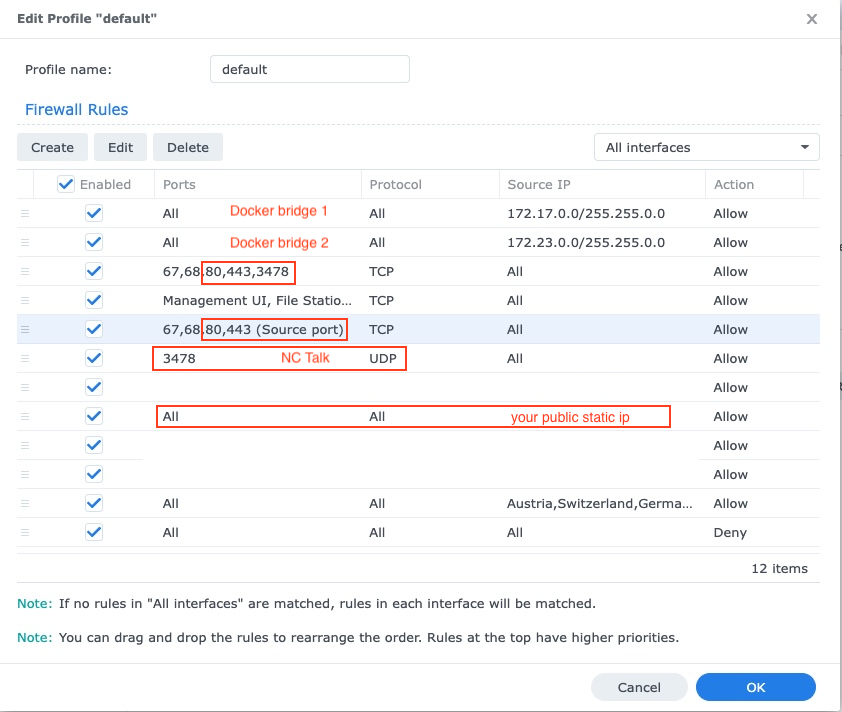
|
||||
|
||||
@@ -125,13 +193,14 @@ The easiest way to run it with Portainer on Linux is to use Portainer's stacks f
|
||||
- It is known that the domain validation may not work correctly behind Cloudflare. You can simply skip it in that case by following: https://github.com/nextcloud/all-in-one#how-to-skip-the-domain-validation
|
||||
- Make sure to [disable Cloudflares Rocket Loader feature](https://help.nextcloud.com/t/login-page-not-working-solved/149417/8) as otherwise Nextcloud's login prompt will not be shown.
|
||||
- Cloudflare only supports uploading files up to 100 MB in the free plan, if you try to upload bigger files you will get an error (413 - Payload Too Large) if no chunking is used (e.g. for public uploads in the web, or if chunks are configured to be bigger than 100 MB in the clients or the web). If you need to upload bigger files, you need to disable the proxy option in your DNS settings, or you must use another proxy than Cloudflare tunnels. Both options will disable Cloudflare DDoS protection.
|
||||
- Cloudflare only allows a max timeout of 100s for requests which is not configurable. This means that any server-side processing e.g. for assembling chunks for big files during upload that take longer than 100s will simply not work. See https://github.com/nextcloud/server/issues/19223. If you need to upload big files reliably, you need to disable the proxy option in your DNS settings, or you must use another proxy than Cloudflare tunnels. Both options will disable Cloudflare DDoS protection.
|
||||
- It is known that the in AIO included collabora (Nextcloud Office) does not work out of the box behind Cloudflare. To make it work, you need to add all [Cloudflare IP-ranges](https://www.cloudflare.com/ips/) to the wopi-allowlist in `https://yourdomain.com/settings/admin/richdocuments`
|
||||
- The built-in High performance backend for Nextcloud Talk will potentially not work out-of-the-box since it needs a separate port (by default 3478 or as chosen) available on the same domain. If you still want to use the feature, you will need to adjust and test your settings in `https://yourdomain.com/settings/admin/talk`.
|
||||
- If you get an error in Nextcloud's admin overview that the HSTS header is not set correctly, you might need to enable it in Cloudflare manually.
|
||||
- If you are using AIO's built-in Reverse Proxy and don't use your own, then may the certificate issuing possibly not work out-of-the-box because Cloudflare might block the attempt. In that case you need to disable the Proxy feature at least temporarily in order to make it work. See https://github.com/nextcloud/all-in-one/discussions/1101.
|
||||
- The built-in High performance backend for Nextcloud Talk will potentially not work out-of-the-box since it needs a separate port (by default 3478 or as chosen) available on the same domain. If you still want to use the feature, you will need to adjust and test your settings in `https://yourdomain.com/settings/admin/talk`.
|
||||
|
||||
### How to run Nextcloud behind a Cloudflare Tunnel?
|
||||
Although it does not seems like it is the case but from AIO perspective a Cloudflare Tunnel works like a reverse proxy. So please follow the [reverse proxy documentation](./reverse-proxy.md) where is documented how to make it run behind a Cloudflare Tunnel.
|
||||
Although it does not seems like it is the case but from AIO perspective a Cloudflare Tunnel works like a reverse proxy. So please follow the [reverse proxy documentation](./reverse-proxy.md) where is documented how to make it run behind a Cloudflare Tunnel. However please see the [caveats](https://github.com/nextcloud/all-in-one#notes-on-cloudflare-proxytunnel) before proceeding.
|
||||
|
||||
### Disrecommended VPS providers
|
||||
- Stratos VPS crash/freeze/make errors when they reach an extremely low PID limit, which is very quickly reached by AIO, see [here](https://github.com/nextcloud/all-in-one/discussions/1747#discussioncomment-4716164), Strato does normally not increase this limit.
|
||||
@@ -141,12 +210,12 @@ Although it does not seems like it is the case but from AIO perspective a Cloudf
|
||||
In general recommended VPS are those that are KVM/non-virtualized as Docker should work best on them.
|
||||
|
||||
### Note on storage options
|
||||
- SD-cards are discrecommended for AIO since they cripple the performance and they are not meant for many write operations which is needed for the database and other parts
|
||||
- SD-cards are disrecommended for AIO since they cripple the performance and they are not meant for many write operations which is needed for the database and other parts
|
||||
- SSD storage is recommended
|
||||
- HDD storage should work as well but is of course much slower than SSD storage
|
||||
|
||||
### How to get Nextcloud running using the ACME DNS-challenge?
|
||||
You can install AIO in reverse proxy mode where is also documented how to get it running using the ACME DNS-challenge for getting a valid certificate for AIO. See the [reverse proxy documentation](./reverse-proxy.md). (Meant is the `Caddy with ACME DNS-challenge` section).
|
||||
You can install AIO in reverse proxy mode where is also documented how to get it running using the ACME DNS-challenge for getting a valid certificate for AIO. See the [reverse proxy documentation](./reverse-proxy.md). (Meant is the `Caddy with ACME DNS-challenge` section). Also see https://github.com/dani-garcia/vaultwarden/wiki/Running-a-private-vaultwarden-instance-with-Let%27s-Encrypt-certs#getting-a-custom-caddy-build for additional docs on this topic.
|
||||
|
||||
### How to run Nextcloud locally?
|
||||
If you do not want to open Nextcloud to the public internet, you may have a look at the following documentation how to set it up locally: [local-instance.md](./local-instance.md)
|
||||
@@ -157,7 +226,7 @@ No and they will not be. If you want to run it locally, without opening Nextclou
|
||||
### Can I use an ip-address for Nextcloud instead of a domain?
|
||||
No and it will not be added. If you only want to run it locally, you may have a look at the following documentation: [local-instance.md](./local-instance.md)
|
||||
|
||||
### Are other ports than then default 443 for Nextcloud supported?
|
||||
### Are other ports than the default 443 for Nextcloud supported?
|
||||
No and they will not be. Please use a dedicated domain for Nextcloud and set it up correctly by following the [reverse proxy documentation](./reverse-proxy.md). If port 443 and/or 80 is blocked for you, you may use the ACME DNS-challenge or a Cloudflare Tunnel.
|
||||
|
||||
### Can I run Nextcloud in a subdirectory on my domain?
|
||||
@@ -166,11 +235,12 @@ No and it will not be added. Please use a dedicated domain for Nextcloud and set
|
||||
### How can I access Nextcloud locally?
|
||||
The recommended way is to set up a local dns-server like a pi-hole and set up a custom dns-record for that domain that points to the internal ip-adddress of your server that runs Nextcloud AIO. Below are some guides:
|
||||
- https://www.howtogeek.com/devops/how-to-run-your-own-dns-server-on-your-local-network/
|
||||
- https://help.nextcloud.com/t/need-help-to-configure-internal-access/156075/6
|
||||
- https://howchoo.com/pi/pi-hole-setup together with https://docs.callitkarma.me/posts/PiHole-Local-DNS/
|
||||
- https://dockerlabs.collabnix.com/intermediate/networking/Configuring_DNS.html
|
||||
|
||||
### How to skip the domain validation?
|
||||
If you are completely sure that you've configured everything correctly and are not able to pass the domain validation, you may skip the domain validation by adding `-e SKIP_DOMAIN_VALIDATION=true` to the docker run command of the mastercontainer.
|
||||
If you are completely sure that you've configured everything correctly and are not able to pass the domain validation, you may skip the domain validation by adding `--env SKIP_DOMAIN_VALIDATION=true` to the docker run command of the mastercontainer (but before the last line `nextcloud/all-in-one:latest`! If it was started already, you will need to stop the mastercontainer, remove it (no data will be lost) and recreate it using the docker run command that you initially used).
|
||||
|
||||
### How to resolve firewall problems with Fedora Linux, RHEL OS, CentOS, SUSE Linux and others?
|
||||
It is known that Linux distros that use [firewalld](https://firewalld.org) as their firewall daemon have problems with docker networks. In case the containers are not able to communicate with each other, you may change your firewalld to use the iptables backend by running:
|
||||
@@ -230,7 +300,9 @@ Here is how to reset the AIO instance properly:
|
||||
1. Now remove all these stopped containers with `sudo docker container prune`
|
||||
1. Delete the docker network with `sudo docker network rm nextcloud-aio`
|
||||
1. Check which volumes are dangling with `sudo docker volume ls --filter "dangling=true"`
|
||||
1. Now remove all these dangling volumes: `sudo docker volume prune` (on Windows you might need to remove some volumes afterwards manually with `docker volume rm nextcloud_aio_backupdir`, `docker volume rm nextcloud_aio_nextcloud_datadir`). Also if you've configured `NEXTCLOUD_DATADIR` to a path on your host instead of the default volume, you need to clean that up as well.
|
||||
1. Now remove all these dangling volumes: `sudo docker volume prune docker --filter all=1` (on Windows you might need to remove some volumes afterwards manually with `docker volume rm nextcloud_aio_backupdir`, `docker volume rm nextcloud_aio_nextcloud_datadir`).
|
||||
1. If you've configured `NEXTCLOUD_DATADIR` to a path on your host instead of the default volume, you need to clean that up as well. (E.g. by simply deleting the directory).
|
||||
1. Make sure that no volumes are remaining with `sudo docker volume ls --format {{.Name}}`. If no `nextcloud-aio` volumes are listed, you can proceed with the steps below. If there should be some, you will need to stop them with `sudo docker volume rm <volume_name>` until no one is listed anymore.
|
||||
1. Optional: You can remove all docker images with `sudo docker image prune -a`.
|
||||
1. And you are done! Now feel free to start over with the recommended docker run command!
|
||||
|
||||
@@ -258,9 +330,22 @@ Backups can be created and restored in the AIO interface using the buttons `Crea
|
||||
|
||||
The backups itself get encrypted with an encryption key that gets shown to you in the AIO interface. Please save that at a safe place as you will not be able to restore from backup without this key.
|
||||
|
||||
Be aware that this solution does not back up files and folders that are mounted into Nextcloud using the external storage app.
|
||||
Daily backups can get enabled after the initial backup is done. Enabling this also allows to enable an option that allows to update all containers, Nextcloud and its apps automatically.
|
||||
|
||||
Note that this implementation does not provide remote backups, for this you can use the [backup app](https://apps.nextcloud.com/apps/backup).
|
||||
Be aware that this solution does not back up files and folders that are mounted into Nextcloud using the external storage app - but you can add further Docker volumes and host paths that you want to back up after the initial backup is done.
|
||||
|
||||
Regarding backup retention, see [this documentation](https://github.com/nextcloud/all-in-one/discussions/1675).
|
||||
|
||||
---
|
||||
|
||||
#### Are remote borg backups supported?
|
||||
|
||||
Not directly but you have multiple options to achieve this:
|
||||
- Mount a network FS like SSHFS, SMB or NFS in the directory that you enter in AIO as backup directory
|
||||
- Use rsync or rclone for syncing the borg backup archive that AIO creates locally to a remote target (make sure to lock the backup archive correctly before starting the sync; search for "aio-lockfile"; you can find a local example script here: https://github.com/nextcloud/all-in-one#sync-the-backup-regularly-to-another-drive)
|
||||
- You can find a well written guide that uses rclone and e.g. BorgBase for remote backups here: https://github.com/nextcloud/all-in-one/discussions/2247
|
||||
- create your own backup solution using a script and borg, borgmatic or any other to backup tool for backing up to a remote target (make sure to stop and start the AIO containers correctly following https://github.com/nextcloud/all-in-one#how-to-enable-automatic-updates-without-creating-a-backup-beforehand)
|
||||
- Additionally, there is the [backup app](https://apps.nextcloud.com/apps/backup) for remote backups
|
||||
|
||||
---
|
||||
|
||||
@@ -308,7 +393,7 @@ sudo borg delete --stats --progress "/mnt/backup/borg::20220223_174237-nextcloud
|
||||
# If borg 1.2.0 or higher is installed, you then need to run borg compact in order to clean up the freed space
|
||||
sudo borg --version
|
||||
# If version number of the command above is higher than 1.2.0 you need to run the command below:
|
||||
sudo borg compact "/mnt/backup/"
|
||||
sudo borg compact "/mnt/backup/borg"
|
||||
|
||||
```
|
||||
|
||||
@@ -418,28 +503,28 @@ Afterwards apply the correct permissions with `sudo chown root:root /root/backup
|
||||
### How to stop/start/update containers or trigger the daily backup from a script externally?
|
||||
You can do so by running the `/daily-backup.sh` script that is stored in the mastercontainer. It accepts the following environmental varilables:
|
||||
- `AUTOMATIC_UPDATES` if set to `1`, it will automatically stop the containers, update them and start them including the mastercontainer. If the mastercontainer gets updated, this script's execution will stop as soon as the mastercontainer gets stopped. You can then wait until it is started again and run the script with this flag again in order to update all containers correctly afterwards.
|
||||
- `DAILY_BACKUP` if set to `1`, it will automatically stop the containers and create a backup. If you want to start them again afterwards, you may have a look at the `START_CONTAINERS` option. Please be aware that this option is non-blocking if `START_CONTAINERS` and `AUTOMATIC_UPDATES` is not enabled at the same time which means that the backup check is not done when the process is finished since it only start the borgbackup container with the correct configuration.
|
||||
- `DAILY_BACKUP` if set to `1`, it will automatically stop the containers and create a backup. If you want to start them again afterwards, you may have a look at the `START_CONTAINERS` option.
|
||||
- `START_CONTAINERS` if set to `1`, it will automatically start the containers without updating them.
|
||||
- `STOP_CONTAINERS` if set to `1`, it will automatically stop the containers.
|
||||
- `CHECK_BACKUP` if set to `1`, it will start the backup check. This is not allowed to be enabled at the same time like `DAILY_BACKUP`. Please be aware that this option is non-blocking which means that the backup check is not done when the process is finished since it only start the borgbackup container with the correct configuration.
|
||||
|
||||
One example for this would be `sudo docker exec -it -e DAILY_BACKUP=1 nextcloud-aio-mastercontainer /daily-backup.sh`, which you can run via a cronjob or put it in a script.
|
||||
One example for this would be `sudo docker exec -it --env DAILY_BACKUP=1 nextcloud-aio-mastercontainer /daily-backup.sh`, which you can run via a cronjob or put it in a script.
|
||||
|
||||
⚠️ Please note that none of the option returns error codes. So you need to check for the correct result yourself.
|
||||
|
||||
### How to disable the backup section?
|
||||
If you already have a backup solution in place, you may want to hide the backup section. You can do so by adding `-e DISABLE_BACKUP_SECTION=true` to the initial startup of the mastercontainer.
|
||||
If you already have a backup solution in place, you may want to hide the backup section. You can do so by adding `--env AIO_DISABLE_BACKUP_SECTION=true` to the docker run command of the mastercontainer (but before the last line `nextcloud/all-in-one:latest`! If it was started already, you will need to stop the mastercontainer, remove it (no data will be lost) and recreate it using the docker run command that you initially used).
|
||||
|
||||
### How to change the default location of Nextcloud's Datadir?
|
||||
⚠️ **Attention:** It is very important to change the datadir **before** Nextcloud is installed/started the first time and not to change it afterwards! If you still want to do it afterwards, see [this](https://github.com/nextcloud/all-in-one/discussions/890#discussioncomment-3089903) on how to do it.
|
||||
|
||||
You can configure the Nextcloud container to use a specific directory on your host as data directory. You can do so by adding the environmental variable `NEXTCLOUD_DATADIR` to the initial startup of the mastercontainer. Allowed values for that variable are strings that start with `/` and are not equal to `/`.
|
||||
You can configure the Nextcloud container to use a specific directory on your host as data directory. You can do so by adding the environmental variable `NEXTCLOUD_DATADIR` to the docker run command of the mastercontainer (but before the last line `nextcloud/all-in-one:latest`! If it was started already, you will need to stop the mastercontainer, remove it (no data will be lost) and recreate it using the docker run command that you initially used). Allowed values for that variable are strings that start with `/` and are not equal to `/`. The chosen directory or volume will then be mounted to `/mnt/ncdata` inside the container.
|
||||
|
||||
- An example for Linux is `-e NEXTCLOUD_DATADIR="/mnt/ncdata"`.
|
||||
- On macOS it might be `-e NEXTCLOUD_DATADIR="/var/nextcloud-data"`
|
||||
- For Synology it may be `-e NEXTCLOUD_DATADIR="/volume1/docker/nextcloud/data"`.
|
||||
- On Windows it might be `-e NEXTCLOUD_DATADIR="/run/desktop/mnt/host/c/ncdata"`. (This path is equivalent to `C:\backup` on your Windows host so you need to translate the path accordingly. Hint: the path that you enter needs to start with `/run/desktop/mnt/host/`. Append to that the exact location on your windows host, e.g. `c/ncdata` which is equivalent to `C:\ncdata`.)
|
||||
- Another option is to provide a specific volume name here with: `-e NEXTCLOUD_DATADIR="nextcloud_aio_nextcloud_datadir"`. This volume needs to be created beforehand manually by you in order to be able to use it. e.g. with:
|
||||
- An example for Linux is `--env NEXTCLOUD_DATADIR="/mnt/ncdata"`.
|
||||
- On macOS it might be `--env NEXTCLOUD_DATADIR="/var/nextcloud-data"`
|
||||
- For Synology it may be `--env NEXTCLOUD_DATADIR="/volume1/docker/nextcloud/data"`.
|
||||
- On Windows it might be `--env NEXTCLOUD_DATADIR="/run/desktop/mnt/host/c/ncdata"`. (This path is equivalent to `C:\ncdata` on your Windows host so you need to translate the path accordingly. Hint: the path that you enter needs to start with `/run/desktop/mnt/host/`. Append to that the exact location on your windows host, e.g. `c/ncdata` which is equivalent to `C:\ncdata`.)
|
||||
- Another option is to provide a specific volume name here with: `--env NEXTCLOUD_DATADIR="nextcloud_aio_nextcloud_datadir"`. This volume needs to be created beforehand manually by you in order to be able to use it. e.g. with:
|
||||
```
|
||||
docker volume create ^
|
||||
--driver local ^
|
||||
@@ -452,11 +537,11 @@ You can configure the Nextcloud container to use a specific directory on your ho
|
||||
### Can I use a CIFS/SMB share as Nextcloud's datadir?
|
||||
|
||||
Sure. Add this to the `/etc/fstab` file: <br>
|
||||
`<your-storage-host-and-subpath> <your-mount-dir> cifs rw,credentials=<your-credentials-file>,uid=33,gid=0,file_mode=0770,dir_mode=0770 0 0`<br>
|
||||
`<your-storage-host-and-subpath> <your-mount-dir> cifs rw,mfsymlinks,seal,credentials=<your-credentials-file>,uid=33,gid=0,file_mode=0770,dir_mode=0770 0 0`<br>
|
||||
(Of course you need to modify `<your-storage-host-and-subpath>`, `<your-mount-dir>` and `<your-credentials-file>` for your specific case.)
|
||||
|
||||
One example could look like this:<br>
|
||||
`//your-storage-host/subpath /mnt/storagebox cifs rw,credentials=/etc/storage-credentials,uid=33,gid=0,file_mode=0770,dir_mode=0770 0 0`<br>
|
||||
`//your-storage-host/subpath /mnt/storagebox cifs rw,mfsymlinks,seal,credentials=/etc/storage-credentials,uid=33,gid=0,file_mode=0770,dir_mode=0770 0 0`<br>
|
||||
and add into `/etc/storage-credentials`:
|
||||
```
|
||||
username=<smb/cifs username>
|
||||
@@ -467,13 +552,14 @@ password=<password>
|
||||
Now you can use `/mnt/storagebox` as Nextcloud's datadir like described in the section above above this one.
|
||||
|
||||
### How to allow the Nextcloud container to access directories on the host?
|
||||
By default, the Nextcloud container is confined and cannot access directories on the host OS. You might want to change this when you are planning to use local external storage in Nextcloud to store some files outside the data directory and can do so by adding the environmental variable `NEXTCLOUD_MOUNT` to the initial startup of the mastercontainer. Allowed values for that variable are strings that start with `/` and are not equal to `/`.
|
||||
By default, the Nextcloud container is confined and cannot access directories on the host OS. You might want to change this when you are planning to use local external storage in Nextcloud to store some files outside the data directory and can do so by adding the environmental variable `NEXTCLOUD_MOUNT` to the docker run command of the mastercontainer (but before the last line `nextcloud/all-in-one:latest`! If it was started already, you will need to stop the mastercontainer, remove it (no data will be lost) and recreate it using the docker run command that you initially used). Allowed values for that variable are strings that start with `/` and are not equal to `/`.
|
||||
|
||||
- Two examples for Linux are `-e NEXTCLOUD_MOUNT="/mnt/"` and `-e NEXTCLOUD_MOUNT="/media/"`.
|
||||
- For Synology it may be `-e NEXTCLOUD_MOUNT="/volume1/"`.
|
||||
- On Windows is this option not supported.
|
||||
- Two examples for Linux are `--env NEXTCLOUD_MOUNT="/mnt/"` and `--env NEXTCLOUD_MOUNT="/media/"`.
|
||||
- On macOS it might be `--env NEXTCLOUD_MOUNT="/Volumes/your_drive/"`
|
||||
- For Synology it may be `--env NEXTCLOUD_MOUNT="/volume1/"`.
|
||||
- On Windows it might be `--env NEXTCLOUD_MOUNT="/run/desktop/mnt/host/d/your-folder/"`. (This path is equivalent to `D:\your-folder` on your Windows host so you need to translate the path accordingly. Hint: the path that you enter needs to start with `/run/desktop/mnt/host/`. Append to that the exact location on your windows host, e.g. `d/your-folder/` which is equivalent to `D:\your-folder`.)
|
||||
|
||||
After using this option, please make sure to apply the correct permissions to the directories that you want to use in Nextcloud. E.g. `sudo chown -R 33:0 /mnt/your-drive-mountpoint` and `sudo chmod -R 750 /mnt/your-drive-mountpoint` should make it work on Linux when you have used `-e NEXTCLOUD_MOUNT="/mnt/"`.
|
||||
After using this option, please make sure to apply the correct permissions to the directories that you want to use in Nextcloud. E.g. `sudo chown -R 33:0 /mnt/your-drive-mountpoint` and `sudo chmod -R 750 /mnt/your-drive-mountpoint` should make it work on Linux when you have used `--env NEXTCLOUD_MOUNT="/mnt/"`. On Windows you could do this e.g. with `docker exec -it nextcloud-aio-nextcloud chown -R 33:0 /run/desktop/mnt/host/d/your-folder/` and `docker exec -it nextcloud-aio-nextcloud chmod -R 750 /run/desktop/mnt/host/d/your-folder/`.
|
||||
|
||||
You can then navigate to the apps management page, activate the external storage app, navigate to `https://your-nc-domain.com/settings/admin/externalstorages` and add a local external storage directory that will be accessible inside the container at the same place that you've entered. E.g. `/mnt/your-drive-mountpoint` will be mounted to `/mnt/your-drive-mountpoint` inside the container, etc.
|
||||
|
||||
@@ -482,19 +568,19 @@ Be aware though that these locations will not be covered by the built-in backup
|
||||
**Please note:** If you can't see the type "local storage" in the external storage admin options, a restart of the containers from the AIO interface may be required.
|
||||
|
||||
### How to adjust the Talk port?
|
||||
By default will the talk container use port `3478/UDP` and `3478/TCP` for connections. You can adjust the port by adding e.g. `-e TALK_PORT=3478` to the initial docker run command and adjusting the port to your desired value.
|
||||
By default will the talk container use port `3478/UDP` and `3478/TCP` for connections. You can adjust the port by adding e.g. `--env TALK_PORT=3478` to the docker run command of the mastercontainer (but before the last line `nextcloud/all-in-one:latest`! If it was started already, you will need to stop the mastercontainer, remove it (no data will be lost) and recreate it using the docker run command that you initially used) and adjusting the port to your desired value.
|
||||
|
||||
### How to adjust the upload limit for Nextcloud?
|
||||
By default are uploads to Nextcloud limited to a max of 10G. You can adjust the upload limit by providing `-e NEXTCLOUD_UPLOAD_LIMIT=10G` to the docker run command of the mastercontainer and customize the value to your fitting. It must start with a number and end with `G` e.g. `10G`.
|
||||
By default are public uploads to Nextcloud limited to a max of 10G (logged in users can upload much bigger files using the webinterface or the mobile/desktop clients since chunking is used in that case). You can adjust the upload limit by providing `--env NEXTCLOUD_UPLOAD_LIMIT=10G` to the docker run command of the mastercontainer (but before the last line `nextcloud/all-in-one:latest`! If it was started already, you will need to stop the mastercontainer, remove it (no data will be lost) and recreate it using the docker run command that you initially used) and customize the value to your fitting. It must start with a number and end with `G` e.g. `10G`.
|
||||
|
||||
### How to adjust the max execution time for Nextcloud?
|
||||
By default are uploads to Nextcloud limited to a max of 3600s. You can adjust the upload time limit by providing `-e NEXTCLOUD_MAX_TIME=3600` to the docker run command of the mastercontainer and customize the value to your fitting. It must be a number e.g. `3600`.
|
||||
By default are uploads to Nextcloud limited to a max of 3600s. You can adjust the upload time limit by providing `--env NEXTCLOUD_MAX_TIME=3600` to the docker run command of the mastercontainer (but before the last line `nextcloud/all-in-one:latest`! If it was started already, you will need to stop the mastercontainer, remove it (no data will be lost) and recreate it using the docker run command that you initially used) and customize the value to your fitting. It must be a number e.g. `3600`.
|
||||
|
||||
### How to adjust the PHP memory limit for Nextcloud?
|
||||
By default is each PHP process in the Nextcloud container limited to a max of 512 MB. You can adjust the memory limit by providing `-e NEXTCLOUD_MEMORY_LIMIT=512M` to the docker run command of the mastercontainer and customize the value to your fitting. It must start with a number and end with `M` e.g. `1024M`.
|
||||
By default is each PHP process in the Nextcloud container limited to a max of 512 MB. You can adjust the memory limit by providing `--env NEXTCLOUD_MEMORY_LIMIT=512M` to the docker run command of the mastercontainer (but before the last line `nextcloud/all-in-one:latest`! If it was started already, you will need to stop the mastercontainer, remove it (no data will be lost) and recreate it using the docker run command that you initially used) and customize the value to your fitting. It must start with a number and end with `M` e.g. `1024M`.
|
||||
|
||||
### What can I do to fix the internal or reserved ip-address error?
|
||||
If you get an error during the domain validation which states that your ip-address is an internal or reserved ip-address, you can fix this by first making sure that your domain indeed has the correct public ip-address that points to the server and then adding `--add-host yourdomain.com:<public-ip-address>` to the initial docker run command which will allow the domain validation to work correctly. And so that you know: even if the `A` record of your domain should change over time, this is no problem since the mastercontainer will not make any attempt to access the chosen domain after the initial domain validation.
|
||||
If you get an error during the domain validation which states that your ip-address is an internal or reserved ip-address, you can fix this by first making sure that your domain indeed has the correct public ip-address that points to the server and then adding `--add-host yourdomain.com:<public-ip-address>` to the docker run command of the mastercontainer (but before the last line `nextcloud/all-in-one:latest`! If it was started already, you will need to stop the mastercontainer, remove it (no data will be lost) and recreate it using the docker run command that you initially used) which will allow the domain validation to work correctly. And so that you know: even if the `A` record of your domain should change over time, this is no problem since the mastercontainer will not make any attempt to access the chosen domain after the initial domain validation.
|
||||
|
||||
### Can I run this with Docker swarm?
|
||||
Yes. For that to work, you need to use and follow the [manual-install documentation](./manual-install/).
|
||||
@@ -506,23 +592,25 @@ You can run AIO also with docker rootless. How to do this is documented here: [d
|
||||
No. Since Podman is not 100% compatible with the Docker API, you cannot use Podman instead of Docker (since that would add yet another platform where the maintaner would need to test on). However you can use and follow the [manual-install documentation](./manual-install/) to get AIO's containers running with Podman or use Docker rootless, as described in the above section.
|
||||
|
||||
### How to change the Nextcloud apps that are installed on the first startup?
|
||||
You might want to adjust the Nextcloud apps that are installed upon the first startup of the Nextcloud container. You can do so by adding `-e NEXTCLOUD_STARTUP_APPS="deck twofactor_totp tasks calendar contacts"` to the docker run command of the mastercontainer and customize the value to your fitting. It must be a string with small letters a-z, spaces and hyphens or '_'. You can disable shipped and by default enabled apps by adding a hyphen in front of the appid. E.g. `-contactsinteraction`.
|
||||
You might want to adjust the Nextcloud apps that are installed upon the first startup of the Nextcloud container. You can do so by adding `--env NEXTCLOUD_STARTUP_APPS="deck twofactor_totp tasks calendar contacts"` to the docker run command of the mastercontainer (but before the last line `nextcloud/all-in-one:latest`! If it was started already, you will need to stop the mastercontainer, remove it (no data will be lost) and recreate it using the docker run command that you initially used) and customize the value to your fitting. It must be a string with small letters a-z, 0-9, spaces and hyphens or '_'. You can disable shipped and by default enabled apps by adding a hyphen in front of the appid. E.g. `-contactsinteraction`.
|
||||
|
||||
### How to add OS packages permanently to the Nextcloud container?
|
||||
Some Nextcloud apps require additional external dependencies that must be bundled within Nextcloud container in order to work correctly. As we cannot put each and every dependency for all apps into the container - as this would make the project very fast unmaintainable - there is an official way how you can add additional dependencies into the Nextcloud container. However note that doing this is disrecommended since we do not test Nextcloud apps that require external dependencies.
|
||||
|
||||
You can do so by adding `-e NEXTCLOUD_ADDITIONAL_APKS="imagemagick dependency2 dependency3"` to the docker run command of the mastercontainer and customize the value to your fitting. It must be a string with small letters a-z, digits 0-9, spaces, dots and hyphens or '_'. You can find available packages here: https://pkgs.alpinelinux.org/packages?name=&branch=v3.16&repo=&arch=&maintainer=. By default added is `imagemagick`. If you want to keep that, you need to specify it as well.
|
||||
You can do so by adding `--env NEXTCLOUD_ADDITIONAL_APKS="imagemagick dependency2 dependency3"` to the docker run command of the mastercontainer (but before the last line `nextcloud/all-in-one:latest`! If it was started already, you will need to stop the mastercontainer, remove it (no data will be lost) and recreate it using the docker run command that you initially used) and customize the value to your fitting. It must be a string with small letters a-z, digits 0-9, spaces, dots and hyphens or '_'. You can find available packages here: https://pkgs.alpinelinux.org/packages?name=&branch=v3.16&repo=&arch=&maintainer=. By default added is `imagemagick`. If you want to keep that, you need to specify it as well.
|
||||
|
||||
### How to add PHP extensions permanently to the Nextcloud container?
|
||||
Some Nextcloud apps require additional php extensions that must be bundled within Nextcloud container in order to work correctly. As we cannot put each and every dependency for all apps into the container - as this would make the project very fast unmaintainable - there is an official way how you can add additional php extensions into the Nextcloud container. However note that doing this is disrecommended since we do not test Nextcloud apps that require additional php extensions.
|
||||
|
||||
You can do so by adding `-e NEXTCLOUD_ADDITIONAL_PHP_EXTENSIONS="imagick extension1 extension2"` to the docker run command of the mastercontainer and customize the value to your fitting. It must be a string with small letters a-z, digits 0-9, spaces, dots and hyphens or '_'. You can find available extensions here: https://pecl.php.net/packages.php. By default added is `imagick`. If you want to keep that, you need to specify it as well.
|
||||
You can do so by adding `--env NEXTCLOUD_ADDITIONAL_PHP_EXTENSIONS="imagick extension1 extension2"` to the docker run command of the mastercontainer (but before the last line `nextcloud/all-in-one:latest`! If it was started already, you will need to stop the mastercontainer, remove it (no data will be lost) and recreate it using the docker run command that you initially used) and customize the value to your fitting. It must be a string with small letters a-z, digits 0-9, spaces, dots and hyphens or '_'. You can find available extensions here: https://pecl.php.net/packages.php. By default added is `imagick`. If you want to keep that, you need to specify it as well.
|
||||
|
||||
### What about the pdlib PHP extension for the facerecognition app?
|
||||
The [facerecognition app](https://apps.nextcloud.com/apps/facerecognition) requires the pdlib PHP extension to be installed. Unfortunately, it is not available on PECL nor via PHP core, so there is no way to add this into AIO currently. However you can vote up [this issue](https://github.com/goodspb/pdlib/issues/56) to bring it to PECL and there is the [recognize app](https://apps.nextcloud.com/apps/recognize) that also allows to do face-recognition.
|
||||
|
||||
### How to enable hardware-transcoding for Nextcloud?
|
||||
The [memories app](https://apps.nextcloud.com/apps/memories) allows to enable hardware transcoding for videos. In order to use that, you need to add `-e NEXTCLOUD_ENABLE_DRI_DEVICE=true` to the docker run command of the mastercontainer which will mount the `/dev/dri` device into the container (⚠️ Attention: this only works if the device is present on the host!). Additionally, you need to add required packets to the Nextcloud container by using [this feature](https://github.com/nextcloud/all-in-one#how-to-add-os-packages-permanently-to-the-nextcloud-container) and adding the required Alpine packages that are documented [here](https://github.com/pulsejet/memories/wiki/QSV-Transcoding).
|
||||
⚠️ Attention: this only works if the `/dev/dri` device is present on the host! If it should not exist on your host, don't proceed as otherwise the Nextcloud container will fail to start!
|
||||
|
||||
The [memories app](https://apps.nextcloud.com/apps/memories) allows to enable hardware transcoding for videos. In order to use that, you need to add `--env NEXTCLOUD_ENABLE_DRI_DEVICE=true` to the docker run command of the mastercontainer (but before the last line `nextcloud/all-in-one:latest`! If it was started already, you will need to stop the mastercontainer, remove it (no data will be lost) and recreate it using the docker run command that you initially used) which will mount the `/dev/dri` device into the container. Additionally, you need to add required packets to the Nextcloud container by using [this feature](https://github.com/nextcloud/all-in-one#how-to-add-os-packages-permanently-to-the-nextcloud-container) and adding the required Alpine packages that are documented [here](https://github.com/pulsejet/memories/wiki/QSV-Transcoding).
|
||||
|
||||
### Huge docker logs
|
||||
When your containers run for a few days without a restart, the container logs that you can view from the AIO interface can get really huge. You can limit the loge sizes by enabling logrotate for docker container logs. Feel free to enable this by following those instructions: https://sandro-keil.de/blog/logrotate-for-docker-container/
|
||||
@@ -576,14 +664,14 @@ What are the requirements?
|
||||
### How to trust user-defiend Certification Authorities (CA)?
|
||||
For some applications it might be necessary to enstablish a secured connection to a host / server which is using a certificated issued by a Certification Authority that is not trusted out of the box. An example could be configuring LDAPS against the Domain Controller (ActiveDirectory) of an organization
|
||||
|
||||
You can make the Nextcloud container trust any Certification Authority by providing the environmental variable `NEXTCLOUD_TRUSTED_CACERTS_DIR` when starting the AIO-mastercontainer. The value of the variables should be set to the absolute path to a directory on the host, which contains one or more Certification Authority's certificate. You should use X.509 certificates, Base64 encoded. (Other formats may work but have not been tested!) All the certificates in the directory will be trusted.
|
||||
You can make the Nextcloud container trust any Certification Authority by providing the environmental variable `NEXTCLOUD_TRUSTED_CACERTS_DIR` to the docker run command of the mastercontainer (but before the last line `nextcloud/all-in-one:latest`! If it was started already, you will need to stop the mastercontainer, remove it (no data will be lost) and recreate it using the docker run command that you initially used). The value of the variables should be set to the absolute path to a directory on the host, which contains one or more Certification Authority's certificate. You should use X.509 certificates, Base64 encoded. (Other formats may work but have not been tested!) All the certificates in the directory will be trusted.
|
||||
|
||||
When using `docker run`, the environmental variable can be set with `-e NEXTCLOUD_TRUSTED_CACERTS_DIR=/path/to/my/cacerts`.
|
||||
When using `docker run`, the environmental variable can be set with `--env NEXTCLOUD_TRUSTED_CACERTS_DIR=/path/to/my/cacerts`.
|
||||
|
||||
In order for the value to be valid, the path should start with `/` and not end with '/' and point to an existing **directory**. Pointing the variable directly to a certificate **file** will not work and may also break things.
|
||||
|
||||
### How to disable Collabora's Seccomp feature?
|
||||
The Collabora container enables Seccomp by default, which is a security feature of the Linux kernel. On systems without this kernel feature enabled, you need to provide `-e COLLABORA_SECCOMP_DISABLED=true` to the initial docker run command in order to make it work.
|
||||
The Collabora container enables Seccomp by default, which is a security feature of the Linux kernel. On systems without this kernel feature enabled, you need to provide `--env COLLABORA_SECCOMP_DISABLED=true` to the initial docker run command in order to make it work.
|
||||
|
||||
### How to enable automatic updates without creating a backup beforehand?
|
||||
If you have an external backup solution, you might want to enable automatic updates without creating a backup first. However note that doing this is disrecommended since you will not be able to easily create and restore a backup from the AIO interface anymore and you need to make sure to shut down all the containers properly before creating the backup, e.g. by stopping them from the AIO interface first.
|
||||
@@ -597,7 +685,7 @@ But anyhow, is here a guide that helps you automate the whole procedure:
|
||||
#!/bin/bash
|
||||
|
||||
# Stop the containers
|
||||
docker exec -e STOP_CONTAINERS=1 nextcloud-aio-mastercontainer /daily-backup.sh
|
||||
docker exec --env STOP_CONTAINERS=1 nextcloud-aio-mastercontainer /daily-backup.sh
|
||||
|
||||
# Below is optional if you run AIO in a VM which will shut down the VM afterwards
|
||||
# poweroff
|
||||
@@ -625,7 +713,7 @@ Afterwards apply the correct permissions with `sudo chown root:root /root/shutdo
|
||||
#!/bin/bash
|
||||
|
||||
# Run container update once
|
||||
if ! docker exec -e AUTOMATIC_UPDATES=1 nextcloud-aio-mastercontainer /daily-backup.sh; then
|
||||
if ! docker exec --env AUTOMATIC_UPDATES=1 nextcloud-aio-mastercontainer /daily-backup.sh; then
|
||||
while docker ps --format "{{.Names}}" | grep -q "^nextcloud-aio-watchtower$"; do
|
||||
echo "Waiting for watchtower to stop"
|
||||
sleep 30
|
||||
@@ -637,7 +725,7 @@ if ! docker exec -e AUTOMATIC_UPDATES=1 nextcloud-aio-mastercontainer /daily-bac
|
||||
done
|
||||
|
||||
# Run container update another time to make sure that all containers are updated correctly.
|
||||
docker exec -e AUTOMATIC_UPDATES=1 nextcloud-aio-mastercontainer /daily-backup.sh
|
||||
docker exec --env AUTOMATIC_UPDATES=1 nextcloud-aio-mastercontainer /daily-backup.sh
|
||||
fi
|
||||
|
||||
```
|
||||
|
||||
Some files were not shown because too many files have changed in this diff Show More
Reference in New Issue
Block a user